Hey, They Can’t Revoke a Pulitzer

22 05 2012

Those who can’t do, criticize. With that in mind, the latest snark-filled edition of Media Malpractice (small-scale). Or, as Brad DeLong asks, “Why Can’t We Have a Better Press Corps?”

Yoda Joins AP Copy Desk

On the controversy over raising interest rates on student loans:

“Agree, they might, and act they surely will. But first, they settled effortlessly into a rollicking good political brawl.”

Politico, Your Hard-Hitting News Source

Politico takes a lot of heat for feeding off the 24-minute news cycle. Once upon a time, it was enough to win the day; now campaigns have to win the lunch hour. A fly lands on Joe Biden’s head during a speech? True story, and you’ll find the video here. In other breaking news: Massachusetts Senator Scott Brown, who has slammed challenger Elizabeth Warren for her Harvard-professor past, is exposed as  . . . a hypocrite?

Brown . . . has accepted $3,900 in campaign donations from eight Harvard employees in the first three months of the year.

Yeah, and Warren accepted donations from a teller at Bank of America! If this is the best argument liberals can find against Scott Brown, perhaps they should join up with the conservatives indignant that President Obama has savings account at JPMorgan.

NYT Automatic Linking Software Run Amok

Whatever program automatically generates informational links based on the text in the Times’ articles needs some tweaking. Health-related words tend to generate the most humor; click on “fever” in a phrase like “the excitement at the campaign rally was at a fever pitch” and the reader is unexpectedly routed to the Times Health Guide page describing a “temporary increase in the body’s temperature, in response to some disease or illness.” The latest winner, from a Q&A in the Fashion section offering advice on how to “tactfully” suggest a neck lift to one’s mother (my advice: don’t):

Finally! A mint (chocolate chip) reason for canning diets once and for all: our ensuing turkey necks. “Waiter, make mine a double scoop.”

Click on “canning,” and the reader is taken from wattles and “flappy skin” to the Times Topic page on “how to can, pickle and preserve foods, with recipes published in The New York Times.” Looking for “Green Tomato Chowchow” or a step-by-step on “marinated vegetables and quick pickles”? Well, you’re in luck!

Taglines “R” Us

Newspapers’ mission statements and catchphrases tend to be ripe for parody. Just think of all the variations on “All the news that’s fit to print” that have popped up over the years. Fox Nation, the sleazier offshoot of Fox News that patterns itself on the Drudge Report and Breitbart’s Big Government sites, characterizes itself thusly:

The Fox Nation is for those opposed to intolerance, excessive government control of our lives, and attempts to monopolize opinion or suppress freedom of thought, expression, and worship.

At first glance, am I the only one who reads this sentence as a parallel construction between “is” and “attempts”? Under this interpretation, the tagline breaks down into two descriptions of Fox Nation: 1) It is for those opposed to intolerance and 2) It attempts to monopolize opinion. True, but perhaps not exactly what the Murdoch minions intended.

The equally conservative Washington Times has a tagline of its own; someone at the paper has branded itself “The Official Newspaper of 2012.” Of course, there’s an official everything; the Superbowl has not only an official pizza sponsor (Papa John’s) but an official “payment service” (Visa). Who is selling the rights to the year 2012? And is the Times the official newspaper of the entire year, or does “2012” just refer to the presidential election? Given the Times’ penchant for breathless, conspiratorial reporting — Obama is an “arbitrary tyrant” who is “making good on his central promise: the destruction of our constitutional republic” — I suspect it is also the official paper of the 2012 Apocalypse. As Harold Camping and the ancient Mayans knew, the end times are near, and the Washington Times intends to be first in line to sponsor them.

Keeping It in the Family

NYT Editor in Chief: “For God’s sake, find the Sulzberger kid something to do in Kansas!”

Like this?

From Eudora, Kansas, cub reporter A.G. Sulzberger covers the day’s urgent news: “The sight is a familiar one along the dusty back roads of the Great Plains: an old roofless silo left to the elements along with decaying barns, chicken coops and stone homesteads . . . . Across a region laden with leaning, crumbling reminders of more vibrant days, some residents have found comfort in their unlikely profiles.” The article wraps up with one farm resident eyeing the green shoots emerging from his silo. “And on this day, he marveled that the tree had finally emerged from the top of its concrete incubator to stretch its branches above the derelict family farm.”

Eh. It’s eloquent, I suppose, but I don’t see your average new Times hire getting paid to write puff pieces on the midwest.


Is Grammar a Liberal Art?

I’m always game to smugly highlight the grammar and copy-editing errors that clutter online news stories, but it’s especially fun when conservative outlets, with their irritating certainty of their superiority over the “lamestream” (read: legitimate) media, goof up. To wit:

Fox News, which has the nerve to run pieces by Chris Stirewalt at straight news items (sample line: “But Obama can count on the establishment press helping him with his preferred narrative for the election”), gives us this head-scratcher:

Better still, Romney’s negative rating is lower than Obama’s – 46 percent to 41 percent.

Even in Rupert Murdoch’s universe, I’m pretty sure 46 is not lower than 41.

*****

Jay Ambrose writes for the OC Register. If you’re wondering about the paper’s political leanings, just know that, yes, “OC” is short for “Orange County” — prime Ronald Reagan real estate. Ambrose warns that Reagan’s free-market utopia is slipping away:

Europeanizing America: More Debt, Less Jobs

Those evil Europeans, some of whose ancestors invented the English language, would at least know enough to tell you they have “more debt,fewer jobs.”

*****

An article in the right-wing Washington Examiner describes Speaker of the House John Boehner’s determination to turn any increase in the debt limit into another hostage situation:

Congressional Democrats quickly refuted the Republican leader for reviving demands that nearly shut down the government last summer and eventually lead to a downgrading of the nation’s AAA bond rating.

Rebuked, maybe. Reproached, possibly. Reproved . . . well, that’s sort of a stretch. But “refuted” is definitely not the word reporter Susan Ferrechio was looking for. Ideas and claims can be refuted; people cannot.

*****

Newsmax, the ultimate new media source for Republican conspiracy theories, plays fast and loose with facts, grammar and standard English in a story about Obama’s poll numbers:

The president fairs slightly better on the auto industry loans, getting 50 to 43 percent approval.

Fares. This is why your sixth-grade teacher warned you against relying on Spell Check.

*****

In a piece slamming Georgetown University for the sin of inviting HHS Secretary Kathleen Sebelius to give the commencement address, the folks at the American Spectator show just how intellectual they are:

It is not just the defense of the invitation by DeGioia that raises the issue of his fitness to continue as president; it is the intellectuall dishonesty represented by the above-described evasions of the truth.

Even Spell Check would have caught this one.

Celebrities Are Real People, Too

“Sarah Palin,” Fox News contributor.

There was something particularly hilarious about Fox News accidentally substituting a picture of Tina Fey in her Sarah Palin SNL garb for a shot of the actual Sarah Palin. But the fair-and-balanced network isn’t the only one fighting the blurry line between celebrity and reality. The Times makes its own gaffe while reporting on Facebook co-founder Eduardo Saverin, who recently renounced his U.S. citizenship. A recent post on the paper’s “Bits” blog included this correction.

An earlier version of this post included a photo published in error. It showed Andrew Garfield, the actor who played Eduardo Saverin in the movie “The Social Network,” not Mr. Saverin himself.

More or less egregious than the Fox News switch? Well, at least the Times never employed Eduardo Saverin.

Saverin (left) and Garfield (right)Oops.

Fey (left) and Palin (right)


How Do You Solve a Problem Like Gretchen Morgenson? (And Other Thoughts)

8 01 2012

Gretchen Morgenson, a New York Times business columnist, has been on her best behavior for so long that I’d nearly forgotten how much of a shameless liar she is. That is, until last week’s meandering column, in which she counted the so-called “toxic twins” — Freddie Mac and Fannie Mae — among the year’s economic woes, right up there with Greece’s potential default and Countrywide’s discriminatory mortgage standards. For Morgenson, even the relentless campaign by Republicans to get government out of the housing market isn’t proceeding rapidly enough. “It looks as if these taxpayer-owned zombies, which did so much damage to our economy, are poised to live on and on,” she writes, peddling the same falsehoods that fellow Times columnists Paul Krugman and Joe Nocera have worked so hard to refute. The “Big Lie,” in a nutshell, is that the 2008 financial crisis was caused not by Wall Street’s shady lending practices or exotic (and ultimately worthless) financial instruments but by Fannie Mae and Freddie Mac, which were forced by the government’s expansive housing policy to make riskier and riskier loans. Because it conveniently lays the blame for the recession at the feet of the government, the Big Lie is a conservative favorite. The problem is, it’s not remotely supported by facts. Morgenson finds it ironic that “Washington’s push to increase homeownership opened the door for companies to sell poisonous and tricky loans that have now imperiled many of the most vulnerable,” yet private lenders were the ones to pioneer these poisonous loans, and made more of them than Fannie or Freddie ever did. Joe Nocera, a colleague of Morgenson’s at the Times who got his start as a business reporter, summed it up quite nicely on Dec. 23 when he stated that conservative scholar Peter Wallison “almost single-handedly created the myth that Fannie Mae and Freddie Mac caused the financial crisis.” Almost, because Wallison had a passel of partners in crime, including the Wall Street Journal editorial page, Congressional Republicans looking for any excuse to attack Fannie and Freddie, and — though he doesn’t mention her — Gretchen Morgenson herself. The Times evidently has a policy against speaking ill of one’s co-workers, as demonstrated by Paul Krugman’s wink-wink-nod criticism of David Brooks’ economic ignorance (“as some pundits have said . . . .”), but Morgenson and her bestselling book Reckless Endangerment are pretty hard to overlook. Reckless Endangerment is the Big Lie writ large — 352 pages large — and has been parroted as gospel by the news media despite an overwhelming consensus by mainstream economists that federal housing policy had almost nothing to do with the financial crisis. The Washington Post named it a “notable non-fiction book for 2011.” USA Today, entranced by Morgenson’s sparkly Pulitzer, repeated the book’s conclusions as if they were fact:

The mortgage crisis started with the “housers” — President Clinton and others who pushed for creative mortgage financing because they believed more Americans should own their own homes. Then quasi-public Fannie Mae and Freddie Mac did away with their traditional underwriting criteria . . . . Then private mortgage execs took cues from Fannie and Freddie and wrote loans for individuals who would not have been deemed creditworthy a few years earlier.

Morgenson could hardly have delivered the GOP a more perfect narrative. Not only were Fannie and Freddie complicit in the mortgage meltdown, but the whole scandal started with Bill Clinton. Could it get any better than this?

But while conservatives like Newt Gingrich (who was all too happy to take $1.6 million from Freddie as a “historian”) and Paul Ryan have latched onto this theory, Morgenson’s government-as-villain narrative has been widely discredited. The Post’s own Barry Ritholz, who coined the phrase “Big Lie,” along with studies by the Federal Reserve and an analysis of subprime mortgages by McClatchy News, have refuted it. In October, the New York Review of Books published an excellent takedown of the book, accusing Morgenson and her co-author of “misleading analysis and over-the-top rhetoric” and tartly observing that “claims that . . . Fannie Mae caused the 2007-2008 crisis by meeting affordable lending goals that were first established and had primary effect in the 1990s are so far-fetched that they require time travel.” Furthermore, “the key point—which is largely missing from Reckless Endangerment —is that private lenders made far riskier loans than GSEs bought or guaranteed, especially during the 1990s, when subprimes issued to borrowers with low income and poor credit were relatively new.”

Given that Morgenson is on record as supporting a scenario that the Times’ own news accounts — not just its editorial board — refute, what happens next? The paper is in an awkward situation; on one hand, Morgenson is a columnist, not a reporter, and her extra-curricular publishing activities are separate from her day job. On the other hand, Morgenson is something of an embarrassment. Her views would not be out of place at the Wall Street Journal or Forbes magazine, where she was once an editor, but they strike a dissonant note at a newspaper that clearly does not believe in the “time travel” required to substantiate a timeline in which Fannie and Freddie blazed the trail of high-risk lending. As the Times’ overview of the two GSEs states, “But as the mortgage market exploded in the middle of the decade, they found themselves losing market share to the more aggressive private lenders, and made a fateful decision to expand their lending to keep up.” Though the paper acknowledges that “the role of Fannie and Freddie in the housing bubble and bust has been hotly debated,” it also points out that the Republican who dissented from the majority conclusion of the Financial Crisis Inquiry Commission included none other than Peter Wallison, the conservative scholar lambasted in Joe Nocera’s “Big Lie” column.

Though the Times has never addressed the situation, I suspect it would defend itself by pointing to the division between its editorial and news pages. Columnists are certainly not expected to toe the newspaper’s editorial line; indeed, the gulf between the paper’s reliably progressive stance and the conservative, traditionalist views of Ross Douhat and David Brooks are on display every week. But it would be disingenuous to suggest that a writer, once elevated to a columnist and given free rein to explore controversial topics, can never be held accountable by his or her employers. There is a limit to free speech even in the halls of a First Amendment defender. To use an extreme example, no newspaper is going to tolerate a columnist preaching the virtues of white supremacy or advocating the return of public executions. Obviously Morgenson is not shilling for the KKK. So the question becomes, at what point does a newspaper censure an op-ed writer? Morgenson’s sin, if indeed the Times considers the “Big Lie” a sin, is apparently minor enough to be ignored. It’s worth noting that there is no indication that the Gray Lady even has a problem with Morgenson. Given that its publishing imprint, Times Books, is responsible for Reckless Endangerment, her editor is hardly likely to raise an eyebrow at a pejorative like “toxic twins.”

Curiously enough for a left-leaning outlet that has provided a platform for Paul Krugman and Joe Nocera to make their case against the Bie Lie, the writers enlisted by the Times to review Morgenson’s book both praise it. Though it is true that the reviews were written in June, before Nocera and other popular bloggers honed in on the deliberateness of the conservative obfuscation surrounding Fannie and Freddie, I nevertheless find it surprising that Robert Reich, a reliably liberal political economist, found so little to criticize in Morgenson’s work. Reich strikes me as someone who keeps up with Paul Krugman’s work, and Krugman has been warning since 2010 about the Republican quest for “a cover story saying that it was all the government’s fault.” Some of Reich’s plaudits are deserved; the book raises valid points — corruption and self-enrichment were rife among the GSE’s top officials —  that readers of any political stripe would deem wrong. But, as Krugman reminds us, “there’s no contradiction between the assertion that F&F were bad institutions run by bad people, and the assertion that they played no important role in creating the financial crisis.”

The problem with Morgenson is that she is more than a vocal columnist. If her role was confined to an opinion writer, the situation would be different. Op-ed pages court controversy by design; newspapers compete with Gawker and the Daily Beast for clicks, and when the Huffington Post can slap up an attention-grabbing headline like “FAIL: Worst Debate Ever!”, it helps to hire bomb-throwers like Charles Krauthammer and Jonah Goldberg. Unlike Goldberg, who rails against the Smithsonian for collecting “some genuine Occupier scat to be preserved next to the alleged specimens from the Yeti and Sasquatch” and regularly deploys invective against “liberals” that verges on hate speech, Morgenson is an awkward reporter-columnist hybrid. Though she is best known for her weekly “Fair Game” column, which is written in first-person and invariably castigates regulators or banks for what she sees as shady practices, her byline also appears on straight news articles. On Dec. 1, her story about the Massachusetts attorney general suing five major mortgage lenders ran in Business Day. With reporter Louise Story, she co-wrote a lengthy Nov. 22 article about an IndyMac executive who blamed federal regulators for pushing him to cover up financial weaknesses. The story reads no differently than any other news piece, but a reader familiar with Morgenson’s anti-GSE philosophy finds himself skeptical of her objectivity.

Bias can manifest itself in a thousand insidious ways; most are not obvious — e.g. “regulators are crooks” — but subtle, surfacing in how a reporter frames the story, which details she chooses to report, and whether she believes a certain subject rises to the level of newsworthiness at all. Would a reporter with less of an axe to grind with the government’s handling of the financial crisis have dedicated four pages to regulatory malfeasance? It’s impossible to know. The story probably received attention from financial publications, but mainstream outlets like the AP and the Washington Post didn’t feature it. When Morgenson writes that “the IndyMac collapse, with its multibillion-dollar cost to the Federal Deposit Insurance Corporation fund, highlights the role played by federal overseers of financial companies in the years leading up to the crisis,” is this a reflection of her low regard for agencies like Fannie and Freddie, which she likewise blames for wasting taxpayer dollars? The tension arises not because Morgenson has an opinion — indeed, it would require a certain degree of naivete to report on the financial crisis without being appalled by its instigators — but because she regularly expresses it in the same pages in which she is expected to be a neutral observer. It is precisely for this reason that most columnists do not write for the news section as well. He or she may be perfectly capable of keeping his personal beliefs out of an article, but even the appearance of mixing opinion and news makes readers wary. Just as elected officials are meant to avoid not only impropriety but the appearance of impropriety, columnists like Thomas Friedman do not moonlight as international correspondents for a reason. Once Friedman tells readers that he is skeptical of the ability of Egypt’s Islamist parties to govern fairly, the objective nature of his reporting from that country would come into question.

Reporters are not automatons, of course, and every human being has his or her own way of seeing the world. Is Morgenson, by telegraphing her own biases through her columns, perhaps being more honest by dispensing with the myth of objectivity? I don’t believe so. True objectivity may be a myth, but is an important myth, and a crucial if unattainable standard. Newspapers do not always practice the even-handed evaluation that they preach, but the fact that they keep trying instills confidence in their readers. When a reporter’s neutrality is questioned — one case at the Times that comes to mind is that of Middle East correspondent, Ethan Bronner, who evidently has family ties to the settler movement and the Israeli military — detractors come out of the woodwork to slam even run-of-the-mill articles as propaganda. It’s unfair, especially considering the Times’ otherwise “anti-Israel” reputation among rightwing pundits, but it’s also distracting and best avoided.

Ultimately, the problem may lie less with the conflict between Morgenson’s book and her reporting and more with the conflict between her two roles at the Times itself. Plenty of reporters write books; just this week, Times reporter Jodi Kantor released The Obamas, which details the first couple’s adjustment to the strains of the presidency. It is not a particularly political account in the sense of approaching its topic from a liberal or conservative perspective, yet it received considerable pushback from the White House, with spokesman Eric Schultz calling it “an overdramatization of old news.” Yet Kantor continues to cover politics for the Times without any noticeable pushback. Though she has made some odd statements to the press about her supposedly “intense” relationship with the Obamas — a claim seemingly undermined by their refusal to be interviewed for the book — I don’t see the tell-all as threatening her career. Readers (and editors) are able to separate a reporter’s daily work from what she writes to win a fat book deal; it is more difficult to see a bright line between opinion and news pieces published in the same media outlet. Books and newspapers are clearly separate media, while a Times article is a Times article, regardless of whether it is technically labeled a column or a news story. All that matters is the byline, and as long as it is Morgenson’s, readers will be skeptical that there is any daylight between her opinion and her facts.

In the end, the problem with Morgenson may not be as unique as it seems, as reporter-subject relationships have grown more incestuous with the arrival of such Fox News commentators-cum-politicians as Sarah Palin and Mike Huckabee. Indeed, the tension between Morgenson’s personal views and professional neutrality likely preceded the publication of Reckless Endangerment. Even if her book had not promoted a widely discredited version of the financial collapse, Morgenson’s dual role at the Times should have raised eyebrows. When she is interviewed on NPR, she is introduced as “an assistant business and financial editor and a columnist for The New York Times” or even just as “Gretchen Morgenson of The New York Times” — technically accurate, but the first description conflates her editorial and reportorial roles, and the second leads the audience to assume she is an average reporter. Obviously Morgenson is entitled to her credentials, but she should be clear that she is speaking as an author and an opinion writer; I doubt she could produce a piece of straight reporting from the Times that attributes the financial crisis to Fannie and Freddie.

It seems fairly straightforward to conclude that Morgenson should not be working both sides of the news-opinion divide. Her value to the Times is as a columnist; the paper does not suffer from a lack of qualified business reporters. Even if Morgenson were limited to her “Fair Game” column, however, the sticky situation of a representative of the Times essentially putting its brand behind a controversial argument persists. The conflict of interest, if one indeed exists, seems to occur less frequently at the Times than at other publications, such as the Washington Post, that have more bombastic and radical opinion-writers. The Times’ stable of columnists is fairly moderate; they differ in philosophy and politics but never venture too far from the mainstream. Yes, David Brooks is conservative, but he is a Mitt Romney conservative, not a libertarian Ron Paul conservative. Only Ross Douhat and Maureen Dowd occasionally veer toward the deliberately inflammatory rhetoric and ad hominem attacks typical of Post columnist George Will, who not only criticizes his opponents but demonizes them. There is a thin line between disapproving of an opponent’s beliefs and claiming that those beliefs make the opponent a bad or evil person, and the Times should be commended for staying on the right side of that line. Enough hate speech and holier-than-thou denunciations are spewed out by talk radio without newspapers jumping into the game. The Post is apparently comfortable with giving its columnists a wide berth to kick the hornet’s nest; Will titled his most recent column “Suddenly, a fun candidate,” then launched into what he presumably considered a “fun” description of the procedure Republicans call “partial-birth” abortion. He writes of “the baby to be killed,” knowing full well that both the word “baby” and the word “killed” are considered propaganda terms by anyone who objects to his anti-choice stance. The paragraph on abortion is ridiculous precisely because it is so obviously intended to provoke; there are plenty of ways to discuss Santorum’s position on abortion without tossing red meat to conservative readers. It is the job of a columnist writing for a mainstream publication to argue a point, but Will is less interested in laying out the argument for his position than in presenting anyone who disagrees as an immoral baby-killer. Pandering to the Republican base is fine for Jonah Goldberg, because he writes for a magazine, the National Review, that caters to the Republican base. The Post’s audience, however, is broader, and Will seems unable to use language that would speak to or attempt to convince that broader audience. Likewise, when Will pretends to understand “liberals” better than they understand themselves — he states that the objective of progressivism is “to weave a web of dependency, increasingly entangling individuals and industries in government supervision” — he merely proves that he probably hasn’t spoken to a real, live progressive since 1980. (As it happens, I’m apparently not the only one who thinks Will is going off the rails. Jonathan Chait at New York Magazine had a post on Jan. 4 titled “George Will Is Actually Kind of a Madman.”)

George Will is an excellent example of everything a columnist for the New York Times is not. Its writers are opinionated but, for the most part, respectful. What gets an editor’s OK at the Post would not pass muster with the Times. For this reason, Morgenson’s deviation — albeit a mild deviation when compared with Will’s bluster — is perhaps a bigger deal at the Times than it would be at another newspaper. I am not suggesting that Morgenson’s minor apostasy presents anywhere near the moral dilemma that bomb-throwing language like Will’s would pose to the Times. I do think, however, it demonstrates what a homogeneous stable of columnists the paper employs. Whether the tendency of Times writers to stay relatively close to the party line is a function of editorial control or self-selection (how many arch-conservatives dream of a job at a liberal rag?), it serves to further highlight the few columnists who do venture beyond the fold.

Will is an instructive comparison for another reason as well: as a climate-change denier, he espouses an anti-fact position akin to Morgenson’s insistence, despite chronological and statistic evidence to the contrary, that Fannie and Freddie precipitated the 2008 financial crisis. That global warming is considered a hoax by a large percentage of conservatives does not make climate-change denial a mainstream position; it simply shows how far to the right the Republican party has shifted. (Denying gravity doesn’t make Isaac Newton wrong; it just makes the deniers ridiculous.) The goal of journalism should be to report facts, not to give equal time to disproportionately viable sides of an argument, though certainly plenty of reporters are guilty of false equivalencies (I’m talking to you, Thomas Friedman). There is a good reason the Times’ science section does not pair every story on evolution with a creationist rebuttal; to do so would be to abandon the ideal of reporting the truth. Frankly, despite the freedom a columnist must be given to express his or her own opinions, the Washington Post should be ashamed to publish George Will’s global-warming-is-a-lie drivel. Reasonable people can disagree on many things, but some stories do not have two sides. Americans still argue over the merits of universal healthcare and correct amount of government regulation, but they do not argue over whether the Earth is round or flat. No newspaper should interpret a columnist’s discretion as a requirement that the paper publish lies. If Will continues to use the Post as a platform for climate-change denial, he should be fired. The question I find myself asking is whether Morgenson’s advocacy of a blame-Fannie narrative is likewise unacceptable. When she uses the pages of the Times to claim that government lending policies created the financial crisis, is that a deal-breaker?

After spending so many words pontificating (and digressing) on Morgenson’s situation, it seems a waste of breath for me to answer in the negative. Yet I have to acknowledge that there is a difference between denying climate change and painting the GSEs as “toxic twins.” There is an overwhelming scientific consensus about global warming, while the culpability of Fannie and Freddie is a more politicized and objective issue. As Paul Krugman points out, the GSEs employed their share of bad apples, and no one denies that their leaders acted inappropriately. Though that’s a long way from single-handedly sparking the 2008 recession, some of Morgenson’s criticism is undoubtedly warranted. If I were her editor, I would be tempted to tell her to tone it down, but perhaps I would be the one in the wrong. Just because Times columnists are not known for stirring up trouble does not mean that a difference of opinion is untenable. It can be unpleasant and embarrassing, as evidenced by the Washington Post, but that doesn’t make it a crime. In the end, Morgenson will probably keep writing her anti-Freddie screeds. The easiest solution, I suppose, is for me to simply stop reading them.


The Best and the Rest

6 12 2011

I haven’t stumbled across any excitingly egregious language bloopers lately, but there have been some highlights . . . as well as some low points. Here’s a roundup of the most memorable.

This Times headline ostensibly refers to the airline, but it’s a nod to the broader geopolitical situation as well. American is to Southwest and JetBlue what America is to China and India.

Once on Top, American Now Fights to Keep Up.

Usually I dislike both puns and the Wall Street Journal, but this headline about factotum-finding websites like Task Rabbit and Mechanical Turk amused me. Anyone willing to milk the cow for $5.00?

Serfing the Web: Sites Let People Farm Out Their Chores.

The reader comments on most websites are a mixture of partisan rants and ad hominem attacks, but this clever gem from the Washington Post is an exception to the rule:

Matt Haig’s The Radleys, a novel about a vampire family passing as everyday folk, serves up a great description of a small British town:

On the map, Bishopthorpe resembles the skeleton of a fish. A backbone of a main street with thin little lanes and cul-de-sacs threading off to nowhere. A dead place, leaving its young people hungry for more.

Haig also provides a wonderfully physical characterization of the school bully:

Harper is actually Stuart Harper, but his first name fell off him in tenth grade, somewhere on the rugby field.

Newt Gingrich says a lot of questionable things, from condemning child labor laws to accusing President Obama of having an “Kenyan, anti-colonial” worldview. However, one recent remark is notable not only for its pompous ridiculousness but because its clumsy grammar suggests Gingrich was rooting out reds in the legislature. Watch out, Bernie Sanders!

“I helped lead the effort to defeat communism in the Congress.”

From a Times article on President Obama’s encouragement of the Arab Spring:

In so doing, the president opened up a litany of risks, exposing a fault line between the United States and the Egyptian military . . . .

A “litany” is not merely a series of things or a large amount; it implies a spoken list, a recitation or chant. The word’s out-loud connotation makes it a poor fit in this context.

There’s nothing particularly bad about the next sentence, but it stands out as a missed opportunity. From a Philadelphia Magazine profile of NBC Universal CEO Steve Burke:

And even when he’s at ease, he stands ramrod straight, hands on his hips, elbows out, a satisfied smile playing across his lips, like Superman observing a peaceful Metropolis from the top of some tall building – his resume fanning out behind him like a cape.

Burke, who became CEO after NBC Universal was purchased by Comcast, is tasked with revamping the company’s television and film brands. Painting Burke as a superhero conveys his success and power, but the image of a cape “fanning out behind him” brings to mind an even better image: an NBC peacock, splaying its feathers and puffing out its chest.

An AP article makes an entry-level editing error:

Public financing, which officially started in 1976, has been on the decline in recent years because of public disinterest and the massive infusion of private money into campaigns.

Recorded announcement: Disinterested = impartial. It does not mean “not interested.”

From an AP story about erstwhile presidential candidate and perpetual blowhard Donald Trump:

In a round of TV interviews, he blistered many of the GOP candidates, saying that former Massachusetts Gov. Mitt Romney “doesn’t get the traction” he needs to nail down the nomination.

Words can be blistering, and an encounter with a hot stove can blister skin, but can Trump blister a candidate? I vote no. The AP is notoriously overeager to create verbs out of other parts of speech; in a story about Black Friday shopping, one reporter writes that “cutthroat marketing has hyped the traditional post-Thanksgiving sales to increasingly frenzied levels.” There is definitely lots of hype surrounding holiday sales, and “to hype” can even work in the sense of “to promote,” but the idea of hyping a sale to a certain level of excitement strikes a discordant note. Likewise, “to blister” does not seem to be the verb the writer of the Trump story is looking for.


. . . The Bad . . .

27 10 2011

A roundup of this month’s best and worst (well, mostly worst) sentences. There’s nothing egregiously wrong with most of these examples; the problem hinges on a single word that doesn’t quite work the way the writer intended. They’re dissonant notes that don’t even require a copy editor to catch — a simple read-through from a fresh-eyed colleague would have sufficed. Today’s blunders come to us courtesy of the Associated Press, which has the dubious distinction of producing all of the following.

An attorney defending a man accused in a failed plot to bring down a U.S.-bound jetliner faces a tough task pecking away at the government’s evidence in a case where the suspect was captured in a snap.

Are we looking for “chipping away”? It’s one thing to choose colorful verbs; it’s another to reach too far in attempting to coin a cute new phrase. And if the suspect was captured in the act, why don’t we say so? “Snap” is unnecessarily vague.

 Eyjafjallajokul volcano . . . chugged ash all over Europe for several weeks in an eruption that local scientist Pall Einarsson describes nonetheless as “small.”

Another verb gone astray. Trains chug, volcanoes . . . spew. Dump. Scatter. Whatever the volcano was doing with its ash, it sure wasn’t “chugging” it.

There are 30,000 fewer federal workers now than a year ago – including 5,300 Postal Service jobs canceled last month.

If “canceled” is supposed to be a cute nod to the Postal Service (which cancels mail), it’s not working. By the time the reader makes the connection, awkwardness (who’s ever heard of a job being canceled?) has already set in.

Hardliners still want more punishment against Ahmadinejad for actions viewed as political hubris.

Can punishment be directed “against” someone? Reword: “Hardliners want to punish Ahmadinejad further for actions viewed as political hubris.”

In a rare political spectacle of a visiting head of state on a field trip outside Washington with the U.S. president, both sounding boosterish about American industry, Lee said the trade pact “will create more jobs for you and your family.”

Seriously? “Boosterish”?

Russia . . . sent two strategic bombers on a mission to circumnavigate the islands last month – a move seen as a test of the new government of Prime Minister Yoshihiko Noda, which had just been launched six days before.

Technically I suppose a government can be “launched,” but the odd word choice draws attention to itself and throws the reader.

Just to prove I’m an equal-opportunity critic, let’s end on an example from the Times. Proving that writing about humor is rarely humorous, the Times offers this awful mouthful of a title for an article on Chinese dissidents using jokes and cartoons to get around online censors: “The Dangerous Politics of Internet Humor in China.”

Ha. Ha. Ha.


The Good . . . .

27 10 2011

Here are my picks for this month’s best bits of writing.

In the New Yorker, Peter Schjeldahl, reviews a “Degas and the Nude,” a “wonderful and weird show at the Museum of Fine Arts in Boston.”

Viewing his work, we breathe the dizzyingly thin air on the snowy peak of the capital “A” in Art.

Paul Krugman, my favorite NYT columnist, apparently never sleeps: In addition to writing a twice-weekly column, he does Nobel Prize-winning work in economics and manages to update his blog five or six times a day. He is also an excellent writer who has come up with the best description of the federal government I’ve ever read. Pointing out that the money lost in the Solyndra debacle amounts to “a rounding error on a rounding error,” he writes that “the vast bulk of . . . spending goes to the big five: Social Security, Medicare, Medicaid, defense, and interest on the debt.” The clincher:

Your federal government is basically an insurance company with an army.

In an article in the UK newspaper The Guardian, author Will Self recounts his experience with a rare blood disease. The personal essay also delves into his history of intravenous drug use, and is far grittier than anything a U.S. paper would run. His language reflects his state of mind without being cutesy or using puns. He describes a skyscraper as

“. . . a vast hypodermic needle lancing up into the cloudy tissue of the sky.”

Adam Kirsch, writing on H.G. Wells in the New Yorker:

A malnourished childhood had left him short and slight, until he became short and stout with age.

Dan P. Lee’s article in New York Magazine describes Harold Camping’s life in the aftermath of the non-apocalypse. Two of his sentences stand out for the terrific, descriptive word choice:

The Bible is perfect—the literal word of God—infallible and utterly precise,” 89-year-old Harold Camping reminded them each weeknight, his slow, sonorous voice spilling from radios across the world.

At any minute, he was sure, trumpets would sound as Jesus Christ, flocked by angels, surfed the billowing clouds.

James Wood, writing in the New Yorker on Alan Hollinghurst’s novel The Line of Beauty, pairs an elegant sample of prose with his own analysis:

“Above the trees and rooftops the dingy glare of the London sky faded upwards into weak violet heights.” We can suddenly see the twilit sky of a big city afresh, and the literary genius is obviously centered in the unexpected strength of the adjective “weak,” which brings alive the diminishing strata of the urban night sky, overpowered by the bright lights on the ground. The effect is paradoxical, because we usually associate heights not with weakness but with power or command.

Those were the highlights of the month. Moving on . . . .


The Day They Fired the Entire Copy Desk

11 10 2011

For your enjoyment (or irritation, or maybe just severe apathy), a roundup of the news media’s latest fist-to-forehead typos and proofreading errors:

The AP not only commits grievous copy-editing sins but neglects to correct its mistakes even days after they appear. I can understand rushing a breaking story onto the wires, but neither of these examples are particularly time-sensitive — and both are still live on the AP’s website.

Yes, Catholics in Brazil are losing inches as we speak. The archbishop is a veritable Tom Thumb. And when did “secular” become a noun? The author (or whoever put this headline together) is obviously attempting to say that Catholicism is on the decline in Brazil, but only the number or percentage of Catholics — not, presumably, Catholics themselves — can “shrink.” Replacing the word “secular” with “secularism” would help the sentence, but not by much. “Secularism rises” makes for an awkward statement; what the author really means is that “secularism is on the rise.”

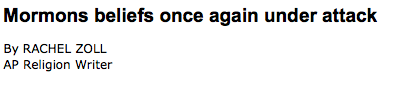
The religion beat apparently doesn’t attract many proofreaders, because we also have this headline:

Apostrophe, anyone? If “Mormons’ beliefs” takes up too much space, “Mormon beliefs” would also work.

Moving on . . . . What exactly is The Atlantic trying to say in this headline?

Are we looking for “Do Tax Cuts or Spending Cause the Deficit?” That version isn’t much better, however, considering the awkward combination of a plural noun (tax cuts) and a singular gerund (spending). The parenthetical “Or Both” doesn’t really work either; it’s a separate question, not part of the first. A suggestion for rephrasing: “Is the Deficit Caused by Spending or Tax Cuts? (Or Both?)”

The latest edition of Newsweek is an even more dismal production than usual. Perhaps all the copy editors got pink-slipped after the Daily Beast merger, because this article on the economic and political mess in Italy has more grammatical errors than a bad SAT essay:

Italians are no different from other nations: like squabbling families, whatever they may say about their faults, they deeply resent it when outsiders start to list them.

Italy may be no different from “other nations,” but the last time I checked, “Italians” were not a nation.

As recently as July, as the storm that is Greece spread through the Mediterranean, people hoped that the ill winds might do Italy some good. . . .

Granted, the writer is speaking metaphorically, but the so-called “storm” is Greece’s debt crisis, or possibly the shakiness of the Greek economy, not Greece itself. No one has spotted bits of Greece drifting around the Mediterranean. (Then again, Crete making an appearance off the Italian coast would certainly be news.)

Italy’s real economy, they protest, is even today far healthier than Spain’s, which has huge private as well as public-sector debts, banks that are badly compromised by its massive property bubble, and more than 20 percent unemployment.

Again, a modifier problem. A country can have “huge private as well as public-sector debts,” but an economy cannot. The subject of the clause about debt is “Spain’s” (shorthand for “Spain’s economy) when it should simply be “Spain.” It doesn’t make much sense to say that Spain’s economy has massive debt or at-risk banks, but by beginning the sentence with “Italy’s real economy,” the writer is forced into an awkward parallel.

Stay tuned for more carping about petty style mistakes. The media will never be perfect, and I will certainly never run out of things to whine about.


Word[s]count — Running the Grammar Gantlet

16 09 2011

UPDATE: It seems I spoke too soon. There are indeed a few reporters at the Times who know the difference between “gauntlet” and “gantlet,” but not A.G. Sulzberger (who, one might assume, was a shoo-in for the job). Some copy editor will probably fix the error in an hour or two, but here it is, immortalized via screenshot:

I especially love how gauntlet is paired with triple digits . . . a three-fingered glove, perhaps?

ORIGINAL POST:

Even as modern-day laziness has eroded the difference between “staunch” and “stanch” and otherwise intelligent people thinking “honing in” is the same thing as “homing in,” the line between “gantlet” and “gauntlet” remains firm. You run a gantlet and throw down a gauntlet; the AP Stylebook notes that “a gantlet is a flogging ordeal, literally or figuratively,” while “a gauntlet is a glove.” More specifically, according to good ol’ Dictionary.com, a gauntlet is “a medieval glove, as of mail or plate, worn by a knight in armor to protect the hand.” The act of tossing a glove to the ground was a silent challenge, indicating the knight’s willingness to fight. “Gantlet” is also a historical reference: “a former military punishment in which the offender had to run between two rows of men who struck him with clubs, etc. as he passed.” That’s according to YourDictionary.com, which, annoyingly, adds that it is “now spelled equally gauntlet.”

Actually, I don’t think it’s that bad yet. Just because some people are sloppy does not mean the rest of us need to be. The words aren’t interchangeable, and the situation is not nearly as hopeless as the staunch/stanch elision. For every misuse, there are two or three cases of a writer choosing the correct word. Thus, from a Businessweek article on the Nordstrom department store chain, we have this mess:

They jogged through a gauntlet of more than 300 employees, and clapping along with tall the store managers, salespeople, and security guards were four tall men.

But we also have two articles from the Times that prove there are still reporters who know the difference between “gantlet” and “gauntlet,” and who make a point not to give their readers a bizarre image of a tiny, kitten-like person shoving his way through a giant mitten. From a story about the heightened security in New York City for the 9/11 anniversary, there is this:

The increased police presence forced drivers heading toward Manhattan on the Brooklyn Bridge to squeeze through a single-lane gantlet as police officers walked between the cars, singling out some for a closer look.

A second article demonstrates that the Times hasn’t just chosen an alternative spelling as a catch-all for both words:

A day after throwing down the gauntlet to Congress, President Obama took his new $447 billion jobs plan on the road on Friday, exhorting college students here to contact their lawmakers in the first salvo of what the White House says will be a sustained campaign by the president to sell his legislation this fall.

As a sort of riposte to those who write the dictionary entries that shrug at the gantlet/gauntlet confusion, I would point you to this bit from a New Yorker article about snooty critic Dwight Macdonald, who waged a relentless battle against middlebrow culture:

When Webster’s Third listed “disinterested” as a synonym for “uninterested,” on the ground that the former word frequently gets used in this way, it was renouncing a dictionary’s basic function. It was refusing to exercise judgment. Macdonald saw the abandonment of such distinctions, between correct and incorrect diction or genuine and sham art, as society’s abandonment of its own history and traditions.

So there.


A Sad Story, Badly Told

11 09 2011

What is it about momentous occasions that brings out the Edward Bulwer-Lytton, of “It was a dark and storm night” fame, in reporters? Maybe it’s tacky to grumble that the articles about the 9/11 anniversary are poorly written, but I’m lodging a complaint anyway. The Associated Press offers multiple takes on the anniversary, as if to give its network of newspapers several options: maudlin, saccharine or lugubrious. I find it insulting that the AP thinks this sort of high school essay writing appeals to the average American. It smacks of what conservatives call media elitism, because it presumes that the only way readers will grasp the significance of a situation is to bang them over the head with it. It offends my intelligence in the same way that laugh-track sitcoms that crack stale, misogynist jokes offend my intelligence. Just as Hollywood assumes no one will pay to see a thoughtful movie about real people, but will fork over eight dollars to watch a cariciatured romp-fest, the AP assumes that its readers will choose melodrama over straight news.

There is nothing particularly unusual about the writing style on display in the AP’s 9/11 stories. Far too many of the news service’s articles are almost willfully bad, in that there is no real excuse for the overly colloquial, casual language. It does not come off as rushed or written on deadline, as one might expect from a wire service. I could understand if the sentences were hastily composed or the metaphors slightly mixed, but that isn’t the problem. The reporters choose their words carefully; it’s just that they choose the wrong ones. Still, the AP’s 9/11 reporting is especially bad. The melodramatic tone suggests that the only way to commemorate a tragedy is through weeping and gnashing of teeth. It is a mistake to assume that a slew of colorful adjectives is the only way to telegraph sincerity or grief. Other publications — the Times, to cite my personal favorite — have produced authentic, compelling 9/11 stories that are vastly more moving than the AP’s stylistic glop. There is a place and time for dramatic devices like repetition; that time, as Tom Junod’s “Falling Man” article proves, is after the author has spent six pages proving he can write. In other cases, Junod is a notorious abuser of repetition — see his 2011 profile of Pixar chief John Lasseter — but by the end of the wrenching 7,000-word “Falling Man,” he has earned his sign-off: ” . . . We have known who the Falling Man is all along.” The AP, by contrast, has done nothing to justify these opening lines:

At churches, we prayed. At fire stations, we laid wreaths. At football stadiums, hands and baseball caps over hearts, we lifted our voices in song and familiar chants of “USA!” – our patriotism renewed once more as we allowed ourselves to go back in time, to the planes and the towers and the panic and the despair, to the memories that scar us still.

Not only does the writer begin the first three sentences with “at,” but she subjects us to “the planes and the towers and the panic and the dispair” as well. Pick one, please. I don’t doubt that the reporter was sincere in her desire to convey the indelible nature of the memories, but the result is overdone and exhausting to read. Just two paragraphs later, the rhythmic list-making returns, as we are told of gatherings “on small-town main streets and in courthouse squares, in big-city parks and on statehouse steps.”

Another article begins with a smattering of descriptions that sound just slightly off:

Determined never to forget but perhaps ready to move on, the nation gently handed Sept. 11 over to history Sunday and etched its memory on a new generation. A stark memorial took its place where twin towers once stood, and the names of the lost resounded from children too young to remember terror from a decade ago.

The nation “gently” handed the day over to history? Its memory was “etched . . . on a new generation”? You can etch a memory into someone’s mind, perhaps, but on an entire generation? There’s nothing explicitly wrong with this sentence, but it sits awkwardly on the page, like a chair with one leg an inch too short. Likewise, the image of names “resound[ing]” from children” doesn’t quite work. The whole paragraph is an exercise in overwriting.

The AP article that my local newspaper chose for today’s front page includes the following:

Close your eyes and picture Sept. 11. The memories are cauterized, familiar forever. The second plane banks and slides in, the fireball blooms, the towers peel away as if unzipped from the top . . . . No one knew exactly what was happening, or how vast, or at whose hand. No one knew, for a time, that the instruments of destruction were not prop planes but jumbo jets. At the very first, almost no one knew there were planes at all.

September 11 isn’t an event that requires embellishment or fancy language. What the AP reporters don’t seem to realize is that the story is horrific enough to stand on its own. Joe Biden once accused Rudy Giuliani of composing sentences from “a noun, a verb and 9/11.” In some cases, that simple noun-verb formula may not be such a bad idea.

To be fair, the AP isn’t the only media outlet guilty of melodrama. Even the vaunted Gray Lady ran a column on September 6 by Roger Cohen that contains some pretty purple prose. Describing the post-9/11 era, Cohen writes:

Irresponsibility was allied to conviction, a heinous marriage. Self-delusion is the mother of perdition. Wars killed. Wall Street made killings. “Whatever” became the watchword of maxed-out Americans; and in time things fell apart.

Scan the rest of the column and you’ll encounter “scurrilous imaginings,” “kleptocratic tyrannies” and ” inexorable currents of history.” That’s quite a mouthful. If you’re looking for SAT-prep words, Cohen is your man.

Not all of the 9/11 coverage was poorly written. It’s just a shame that the AP, which provides content to newspapers across the country, didn’t hold itself to higher standards.


High Hopes

27 08 2011

Usually I gripe about everyone else’s spelling and grammar errors (while probably making plenty of my own), so perhaps today’s post will be a breath of fresh air. It does say something, however, about the state of the English language that I am pleasantly surprised when I stumble across the correct usage of a word. “Hopefully” is right up there with “nauseous” when it comes to errors made so frequently that you draw more attention to yourself by using the word properly than by making the mistake. Pronounce the “e” on the end of “forte” and nobody bats an eye; drop the vowel and people look at you as if you’re an idiot, no matter what the dictionary says. I tried for awhile, in high school, to answer “How are you?” with “well” instead of “good,” until I met someone who did the same and realized how pretentious it sounded. So, to the dismay of the persnickety chorus of grammarians that I imagine hovers just above my shoulder, I say “good” — and share responsibility for the sorry state of the language.

As usual, I digress. The point is, I was happy to discover that a writer for the NYT Sunday Magazine is doing her best to prevent English grammar from going to hell in a Twitter- and text message-induced handbasket. This is how Susan Dominus begins an article about a Hollywood screenwriter:

If Aline Brosh McKenna were to write a script about her life, it might open with McKenna, wavy-haired and underdressed, hopefully showing her work to a series of unsmiling magazine editors in New York.

Most people (mis)use the word “hopefully” as a stand-in for “It is to be hoped that.” While there are a few online dictionaries that accept this loosened definition of the word, traditionally “hopefully” is an adverb. It describes how you do something and means “in a hopeful manner.” Dominus uses it correctly; the screenwriter shows her work hopefully, in a hopeful manner. We’ve been so conditioned to accept the second sense of the word that I initially read uncertainty into the sentence. Is McKenna showing her work? Well, “hopefully” she’s showing it, but maybe she was hit by a bus on the way to the meeting.

Given the persistence of my aforementioned chorus of grammarians (is there such a thing as a grammar conscience?), I can’t side with the laissez-faire school of thought that would be OK with the statement “Hopefully, we can go to Disneyland this summer.” Yes, that’s how everyone uses “hopefully,” but the fact that everyone does something wrong does not make it right. We’re not going to Disneyland “in a hopeful manner”; we’re hoping that we’ll be able to go.

I probably have as much chance of winning this battle as I did the one over “well” and “good” or “nauseated” and “nauseous.” I can only hope that, by rambling on about it, I can bore my readers into submission. I suppose you could say I’ll be rambling hopefully.


August Lines

24 08 2011

Impressive writing turns up in all manner of places, from the dependably sharp-witted New York Magazine to the more serviceable yet equally as amusing reviews in Entertainment Weekly. A roundup of the latest bits that caught my eye:

1) From a New York Magazine article by John Heilemann on Rick Perry’s fledgling candidacy:

But a more problematic side of Perry’s persona also came through last week: a hotness that if left unchecked can easily turn self-scalding.

This isn’t necessarily Pulitzer-worthy prose, but to characterize Perry’s hot-headedness as “self-scalding” gives the sentence a nice internal consistency. It’s a turn of phrase subtle enough to be overlooked but appropriate enough to make for a satisfying read.

2) From a New Yorker reviewof the exhibit “Frans Hals in the Metropolitan Museum” by the inimitable Peter Schjeldahl:

Frans Hals' "Portrait of a Man," 1636 (photo via metmuseum.org)

I’d cross the street to avoid meeting most of the people Frans Hals painted.

Schjeldahl goes on to say that Hals’ subjects “impress me as bores of one caliber or another: oafish, supercilious, run-of-the-mill,” but that first sentence is perfect by itself. Anyone who’s seen a Hals knows exactly what he’s talking about.

3) From a piece in Vogue by Jacob Weisberg about Jon Huntsman:

With his tanned face and salt-and-pepper hair, he looks so good in checked shirts and denim jackets that The Wall Street Journal recently compared the launch of his campaign to a Ralph Lauren product rollout.

Perhaps the credit here should go to the WSJ, but the description is tailored to Vogue’s audience and rings particularly true to anyone who’s seen even a headshot of Huntsman. This is a man whose very eyebrows scream “dapper.”

4) From a capsule review by Keith Staskiewicz of the movie The Smurfs in Entertainment Weekly:

The smurfs may be blue, but their movie is decidedly green, recycling discarded bits from other celluloid Happy Meals like Alvin and the Chipmunks, Garfield, and Hop into something half-animated, half live action, and all careful studio calculation.

If you ignore the irksome Oxford comma after Garfield, this sentence is nearly perfect. It tells you everything you need to know about the movie, tweaking the over-commercialization of children’s flicks while simultaneously landing a punch on the lack of creativity in Hollywood today.

5) Again from New York Magazine, in an article by Robert Sullivan about a mega-mall being built in New Jersey:

If you disregard military bases and airports, and maybe the dam the Chinese government is beginning to regret it built on the Yangtze, the mall currently under construction at the Meadowlands will be one of the biggest feats of construction in history: the world’s largest commercial space, with at least six zeros attached to all the calculations.

The inclusion of “beginning to regret” gently suggests that the Meadowlands project may be similarly ill-advised, and the “six zeros” bit is the cherry on top of this prose pie. (Yes, go ahead and groan. I never said my own writing would meet the “impressive” standard. Let’s all roll our eyes at my cutesy “august lines” while we’re at it.)


Design a site like this with WordPress.com
Get started