Misadventures in Politics

1 04 2012

Signs the GOP Primary Is Over

As if the inevitable “would you consider the VP slot?” question (answer: “I’ll do whatever is necessary to help our country”) weren’t bad enough, Rick Santorum is facing a serious case of media neglect. Despite an attempt to infuse excitement into what was billed as a “major foreign policy speech” by delivering it at the Fairfield, CA, headquarters of Ronald Reagan’s favorite candy (Jelly Belly), the Washington Post’s front page led with a different story: “Mitt Romney Prepares to Challenge Obama on Foreign Policy.” On page A4 of the Wall Street Journal (and on the splashpage of the WSJ website for most of the evening), there was “Romney’s Hawkish Stands Are Drawing Attention.”


And the Jelly Belly backdrop may not have been as helpful as Santorum wished. What little coverage his speech did receive focused not on his familiar foreign policy talking points (Iran is evil! Obama hates Israel!) but on the candy company itself. FYI: Three tons of jelly beans were consumed during Reagan’s 1981 inauguration. Most distressing for Jelly Belly lovers, however, may have been this tidbit from the Times:

The rally Thursday was hosted by Herman G. Rowland Sr., chairman of the board of Jelly Belly Candy Company, who calls himself “an ultra conservative” and whom Federal Election Commission records show has contributed to the campaigns of Mr. Santorum’s opponents: Newt Gingrich, Mr. Romney and Gov. Rick Perry of Texas. When asked about it, Mr. Rowland said a check for Mr. Santorum “is sitting on my desk, and he’s going to pick it up today.”

Time to find a new favorite candy.

Unhelpful Endorsements

Romney, George H.W. Bush, and Barbara Bush (Photo: Donna Carson/Reuters)

George H.W. Bush officially endorsed his “old friend” Romney on Thursday, saying that “He’s a good man, he’ll make a great president, and we just wish him well.” Now, some endorsements are worthwhile: Marco Rubio, the Florida senator much-beloved by the Tea Party, may firm up support for Romney among Hispanics and social conservatives, despite his unenthusiastic recommendation (“There are a lot of other people out there that some of us wish had run for president, but they didn’t. I think Mitt Romney would be a fine president, and he’d be way better than the guy who’s there right now”). A nod from Jim DeMint, who is backing Romney but not officially endorsing him, will give the candidate credibility among fiscal conservatives.

As for Thursday’s announcement, few endorsements could be more counterproductive. Republican voters suspicious of Romney’s constant flip-flops on everything from abortion to health care will not be comforted by the sight of Romney standing alongside George “Read My Lips, No New Taxes” Bush. It’s the equivalent of Jimmy Carter endorsing President Obama — anyone spooked by Iran’s saber-rattling or long-term economic malaise will not be reassured. Worse endorsements are certainly imaginable (French president Nicholas Sarkozy publicly backing any Democrat, for example), but not by a whole lot.

Creative Accounting

Paul Ryan’s Friday endorsement of Romney, however, was a big get. The far right is in love with Ryan and his austere “Path to Prosperity” budget, which preserves the Bush tax cuts, prunes billions from domestic programs, and eventually balances the budget by 2040. Romney is on record as supporting the proposal. Calling it a “bold and exciting effort” that is “very much needed,” Romney offers the ultimate praise: “It’s very much consistent with what I put out earlier.” Disregarding the ridiculousness of competing over who had a bad idea first, Romney’s endorsement of a plan that pares all discretionary federal spending to 3.75% of GDP by 2050 (currently, it’s over 12%) defies logic. “Discretionary” spending includes everything — defense, infrastructure, food stamps, education — except Medicare, Medicaid and Social Security. As Ezra Klein notes at Wonkblog, “Consider that defense spending has never fallen below three percentage points of GDP, and Mitt Romney has promised to keep it above four percentage points of GDP.” Per Romney’s own website:

Mitt will begin by reversing Obama-era defense cuts and return to the budget baseline established by Secretary Robert Gates in 2010, with the goal of setting core defense spending . . . at a floor of 4 percent of GDP.

For a businessman who excelled at wringing every cent of savings out of the companies snapped up by Bain Capital, Romney apparently has some difficulty with math.

4.00% > 3.75%

Enough said.

Mitt’s Beach Cabin

Romney, whether describing $374,000 as “not very much” money or joking about his father shutting down a factory in Wisconsin, already has a reputation for being out of touch with the 99%. A recent Bloomberg News article quoted a former classmate as objecting to the Romney’s rich-guy image. “When he’s in an environment with people he knows and likes, he’s just like everybody else,” says Howard Serkin, who now runs an investment bank in Jacksonville, Florida. To which I can only say: Well, of course he’s “just like everybody else” when “everybody else” is a room full of financial-sector millionaires.

Otherwise studiously attentive to his image — see the everyman Wrangler jeans and shellacked Ken-doll hair — Romney seems to be clueless when it comes to his wealth. Case in point: Plans on file with the City of San Diego detail the Romneys’ proposal to renovate their 3,000-square-foot beach house, more than doubling its dimensions and adding what Politico calls a “split-level, four-vehicle garage that comes with a ‘car lift’ to transport automobiles between floors.” (Presumably those autos include Ann Romney’s multiple Cadillacs.) The family even hired its own lobbyist to guide the project through the San Diego permit process.

News of the potential water-feature and 3,600-square-foot basement is music to Democrats’ ears, however. Such a nice house, and so far from Washington . . . . It certainly doesn’t sound as if someone is counting on moving into the White House.

I Hear Kid Rock Is Available

NJ Gov. Chris Christie

In other, non-Romney news, the inexplicable Republican enthusiasm for Bruce Springsteen continues. While media accounts regularly cite Springsteen’s patriotic, love-your-country music as appealing to both sides of the aisle, the singer is not exactly shy about his liberal politics. Yet the AP reports that brashly conservative New Jersey governor Chris Christie is “calling on native son Bruce Springsteen to step up and help Atlantic City by performing at the new Revel casino on Labor Day weekend.” You have to wonder whether Christie, who has apparently seen Springsteen perform over 100 times, has actually listened to any of the lyrics. From Springsteen’s latest album, “Wrecking Ball”:

Send the robber barons straight to hell
The greedy thieves who came around
And ate the flesh of everything they found
Whose crimes have gone unpunished now
Who walk the streets as free men now

It gets worse:

They destroyed our families, factories, and they took our homes
They left our bodies on the plains, the vultures picked our bones

Hey, Christie — I don’t think he’s talking about the teachers unions.


Sketch Comedy

30 03 2012

“Well, I think you hit a reset button for the fall campaign. Everything changes. It’s almost like an Etch-a-Sketch – you can kind of shake it up, and we start all over again.”

– Eric Fehrnstom, adviser to Mitt Romney

I’m a little late to the whole Etch-a-Sketch debacle, but let me point out that it does prove one thing: Anyone bemoaning the decline of American creativity can rest easily. While the U.S. may not be able to produce an iPad or find Britain on a map, Americans are still doing O.K. on comedy. In the days since Romney’s top adviser likened the candidate to an etch-a-sketch, some hilarious responses have bubbled up on the Internet. More serious pundits opine that the etch-a-sketch meme is so potent because it reinforces an existing narrative about Romney — that he has no core and erases his previous positions faster than an impatient kid shaking his red plastic toy. It seems, however, that what really story life is that it’s funny, much in the same way that Romney speeding down the freeway with his dog strapped to the station-wagon roof is funny. When Jennifer Rubin, the Washington Post’s humorless conservative blogger, triumphantly announces that President Obama’s open-mic slip-up is a “mega-error” that “dwarfs” Fehrnstrom’s statement and is “the worst gaffe of the race,” she misses the point entirely. The etch-a-sketch meme, like the dog-on-roof story, went viral because it was so ripe for parody. Obama’s conversation with the Russian president is hardly side-splitting material.

One of the best imagines to turn up online conflates the two funniest Romney stories and was picked up by Buzzfeed:

Plus, it complements this line from an AP article: “The episode, likely to dog Romney in the coming days . . . .”

*****

Etch-a-sketch isn’t the only classic toy appropriate for the campaign trail, though. Here’s my contribution to the fun:

If Republican Candidate Were Toys . . . .


Mitt Romney may be too stiff to have a sense of humor (then again, what do you call “the trees are the right height”?), but Fehrnstrom was able to laugh at himself. He tweeted:

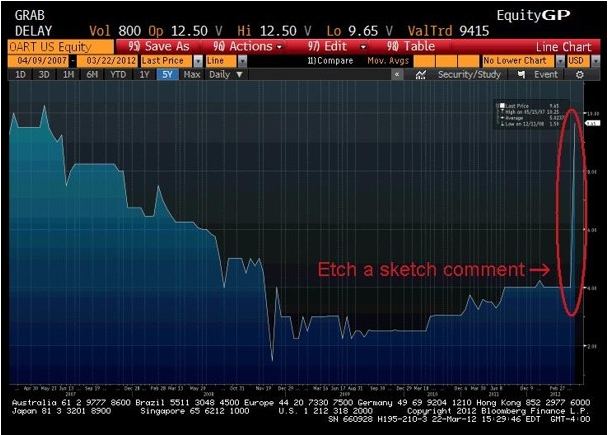
Etch A Sketch stock is up? Psst, I’ll mention Mr. Potato Head next. Buy Hasbro.

Maybe not such bad advice. Wonkblog offered this chart, showing the gaffe-fueled spike in Ohio Art’s stock price.

The Washington Post debuted a new feature, “Comments of the Week,” which presumably rewards the 10% of comments on the site that don’t degenerate into ad hominem attacks or all-caps shouting matches. A reader called “gardyloo” left the following remark:

The main difference between an Etch-a-Sketch and Mitt Romney is that with the Etch-a-Sketch the control knobs are visible.

An entire website went up at www.etchasketchmittromney.com that generates pairs of conflicting statements from the candidate. Example: “I’ve been a hunter pretty much all my life” shows up alongside “I’m not a big game hunter . . . I’ve always been a rodent and rabbit hunter. Small varmints, if you will.” Yes, Mr. Romney often gets out his shotgun when there’s a mouse in the house.


Pinterest users have assembled a collection of Romney’s favorite classic toys:


Finally, Etch-a-Sketch maker Ohio Art is getting in on the game itself, launching an ad campaign that plays off its sudden notoriety. The creative director of Team Detroit, the company’s ad agency, remarked that “we wanted to steer the direction of the conversation in a little bit more of a positive direction.” As you might expect, the ads are carefully non-partisan and riff on the viral nature of the incident itself, not the comparison to Romney’s erase-and-replace politics.

Conservatives (like the aforementioned Rubin) are feeling vindicated by a recent Pew Research Center poll showing that 55 percent of respondents hadn’t heard about the Etch-a-Sketch gaffe at all. Among those who did know about the incident, only 11 percent said it made them less likely to support Romney; 29 percent said it made no difference. Well, thank goodness Americans aren’t basing their votes on whatever’s most popular on BuzzFeed at the moment. You can’t argue, though, that the Etch-a-Sketch humor wasn’t a refreshing break from the usual campaign rhetoric. This week, the candidates returned to attempting to outdo each other on the evils of the Obama administration. Romney: Obama surrenders to “our number one geopolitical enemy.” (Russia — really? I thought it was Iran.) Santorum: Obama “told Russia we’re not going to defend ourselves.” Gingrich: “Elect me president, and we’ll take out Putin with an Earth-orbit death ray.”

OK, I made that last one up. But it sort of proves the point: All the Etch-a-Sketch talk was labeled a distraction, but it’s not as if it distracted from anything more serious or adult. In comparison to the usual block-throwing temper-tantrums that have characterized the 2012 Nursery School Primary, the ability to use an Etch-a-Sketch — dexterity! hand-eye coordination! — just might be a step up.


GOP Tries All 31 Flavors, Orders Vanilla

27 03 2012

“Coalescing” was the word of the day after Mitt Romney won last Tuesday’s Illinois primary. Did the victory suggest that “at long last, Republicans seem to be finally coalescing around Mitt Romney’s candidacy”? Was his handy win in the Land of Lincoln evidence that “much of the GOP establishment has coalesced around Romney’s increasingly inevitable coronation”?

In any other year, Romney would already be waging a general election campaign against President Obama, but in 2012, the inability of his party to settle on one standard-bearer has raised doubts about the strength of the Republican establishment. The Tea Party wing, effectively sticking its tongue out at party elders, ignored pleas for unity as it hopscotched between Michele Bachmann, Herman Cain and Newt Gingrich. The Tea Partiers’ distaste for authority dulled the impact of those who might, in previous years, have called an end to the race. Who wants to listen to Karl Rove when he represents everything about Washington — big government, earmarks, Bush-era federal policies like No Child Left Behind — that they love to hate? That Jeb Bush’s much-coveted endorsement of Mitt Romney was overshadowed by an adviser’s Etch-a-Sketch gaffe speaks volumes about the weakness of the GOP establishment. What might once have ended up as a one-liner on David Letterman is now sufficient to distract from the fevered efforts of party stalwarts like Jim DeMint and Haley Barbour to hand Romney the crown. If DeMint, who has declined to make an official endorsement but whose profession that he is “comfortable” and “excited” about a Romney candidacy is “the functional equivalent,” can’t stage a decent coronation, are there any kingmakers left in the Republican party?

That isn’t to say that endorsements don’t matter; they just matter less than candidates, who announce each new backer with an e-mail blast to the press, would like us to believe. No endorsement is a game-changer, with the possible exception of a resurrected Ronald Reagan materializing in Tampa to offer Mitt Romney an in-person benediction. Especially in presidential races, when the candidates themselves are bigger stars than most of the senators and governors doing the endorsing, it’s unlikely that many votes hinge on a nod from a local representative or grass-roots activist. Endorsements matter primarily at the margins, when the approval of a respected figure is enough to tip undecided voters toward a semi-appealing candidate. Though this is most obvious in extreme cases — even Ronald Reagan would have a hard time selling Ron Paul to the hawkish, my-country-right-or-wrong GOP — it is arguably most significant in Romney’s situation. Jim DeMint’s stamp of approval would mean little if the public were already in love with Romney, but because even the people voting for Romney do so without much passion, the candidate needs every bit of momentum he can get.

I’ve long doubted the impact of endorsements. The candidates themselves make by far the strongest arguments for or against their skills. Endorsements are quiet, bloodless announcements, while a politician’s own words and demeanor serve as immediate, in-your-face advertisements. Exhibit A is surely Rick Perry, an instant front-runner who entered the race with legions of millionaire backers and a presumption of competence. But the lesser Republican office-holders who thought it a safe bet to fall into line behind him ended up with egg on their faces when the Texas governor wanted to eliminate more cabinet departments than he could name. Oops. Likewise, the support of all the “Hermanator” fans in the world couldn’t couldn’t save Herman Cain’s candidacy after multiple women went public with claims of sexual harassment.

Romney, however, is neither a village idiot nor a womanizing slimeball. Despite a persistent tendency to stick his foot in his mouth (“I like being able to fire people”) and highlight his wealth (“I have some friends who are NASCAR team owners”), he is nothing if not highly qualified. The biggest dilemma Romney faces is that voters just aren’t sure they can trust him. Is he the “severely conservative” businessman who will repeal “Obamacare” on Day 1 and cut off funding for Planned Parenthood? Or is he the mushy moderate who once promised to be a stronger advocate for gay rights than Ted Kennedy, who never met an issue on which he couldn’t change his mind? One 58-year-old Louisiana voter is quoted by the Washington Post as saying, “I don’t like Mitt Romney. I think he’s a Democrat coverup.” But most Republicans don’t necessarily hate Romney — they’re just not passionate about him. With uncertain, undecided voters are ripe for swaying, Romney’s situation is tailor-made for endorsements to matter. His campaign is all about influencing people at the margins, about tipping voters from ho-hum to . . . well, if not to enthusiasm about his candidacy, at least resignation to it.

If the biggest concern Republicans have about Romney is his perceived lack of conservative bona fides, an endorsement from Tea Party darling Jim DeMint could be particularly influential. When Pat Toomey, the Pennsylvania Republican who once chaired the anti-tax Club for Growth, submits that “I think Mitt Romney is a conservative, and I think if elected, he’ll govern as a conservative,” the effect is of a Nixon-goes-to-China moment. Especially given the skittishness this election cycle of big names to put their reputation behind a candidate reviled by the grass roots, Toomey’s endorsement means something. Endorsers are wary, of course, of what might be called the Nikki Haley effect; the South Carolina governor alienated her Tea Party supporters by stumping for Romney in the lead-up to the state’s primary, then suffered a double humiliation when Newt Gingrich breezed to a win. But Toomey addressed the Tea Party issue head-on, saying that “I think Governor Romney is absolutely committed to the principles of limited government. I think he knows the free enterprise system is a source of prosperity, and opportunity, and personal fulfillment, and elevating people out of poverty.” Though the backing of a stalwart conservative wasn’t enough to make a difference in January, when South Carolina voted, the race has changed dramatically since then. Gingrich is no longer a viable alternative, and Rick Santorum’s delegate-starved candidacy looks less plausible by the day. Ten months of constant campaigning has worn on voters, who are ready for the whole thing to end. They want a leader to unite behind, and they’re ready to be convinced that Romney is it. In this atmosphere, Toomey’s endorsement — and probably Haley’s, if she’d been able to put off her decision — may be enough to push Romney over the edge.

Personally, the only scenario in which I can imagine caring about an outside recommendation is similar to this. If I were faced with a Democratic candidate with a weak background on abortion rights, I would certainly be comforted to know that he or she had been vetted by someone unquestionably pro-choice — former Speaker Nancy Pelosi, for example, or Planned Parenthood CEO Cecile Richards. It wouldn’t make me vote for a candidate I hated — and there are definitely Republicans who hate Romney, and wouldn’t be influenced even by the aforementioned second coming of Ronald Reagan — but it could tip me toward one who I tepidly favored.

Just because certain endorsements are valuable doesn’t imply that all are equally relevant, however. When everyone from state senators to county commissioners sign on to a national ticket, the announcements become rote tallies of names unfamiliar to all but the most politically active voters — unfortunately, the very voters who are informed enough to make up their own minds. Did anyone in Illinois care that Christine Ragdogno, the Republican leader in the state senate, threw her weight behind Romney? (Or that, as she did so, she accidentally referred to him as “Mittney”?) Alone among the candidates, Romney has run a campaign well-staffed and meticulous enough to coddle local politicians and tote up minor endorsements. Since 2008, political committees controlled by his campaign have donated $1.78 million to Republicans at the state and local level, including $500,000 to conservative candidates in the first 13 states to hold primaries. By contrast, Rick Santorum is handicapped by logistical errors; he fails to file enough delegate names to receive the full slate in Illinois, and he misses the ballot altogether in Virginia. While toting up minor endorsements may not help Romney’s poll numbers, it does deny other candidates the backing and free publicity that may be more important to a small, struggling campaign. Timing also makes a difference; though Romney has been steadily accumulating supporters throughout the primary season, a last-minute wave of approvals can reinforce the sense of inevitability that the former governor so desperately needs. The Washington Post writes:

[H]e is also picking up more conservative support as impediments to his nomination appear to be diminishing. On Monday Romney trumpeted the endorsements of a handful of prominent conservative leaders — House Majority Whip Kevin McCarthy (Calif.), American Conservative Union Chairman Al Cardenas and tea party star Sen. Mike Lee (R-Utah) — who called on Republicans to unite behind Romney.

Al Cardenas hardly has the star quality of Nikki Haley, but his endorsement comes at a more crucial moment, when the field is narrower and Romney is close to sealing the deal.

That political bigwigs have favored Romney over Santorum or Gingrich is a function not only of Romney’s sustained courtship but of the nature of his candidacy as well. A man who once attended Planned Parenthood fundraisers needs the approval of the party’s right wing, while all three of his opponents thrive on their reputations as buck-the-establishment outsiders. Ron Paul is only the most obvious example of the appeal of orthodoxy overturned; in their own ways, Santorum and Gingrich also disdain the Washington in-crowd and the “Republican establishment.” Michael O’Brien of MSNBC observes that “the fact that Romney has rallied more establishment support to his campaign than any other candidate . . . adds kindling to the fire Gingrich has sought to stoke in the race.” Rejected from the mainstream GOP for past sins (Gingrich), perceived apostasy (Gingrich, perched on the couch beside Nancy Pelosi), or uncompromising rhetoric (Santorum), these candidates are now in a position to do the rejecting. Both pride themselves on speaking supposedly hard truths to the ossified establishment, and neither tempers his extremism to become more palatable to supporters. For this reason, the media focuses little on circumstances — Rick Santorum served in Congress for 16 years, yet no sitting senator has endorsed him — that would be damaging to a candidate seeking a stamp of approval.

I still find it humorous when sundry local officials soberly throw their support to a national candidate, as if the public is waiting with bated breath for the endorsement of the county dog-catcher. The Washington Post described Jim DeMint as the “Big Fish,” but a fish is still a fish. We’re not talking about the hand of God reaching down from the heavens, a la a medieval altarpiece, to tap a politician on the head. Save for the occasional horrific mistake (Santorum surely regrets backing Arlen Specter in 2004), few endorsements really matter. But for a candidate struggling to come off as likable (paging Mitt Romney), each one must be something of a relief: You like me! You really like me!

The latest indication that they at least sort of like him? The chairman of Florida’s Republican party, though officially neutral, told CNN that “it’s time that Republicans step back and think about what’s best for the party . . . . Governor Mitt Romney’s made the case and it’s time to” — wait for it! — “coalesce.”


Hot-Button Issues: Abortion, Taxes . . . Salmon?

19 03 2012

An editorial in my local paper bemoans the cancellation of the final Republican debate, originally scheduled for March 19 in Portland. The candidates, writes the ed board, “have yet to focus on many of the issues that are of vital importance to Oregonians and Northwesterners.” Seemingly unaware that the issues most important to Oregonians are the same issues — the economy, “entitlement” programs, how many cabinet departments each candidate promises to slash — important to the rest of the country, the paper then goes on to opine that “Without a debate, it may be difficult for Oregonians to figure out where the candidates stand on the state’s medical marijuana law and protections for imperiled salmon species in the Columbia River basin.”

Well, yes. It will be difficult to figure out where the candidates stand on these issues because the candidates have probably not even considered the issues. (Ron Paul, who would legalize marijuana full-stop, without monkeying around with this “medical” business, is the exception.) Why each state feels entitled to address its parochial concerns on the national stage is beyond me. At the Jan. 26 debate in Florida, the candidates went into mind-numbing detail on American policy toward Cuba, a topic which anyone outside of the Palmetto state devotes very little attention. Newt Gingrich in particular has made a point of pandering to whichever community he happens to land in, from talking up a new VA hospital in New Hampshire to advocating the expansion of the Port of Jacksonville in Florida. At one debate, Romney brushed off “this idea of going state to state and promising people what they want to hear, promising hundreds of billions of dollars to make people happy.” Besides, if there are Republicans in Oregon basing their primary votes on Rick Santorum’s take on federal timber payments or fish management, I would suggest they reconsider their priorities. Really, when a candidate wants to tear down the wall between church and state, does it matter what he thinks about a few fish?

The Register-Guard’s professed curiosity about Northwestern issues is especially curious considering the ease with which any moderately intelligent person can predict the candidates’ responses. For the slow types that apparently make up the paper’s ed board, I offer the following primer:

Mitt Romney: Favored protecting salmon under the Endangered Species Act in 2005. Now denies he was ever pro-fish.

Ron Paul: Sorry, Fish and Wildlife Services was eliminated when the Interior Department got the axe. But don’t worry — the free market will save the salmon. (Just hope the free market isn’t hungry for fish sticks.)

Newt Gingrich: Will enable fish to self-defend by outfitting streams with laser-guided defense missiles. Alternatively, may consider shipping salmon to Mars to aid in terraforming project.

Rick Santorum: Clearly humans have dominion over the fish of the sea, and over the fowl of the air, and over every living thing that moveth upon the earth. Rejects the “phony theology” of environmentalism.


Welcome to the Hall of Lame

19 03 2012

Another week, another round of “huh?” remarks from the GOP presidential field. The latest, along with some snark from the peanut gallery:

Rick Santorum attacked Mitt Romney recently for his changing positions on abortion, health care mandates and the like by saying this:

I am not someone when the climate changes, I change.

Hey, did Rick “Global Warming Is A Hoax” Santorum just admit the climate is changing?

*****

Extending the GOP’s impressive track record on energy policy, Newt Gingrich mocked President Obama for suggesting that algae-derived biofuels could one day reduce the country’s reliance on oil:

Maybe we should, as an experiment, get some algae and go to a gas station, and you know, sort of the “Barack Solution.” Would you like some algae instead of gasoline? This is the kind of stuff that’s Cloud Cuckoo Land.

Gingrich was practically born in Cloud Cuckoo Land. This is the guy who promised to give statehood to a Moon colony once it reached 13,000 people. Who planned to light cities with giant, sun-reflecting mirrors in Earth orbit. Who sponsored legislation to give marijuana smugglers the death penalty. And who, most pertinently, is currently promising to bring gas prices down to $2.50 per gallon. “I think grandiose thoughts,” Gingrich announced. “I accept the charge that I am grandiose and that Americans are instinctively grandiose.” So, remind me — what’s his problem with algae again?

*****

Rick Santorum gets frustrated when reporters focus on social issues and neglect what he considers his economic bona fides. Why can’t Santorum shake his reputation for being obsessed with other people’s sex lives? This sort of remark, in which he criticizes his opponents’ plans to limit charitable tax donations, may have something to do with it:

Mitt Romney is bed with Barack Obama on destroying these vital mediating institutions in our society by starving them of money from the very people that keep these organizations alive and well in our society.

Of course, his Freudian slips don’t help much either, as when he lays out his policy on Iran by beginning, “Under a Santorum pregnancy . . . .”

*****

Writing on the conservative website Redstate, Santorum castigated Romney for being insufficiently committed to destroying the environment. Not only has Romney “appointed litigation-happy environmentalists to key government jobs, flip-flopped on cap and trade, flip-flopped on carbon taxes,” but he also “made the following promise about a coal-fired plant: ‘I will not create jobs or hold jobs that kill people, and that plant, that plant kills people.’”

Rick Santorum: Protects the unborn, but A-OK with killing people.


Fear and Loathing on the Campaign Trail, 2012 Edition

9 03 2012

Gingrich supporters in South Carolina (Photo by Christopher Anderson/Magnum Photos/New York Magazine)

This photo from a Jonathan Chait article in New York Magazine captures a central truth of the Republican race: it’s been a real downer. Newt Gingrich may describe himself as “cheerful,” but the Newtser is far from a happy warrior. In fact, the entire Republican field is in a funk. Debates are BYOR — bring your own raincloud. Of course, for every angry audience shot, you could probably dig up a photo of gleeful kids crowding around Ellis the Elephant. But there is truth to this meme of negativity. Not only is it a contrast to Obama’s 2008 campaign, which packed stadiums with excited fans and spawned spontaneous YouTube love letters to the candidate, but it is a contrast to Obama’s 2012 campaign. The president may be looking for a new slogan — “hope” is still on the menu, but an incumbent can’t exactly call for “change” — but he is still pushing the theme of a brighter future. Columnists have compared his most recent push to Reagan’s Morning in America; the Republican candidates, on the other hand, see not sunshine but gathering storm clouds on the horizon.

Ellis the Elephant and Callista Gingrich (Photo by CNN)

There is an element of necessity in the Republican rhetoric. The job of any challenger is to tear down the incumbent, while the sitting president is charged with defining his record in the most positive terms possible. Even Obama, in 2008, positioned himself in opposition to George W. Bush; if Obama was the country’s great hope, Bush was the war-monger who had driven hope into the ground. If you’re trying to convince voters to change horses midstream (or, as it was cleverly recast in one of the left’s few messaging victories, to change horsemen in mid-apocalypse), you’d better argue not only that the horse is too small but that the stream is too deep and swift for the beast in question. Beyond demonizing the opponent himself, the opponent’s entire record — and thus the state of the country — must be tagged as a failure. The GOP’s problem is that it has crossed the line from criticizing the “Obama economy” to painting the entire nation as a gloomy, dismal place.

Will all the negativism stir up the base and drive turnout in November, or will sad-sack voters be saddled with seasonal affective disorder? (Or perhaps it’s election-season affective disorder.) The constant barrage of negativity also threatens to cast a pall on the candidates themselves. It’s no surprise that the (literal) mud thrown in attack ads can splatter even the candidate doing the attacking, but even a general aura of negativity can be a reputation-ruiner. Project gloom long enough and you will be known as the gloomy candidate, as Rick Santorum has been described. “Dismal,” “righteous” and “finger-wagging” are other words often applied to the former senator, though he is hardly the only member of the Eeyore brigade. As Steven Pearlstein writes at the Washington Post, “If all you did was to listen to Republican presidential candidates . . . you would surely be under the impression that the country was teetering on the brink of bankruptcy, businesses were barely getting by under the weight of excessive taxation and regulation, and most of the middle class was standing in bread lines.”

The angry resentment on the faces in the New York Magazine photo cannot be solely attributed to standard campaign negativity, however. The downfall of western civilization is not an inherently uplifting topic, but it is one that half the Republican field — Santorum and Gingrich — feels compelled to address. Both men genuinely believe that America is on the edge of a precipice; as Gingrich says, the current “danger to America is greater than anything I dreamed possible after we won the Cold War and the Soviet Union disappeared in December 1991.” A website set up by Winning Our Future, the super PAC supporting Gingrich, announces that “Super Tuesday could absolutely mean Life or Death to America as we know and love it!” Santorum is equally convinced that America’s fate hangs on the results of the 2012 election, though he speaks less of a slide toward socialism than a future straight out of the Book of Revelation. “Satan is attacking the great institutions of America,” he told students at Ave Maria University in 2008. Gingrich may warn against President Obama’s “Kenyan, anti-colonial” radicalism, but no one can beat the Devil himself. Presumably, Beelzebub is working his dark arts through HHS Secretary Kathleen Sebelius, as the administration’s policy on birth control is part of an agenda that is “systematically trying to crush the traditional Judeo-Christian values of America.” If I thought the country was literally going to hell in a handbasket, I would probably be depressed too. Even after George W. Bush’s 2004 reelection, liberals might have joked about moving to Canada, but I can’t remember anyone seriously claiming that the president was ushering in the End of Days. Despite the frequency with which the Republican candidates invoke “American exceptionalism” and promise to “restore America’s greatness,” they have remarkably little faith in the nation and its institutions to survive four more years of Obama. Santorum plainly states that re-electing the president will be “the beginning of the end of freedom in America.” It raises the question: If a country can be destroyed by a middle-aged community organizer from Chicago, was it really that great to begin with?

The candidates’ embrace of the dour and the grim is partly a political calculation — the worse the incumbent looks, the more appealing even a middling challenger appears — but especially in Santorum’s case, it reveals almost a fetish for the apocalyptic. David Brooks, who is no bleeding-heart liberal himself, sums it up perfectly when he writes that the former senator “has a tropism for the tragic”:

The odd thing is that Santorum seems to be enjoying all this. That’s in part because he has a tropism for the tragic. Most of us look past bad events. We want life to look like our photo albums — a bunch of happy faces, editing out all the bad times. But Santorum seems to dwell on misfortune — the enemies the country faces, the depravity closing in on us, the unfair criticism hurled against him, the terrible things that have happened. When the campaign goes into its fallen state, he has the pleasure of seeing his tragic worldview confirmed.

I get the feeling that the people who attend Santorum rallies are big fans of Tim LaHaye’s Left Behind series, perhaps the sort of folks who welcome the Tribulation because it signifies the second coming of Christ. The worse the situation gets here on earth, the closer we are drawing to the End of Days — which, if you’re among the chosen, may not be such a bad thing. When the sheep and goats are separated on Judgment Day, you can bet the sheep will be wearing schadenfreude-filled smirks. And when the Obama administration plays into day-of-reckoning prophecies by waging “war on religion,” I suspect Santorum’s public rage disguises a private feeling of vindication: Finally, the evils of the godless left are being exposed.

Less clear is whether Newt Gingrich buys into this Biblical worldview. Certainly the candidate is convinced that his background as a “historian” entitles him to speechify on the Judeo-Christian foundations of America, but Gingrich is also the consummate politician. His campaign is driven by rage, and he surges in the polls when he inveighs against the “media elite” or the “Washington establishment.” If Santorum’s base is angry at the secularization of America, Gingrich’s base is angry at . . . everything. His talent is in channeling that anger, and he engages a more passionate section of the electorate than the cool, businesslike Mitt Romney, whose negativity on the stump is mostly confined to the exigencies of the “Obama economy.” When Romney attempts to emote, the furthest he gets is declaring that “If Barack Obama is reelected, Iran will have a nuclear weapon.” Hand Santorum or Gingrich the same briefing book, and you’ll get a disquisition on electro-magnetic pulses or the imminent dangers to cities like Cleveland. The most Romney can promise is this lukewarm prediction, delivered on Super Tuesday in Boston: “But, on November 6th, we will stand united, not only having won an election, but having saved a future.” Woo. Save that future — but don’t win the future, because that line, depending on who you ask, belongs to either Gingrich or Obama.

The sourness of the Republican race is the polar opposite of the increasingly upbeat attitude coming from the White House. As the man with whom the buck has stopped for the last four years, Obama has a vested interest in cultivating a positive atmosphere; the more positive voters feel, the more likely they will be to endorse the status quo. The unemployment rate has happily obliged, dropping from 8.6 to 8.3 percent in February, and public sentiment has followed:

In an Associated Press-GfK poll last month, 48 percent said they approved of how Obama was handling the economy, up 9 points from December. And 30 percent of Americans described the economy as “good” – a 15-point jump from December and the highest level since the AP-GfK poll first asked the question in 2009.

As his re-election campaign has ramped up, Obama has adopted a pugilistic yet hopeful stance, managing to criticize his rivals while keeping the emphasis on broader themes of “fairness” (what conservatives call class warfare) and “an economy built to last.” He speaks less of the catastrophe that awaits a Republican win in November and more of his own plans for a second term. Washington Post columnist Matt Miller writes that, “last week, the president’s rousing defense of his auto bailout marked the return of the ‘happy warrior’ persona that gives political leaders their greatest appeal, and which Obama too often lacks.” Of course, Obama has the advantage of running unopposed for the Democratic nomination. He has remained largely above the fray, holding his fire until the general election and rarely mentioning his potential challengers by name. This is a luxury not afforded to Romney and company, who have been forced to lace into each other with venom typically reserved for their liberal opponents. The danger of such attacks — Barbara Bush has called this year “the worst campaign I’ve ever seen in my life” — is that they leave the eventual nominee saddled with a record of denouncing aspects of the standard Republican platform. (One wonders whether Barbara Bush, in declaring this year’s campaign “the worst,” is forgetting the Willie Horton ad her husband’s backers ran against Michael Dukakis in 1988.)

Instead of focusing on the perceived shortcomings of the liberal worldview, Gingrich is forced to smear private equity as “vulture capitalism” and Santorum is obliged to dismantle the parts of the Speaker’s legacy — the 1994 takeover of the House, welfare reform — still surrounded by a rosy conservative glow. Arguing over the finer points of conservatism when they could be delivering broader rebuttal of big government, the candidates have revealed chinks in the GOP armor that Obama will surely exploit in the general election. When Obama wants to accuse his opponent of selling out the middle class, he need only cue up video of Rick Santorum going after Mitt Romney. When it’s time to debate health care, Romney’s assertion to Gingrich that “the individual mandate was your idea” will come back to haunt Newt. Forced to argue that their opponents are unelectable, the candidates inadvertently sow doubts that will haunt the party’s standard-bearer in November. In a post-Super Tuesday speech in Alabama, Gingrich declared that “we are staying in this race because I believe it’s going to be impossible for a moderate to win the general election.” Democrats will be all too happy to quote him on that once the Romney-Obama battle heats up. The electorate’s response to all the negativity has been predictable. The percent of Republican voters who view the candidates unfavorably has spiked, and the Times reports that, in an “NBC/Journal survey, four in 10 Americans say the primary process has given them a less favorable impression of the party, with only 12 percent indicating that the season has given them a better impression.”

Despite such internecine warfare, GOP stalwarts are convinced that the party will eventually coalesce around the nominee, whomever it may be. Bob McDonnell, the Republican governor of Virginia, maintained that “I’d love for this to be over sooner rather later so we can focus on the president’s record. But however long it takes, the desire to replace President Obama will motivate conservatives and libertarians in such a significant way.” This sentiment, though widely echoed among the Republican elite, is less of a sure thing than McDonnell might hope. Anti-Obama rage is surely a motivator for conservatives, and it will certainly drive Tea Party types to the polls, but how potent a force is it among those who don’t see the president as the anti-Christ? No less a dyed-in-the-wool conservative than Wall Street Journal columnist Kimberly Strassel makes the following observation:

A senior campaign aide airily dismissed Mr. Romney’s Super Tuesday weaknesses, noting: “The areas we didn’t do as well in are rural and they are more anti-Obama.” Meaning, who else are these guys going to vote for come November?

How about: no one. They could stay home.

Anger worked for the GOP in 2010, when Tea Party fervor crested in an anti-incumbent wave that swept Democrats and insufficiently conservative Republicans out of Congress. And the party’s disparate factions could still unite behind the eventual candidate, as Super Tuesday interviews by the New York Times suggest. Reporter Kim Severson describes voters as “unanimous on one point . . . They wanted a candidate who could defeat President Obama.” Tina Kreimer, a Georgia Republican, is quoted as vowing, “I’d pick the geese in the parking lot before I’d pick Obama.” However, though Republican representatives in states like Ohio have lost primaries to challengers from the right, in 2012 the Tea Party fire is burning at a lower grade. Elections in a country split down the middle are decided by turnout; will anger be enough to bring out occasional or first-time voters? Obama won in 2008 by mobilizing segments of the population — minorities and young people — that were not even registered the year before, and his campaign apparatus is rightfully legendary. New York Times columnist Charles Blow is bullish on Obama’s chances, writing that “[t]he elections will boil down to a duel between anger and optimism, and in general elections optimism wins. Energy wins. Vision wins.” Real Clear Politics, a slightly more neutral source (Blow is uber-liberal even by the Times’ standards), offers a telling distinction between Republican and Democratic supporters:

The bulk of Tea Party activity in 2010 was inspired by intense anger at government; it rose up out of negativity. But each of the Obama volunteers RCP interviewed for this story insisted that they are fueled by a positive message. They had nothing to say about Romney or any of the other Republicans, just that they were focused on supporting the president.

To some extent, Romney is aware of this positivity gap. Unidentified aides tell the Times that he “has become too mired in the nuts and bolts of how to win the nomination rather than offering an inspiring argument for why he should.” Indeed, “inspiring” is not the word I would choose to describe Romney, who waxes about trees being the right height and whose most rousing line on the stump is that “real change is finally on the way.” Of course, insisting that declining unemployment is a mirage, or that the uptick in consumer optimism is misplaced, is not exactly the way to rev up a crowd.

Obama campaigns in Michigan in 2012: Still cheerier than Gingrich's crowd (Getty Images)

Even Obama cannot match the enthusiasm stoked by his 2008 campaign. There is truth to his acknowledgement that he is older and grayer, no longer the blank-slate candidate of hope and change. (If you’re looking for confirmation that the bloom is off the rose, note that Shepard Fairey of Obama-poster fame just pleaded guilty to charges stemming from his “borrowing” of an AP photo.) Obama spoke to stadiums full of people in 2008; crowds like that are not dime-a-dozen in 2012. But this picture, of an Obama rally this year in Michigan, nevertheless makes the case that, compared to the Gingrich crowd in the New York photo, the Democratic Party is still the place to be.


“One of the Finest Minds of the 13th Century”

29 02 2012

Every time Rick Santorum shuts his mouth, an angel gets its wings. Unfortunately, since the guy practically leaps at every chance to say something offensive or bizarre, there are a lot of wingless angels shuffling around in heaven. Journalist Tom Ferrick, Jr., once remarked that Santorum “has one of the finest minds of the 13th century,” which pretty much sums it up. Some thoughts on the unlikely candidate’s latest gems:

1. The Times reports that Santorum offered a dismal — and personal — view of the housing market at a Friday night campaign event in Michigan:

I’m in a situation in our own house. We happened to buy in a very bad year . . . the value of my house is a fraction of what it was when I bought it.

And what a fraction it is! The five-acre property was assessed at $1.65 million in 2008, but is worth just a paltry $1.25 million today, according to the Washington Post. That must be quite a burden on Santorum’s finances, considering his income dropped from $1.1 million in 2009 to $923,000 in 2010. Perhaps that explains why, despite constantly praising Christian charities as superior to government welfare, the candidate donated only 1.8% of his 2010 income to charity, lagging Gingrich (2.8%) and Romney (13.8%) as well as President Obama (14.2%).


2. At the same event, Santorum challenged Romney for supporting TARP while simultaneously opposing the government bailout of GM and Chrystler:

You may not like my position on bailouts, but I’ve been principled and consistent, unlike other people in this race.

He’s right — I don’t like his position on bailouts. By his logic, should I then support the guy who was wrong 100% of the time, or the guy who was wrong only 50% of the time? Neither option is looking very attractive.

Then, in the run-up to Tuesday’s Michigan primary, Santorum’s campaign robo-called Democratic voters, hoping to encourage them to support him in the Republican race. The script: “Romney supported the bailouts for his Wall Street billionaire buddies but opposed the auto bailouts. That was a slap in the face to every Michigan worker, and we’re not going to let Romney get away with it.” Hey, Democrats — don’t let Romney get away with it! Vote for the guy who embraced those bailouts . . . oh, wait.


3. Last Thursday, Santorum addressed President Obama’s efforts to increase college attendance, reports the National Journal:

I understand why Barack Obama wants to send every kid to college, because of their indoctrination mills, absolutely . . . . The indoctrination that is going on at the university level is a harm to our country.

Of course, the president’s initiative has nothing to do with the fact that college graduates earn nearly double the average income of a worker with only high school diploma. It’s all about the left-wing brainwashing.

Santorum might also be interested to know that research shows that better-educated Republicans are actually more skeptical of facts and science (or, as Santorum would say, “facts” and “science”) than their less-educated counterparts. As Chris Mooney writes in Salon, “only 19 percent of college-educated Republicans agreed that the planet is warming due to human actions, versus 31 percent of non-college-educated Republicans.” In the same vein, between 2009 and 2010, the belief that Obama is a Muslim increased more among educated conservatives than among those without degrees. By this logic, Mr. “Global Warming Is Junk Science” should be pushing college on everyone.


4. Santorum has also criticized Obama’s health care law for mandating insurance coverage of prenatal testing, which he claims “encourage abortions” He told the CBS show “Face the Nation” that “the bottom line is that a lot of prenatal tests are done to identify deformities in utero and the customary procedure is to encourage abortions,” though the Washington Post notes that he also feels some tests — like sonograms — should be provided for free. Presumably, Santorum would also favor the controversial Virginia bill, since modified, that would have forced a woman seeking abortion to undergo a transvaginal sonogram — whether or not she needed or wanted the test.

Well, that’s one strike against “principled and consistent.” When the government requires insurers to cover one form of prenatal testing, that’s an attack on religious freedom. But when government requires women, willing or not, to undergo another form of prenatal testing, that’s just “informed consent.”

Supporters of the Virginia legislation pointed to a recent ruling by the Fifth Circuit Court of Appeals upholding a similar Texas law, which concluded that “the point of informed consent laws is to allow the patient to evaluate her condition and render her best decision under difficult circumstances. Denying her up-to-date medical information is more of an abuse to her ability to decide than providing the information.” The hypocrisy is breathtaking. Conservatives assure us that the “up-to-date medical information” provided in a pre-abortion sonogram will actually empower women to make the right choices, yet their drive to deny women the similar information of a prenatal screening reveals that they obviously have little faith in female decision-making ability. Times columnist Frank Bruni writes this week about Santorum’s claim that universities threaten students’ faith, but Bruni’s perspective could apply to Santorum’s selective push for “informed consent” as well:

But to listen to him talk about universities is to get the sense that he doesn’t trust others to emerge from such an obstacle course of unsavory influences as uncorrupted as he did. For safety’s sake, he’ll bless a little ignorance.

Especially for women, it’s hard not to conclude that Santorum thinks ignorance is a good thing.


The Offensiveness of (Almost) Everything

17 02 2012

Ah, serendipity. Dana Milbank, an op-ed writer for the Washington Post, rolled out a column today about “one of the most annoying components of our decaying political culture: false umbrage.” Nominally about the conservative blogosphere’s overheated, slightly hysterical reaction to a tweet by David Axlerod about chimichangas (just read the column; it’s a long story), Milbank’s column takes a broader look at the apology-hungry culture of Washington. Offense is taken at the tiniest slight, from standard campaign mud-slinging (Newt Gingrich slams Mitt Romney on immigration) to rude slips of the tongue (basically anything Joe Biden says). Even as Milbank was writing his column, Eric Wemple, his colleague at the Post, was pointing to the morning’s latest example of false outrage: Jack Shafer, the media critic for Reuters, dinged the White House for expressing sorrow over the death of Pulizter Prize-winning reporter Anthony Shadid. “The White House should shut up,” Shafer tweeted. “Bad form for the WH to endorse journalists (living or dead), don’t you think?” No, I don’t think. Other media types didn’t think so either, prompting what Wemple characterized as “a Friday afternoon Twitterama.”

Shafer’s snarky umbrage-taking paled in comparison to the day’s real proof of Milbank’s point, however. Charles Blow, a New York Times columnist who leans even further left than Milbank himself, offered a Friday evening overreaction of his own. Blow’s column, titled “Rick Santorum’s Gospel of Inequality,” took serious offense at comments that were, for Rick “man on dog” Santorum, actually pretty benign. In a speech to the Detroit Economic Forum, the candidate said:

I’m not about equality of result when it comes to income inequality. There is income inequality in America. There always has been and, hopefully, and I do say that, there always will be.

If the speaker had been someone other than Santorum, would Blow have still found the remarks “unbelievable,” “stunning” and “unhinged”? Does he have the same reaction when liberal pundits refute Mitt Romney’s allegation that President Obama is for “equality of outcome” by noting the major difference between equality of outcome — which Obama has never advocated — and equality of opportunity?

There is nothing offensive, or even particularly conservative, about Santorum’s remarks. No one — including, I suspect, Blow himself — is for “equality of result.” It makes little sense to pay a surgeon the same salary as a Starbucks barista. Different income levels are the driving force behind American innovation, as hard work is rewarded with higher income. The problem is not income inequality but the degree of income inequality. It’s one thing for CEOs at large companies to make 42 times as much as the average worker, as they did in 1980; it’s another thing entirely for CEOs to make 531 times as much, as they did in 2001. Few people begrudged Steve Jobs his billions, and fewer people would have thought it logical to pay Jobs the same salary as an Apple Store salesman.

Fundamentally, this is all Santorum is saying when he hopes “there always will be” income inequality. Yet Blow, in an attempt to manufacture outrage at an otherwise innocent statement, conflates Santorum’s remarks with the general Republican distaste for any government efforts to level the playing field. This outrage is particularly silly — and in this regard reminiscent of the fuss over Mitt Romney’s out-of-context “I like to fire people” comment — considering Santorum’s rich history of making truly outrageous statements about inequality and poverty. He accuses President Obama of “systematically destroying the work ethic … by the narcotic of government dependency.” He slams “liberal welfare policies,” claiming that “we know from our history that taking care of people destroys them, destroys communities, destroys families, destroys country.” And let’s not forget the classic assertion that “I don’t want to make black people’s lives better by giving them other people’s money.” (Or perhaps he said “blah people.” We’ll never know.)

In labeling Santorum’s take on inequality “stunning,” Blow also ignores the fact that, of the remaining four Republican candidates, Santorum is the only one who gives a fig about the poor, albeit in his own faintly perverse way. When Mitt Romney was forced to defend his statement that “I’m not concerned about the very poor,” Santorum’s response — that “I really believe that we should care about the very poor, unlike Governor Romney” — was at least more believable than Newt Gingrich’s blather about the pursuit of happiness. Santorum, whether you agree with him or not, genuinely believes that promoting traditional families and Christian values is in the best interest of those at the bottom of the economic ladder. While his proposed policies would actually eviscerate programs like Medicaid and food stamps, he seems truly convinced that a Santorum administration would care about the poor. That’s more than you can say for Romney, whose cluelessness leads him to describe $374,000 as “not very much,” and who mentions the poor only as an afterthought.

The anodyne nature of Santorum’s inequality comments is further emphasized by the rest of Blow’s column, in which he runs through a list of infinitely more ludicrous Santorum quotations — including the candidate’s suggestion that the Obama administration’s contraception-coverage mandate will put America on the road to guillotine of the French Revolution. There’s no need to turn a mountain into a molehill, as Blow has done with a statement about income inequality that, by itself, is no more offensive than the fact that Charles Blow makes more money than the New York Times’ janitor. When Santorum starts blaming Boston liberals for pedophilic Catholic priests and “radical feminists” for oppressing women . . . that is when we can all take umbrage — and there will be nothing false about it.


The GOP’s Mr. Right

14 02 2012

Rick Santorum's three favorite words (photo via salon.com)

How do you beat the perfect Republican candidate? That is the question Mitt Romney must be asking himself right now, as he absorbs Rick Santorum’s Minnesota-Missouri-Colorado trifecta and blanches at the latest polls, which show Santorum leading the race at the national level. Newt Gingrich was easy to take down; with his history of shady ethics and $1.6 million from Fannie Mae and Freddie Mac, Romney’s attack ads could have been written by a roomful of monkeys with typewriters. Santorum, however, is a harder nut to crack. To wit: The latest ad from Restore Our Future, the super PAC backing Romney, goes after the former Pennsylvania senator for being a “Washington insider” and a “big spender.” If earmarks and debt-ceiling hikes are the worst sins Restore Our Future’s opposition researchers can pin on Santorum, it’s going to be a long trudge to Super Tuesday. Even among pork-eschewing Tea Partiers, it’s hard to imagine an epithet like “Washington insider” will be the kiss of death. For one thing, Santorum was a senator. He worked in thecapitol building.Which, needless to say, is located in Washington, D.C. These are not earth-shattering revelations, people.

The funny thing — and I use “funny” in the sense of “isn’t it hilarious how the world is going to hell in a handbasket? — is that, in a general election, the target on Santorum’s back would be a mile wide. This is a guy who seemingly equated gay relationships with “man-on-dog” sex. Who believes global warming is a conspiracy orchestrated by liberals to “make you feel guilty so you’ll give them power so they can lord it over you.” Who neglected to correct a woman at a campaign rally who told him President Obama was an “avowed Muslim” and ineligible to be president. Who tells supporters that the president’s “overt hostility to faith in America” will lead to a French Revolution scenario complete with “the guillotine.” Who wrote a book blaming “radical feminists” for looking down on stay-at-home mothers and pushing women into the workforce — then promptly threw his wife under the bus as the (uncredited) author of the offending passage.

In short, Santorum is an ignoramus wrapped in a hypocrite surrounded by a bigot. As someone representing the left wing of teh Democratic party, I have to wonder,Who would vote for him? And that’s where things get a little — funny. The fact is, Santorum is everything that the GOP base wants. He is perfectly in sync with a party that has veered sharply to the right on equality, taxes, women’s rights, and foreign policy. In my eyes, he represents everything that is wrong with the conservative worldview; but to conservatives themselves, he represents everything that is right (no pun intended). If you believe that same-sex marriage is a threat to Western civilization, that welfare recipients are lazy moochers who sap resources from the rest of us, that a zygote is morally equivalent to a five-year-old child . . . then Santorum is your guy. Obviously I think these positions are ridiculous, but just as obviously, the people who hold them do not agree.

Attacking Rick Santorum should be easy, for all of the above reasons. But Romney can’t possibly use that line of attack, because no one voting in the Republican primaries sees these things as negatives. Ross Douhat, the New York Times columnist whose religious and social beliefs generally align with Santorum’s, suggests that, “while it was easy to design an anti-Gingrich ad assault that would render the former speaker radioactive, Santorum doesn’t present half so ripe a target.”

Romney, for all his faults, at least maintains a veneer of bipartisanship and moderation. His weaknesses in the primary campaign — health care, his flip-flops on abortion and gay rights — are the very qualities that would make him a viable candidate in November. But he is no longer in step with the heart of the GOP base, and his attempts to dance to the new conservative beat are about as successful as his renditions of “America the Beautiful.” It’s a cliche that nations get the government they deserve. But if parties get the candidates they deserve, then Romney has no business with the GOP nomination. The Republican faithful and Rick Santorum: As a snarky teenager might say about her ex-boyfriend and his new flame, “They deserve each other.”


Design a site like this with WordPress.com
Get started