Reads and Reactions

10 05 2012

Cable news shows call it “commentating.” Direct from the peanut gallery, here are four interesting bits of analysis, with my own two cents thrown in, free of charge. To start us off, the best editorial cartoon from the past week:


But if Romney wins, we’re headed for 1984

Journalists can find historical parallels for the 2012 election in almost every presidential race of the last hundred years. Nate Silver of the Times breaks down the precedents by statistics and margins of victory, but Ed Kilgore, the “Political Animal” blogger at Washington Monthly, is particularly insightful. Each party has its own version of history to impose on 2012, though neither makes a very compelling argument.

Most of the arguments we’ll hear from the two campaigns about historical precedents for this election will continue to more or less involve Democrats talking about 1964 and Republicans talking about 1980, even if it winds up looking more like 2004.

The left would like us to see Romney as Barry Goldwater, a Republican out of step with the electorate whose “severe” brand of conservatism handed President Johnson his first victory at the top of the ticket, while the right hopes the media latches onto the the narrative of another Carter vs. Reagan match-up, “an incumbent Democratic president with a poor economy who tried to make the election something other than a straight referendum on his record.” In reality, however, Obama may be neither Johnson nor Carter — health care reform was no Civil Rights Act, but taking out Osama bin Laden was not a bungled hostage situation in Iran. Ironically, Kilgore suggests, Obama most closely resembles the man he replaced, a sitting president whose strength on foreign policy brought him a narrow victory over  a lackluster and flip-flopping challenger.

Negotiating with China

William Pesek, a Bloomberg News columnist, makes an interesting point about the crisis in China over the fate of human rights activist Chen Guangcheng. Pesek is not a right-winger attempting to paint Obama as weak on foreign policy or naive in his handling of authoritarian regimes; though he believes that the administration should have taken a harder line in negotiations, what he finds most important is that the administration could have taken a harder line. The pressure to wrap up the talks over Chen before Hillary Clinton’s arrival was self-imposed and unnecessary, because the summit itself was largely for for show. Like many China watchers, Pesek believes that Beijing is playing to the home crowd. Party leadership cares far more about the domestic implications of its actions than any international repercussions; in fact, it is so preoccupied with its own internal struggles that substantial progress on U.S. relations is unlikely.

So let’s not pretend any one U.S.-China summit, this one included, matters all that much. China is undergoing a major leadership change this year with Xi Jinping expected to replace President Hu Jintao. It is taking place amid the biggest scandal to face the Communist Party in decades. Against that backdrop, the U.S. could have sacrificed this week’s Beijing summit with China’s departing leaders and little would have been lost.

While Hillary Clinton’s team may have felt the summit was important, the Chinese government, convinced that “Mr. Chen should be punished, not coddled by the Americans,” was ready to let the talks founder. The Times writes that “China’s negotiators suggested that they would cancel the Strategic and Economic Dialogue, which was scheduled to begin four days later with the arrival of Mrs. Clinton and Treasury Secretary Timothy F. Geithner.”

Pesek’s analysis is also borne out by reports detailing the Chinese media’s coverage of the Chen incident. The harsh line taken initially by the nationalist Global Times — “The West and its supporters in China always need a tool to work against China’s current political system” — seems intended more for domestic consumption than as an actual rebuke to the U.S. Projecting strength to its own restless population, especially given the uncertainty surrounding this year’s political transition, takes priority over persuading the U.S. to back off its talking points on currency devaluation or trade issues. The Times reports that intra-party divisions among China’s elite were as much an issue as the split between China and the U.S.: “Mr. Chen’s case highlighted what the Americans view as an intensifying struggle within the Chinese leadership between hard-liners and reformers.”

College is a two-story colonial in the suburbs

Daniel Indiviglio’s latest Reuters Breakingviews column compares student loans to the subprime mortgages pushed on low-income consumers in the pre-crash years.

A decade ago, government subsidies and guarantees helped expand the “dream” of homeownership to many Americans who would have been better off renting. Today, it’s college education being made more accessible with cheap funding provided by Uncle Sam . . . .

Like homeownership, college education has been exploited as a moral good. Anyone aspiring to earn decent wages needs a degree these days. Even jobs that haven’t traditionally required such academic training, like police work, now do.

Beyond the most superficial similarities — massive debt, a possible bubble — between the two industries, student loans and hard-sell mortgages don’t actually have that much in common. Both education and homeownership may be marketed as “moral goods,” but while the former is truly necessary to snag a well-paid job in today’s economy, the latter was never a required rung on the ladder to success. No one had to buy a home to get ahead in the world; as appealing as that McMansion may have been, it was a want, not aneed. Without a home, a couple could still save for retirement and maintain a satisfying lifestyle — in fact, millions of people in urban rental markets like New York City did just that.

By contrast, without a college education, a young person’s future is extremely limited. There is much less choice involved in attending college. As difficult as it may be to pay off student loans, their holders did not typically load up on debt out of greed or ignorance of the terms. Students, unlike homeowners who didn’t understand how quickly the payments on their adjustable-rate mortgage would balloon, typically know how hard it is to pay off loans. They just don’t feel they have any other option.

George Washington: the last president not to tell a lie

CNN political analyst Gloria Burger buries the lede in her piece about Mitt Romney’s more conservative rivals falling into line behind the presumptive nominee:

But after this combative primary season, watching Mitt Romney’s former GOP rivals struggle with ways to endorse their onetime nemesis is painful. It’s like they’re trying to find ways to snuggle with Darth Vader. At the very least, the contortions are a tad awkward and unseemly. And in the real world (as opposed to the political world), the result is completely unbelievable.

It’s also a perfect example of why voters don’t trust politicians.

Consider this: Newt Gingrich finally announced his support of Mitt Romney this week. Yet in his obvious struggle to find the right words to embrace a man he once called a liar, Gingrich came up with this tortured equation: “I am asked sometimes is Mitt Romney conservative enough? And my answer is simple — compared to Barack Obama? This is not a choice between Mitt Romney and Ronald Reagan. This is a choice between Mitt Romney and the most radical leftist president in American history.”

Well, Gingrich is the historian, so he would know.

Really, though, Burger makes a good point. We’re used to seeing elected officials do backflips on supposedly deeply-held positions (Mitt Romney on abortion, Newt Gingrich on global warming, the entire Republican party on the individual mandate), but it’s even more jarring to see a politician doing a 180 on something as basic as liking or not liking an enemy. Plenty of regular Americans tell fibs at work all the time — “That’s a great idea, sir!” — but they feel differently when a friend double-crosses them or a supposed pal cozies up with an ex-husband. Gingrich’s approval of Romney, albeit granted through gritted teeth, is just this sort of interpersonal hypocrisy that makes voters shake their heads. No one likes to remember the year in high school that her best friend fell in with the popular crowd and started gossiping behind her back.

It’s just one more thing sure to increase the trust deficit between Washington and middle America.




Sketch Comedy

30 03 2012

“Well, I think you hit a reset button for the fall campaign. Everything changes. It’s almost like an Etch-a-Sketch – you can kind of shake it up, and we start all over again.”

– Eric Fehrnstom, adviser to Mitt Romney

I’m a little late to the whole Etch-a-Sketch debacle, but let me point out that it does prove one thing: Anyone bemoaning the decline of American creativity can rest easily. While the U.S. may not be able to produce an iPad or find Britain on a map, Americans are still doing O.K. on comedy. In the days since Romney’s top adviser likened the candidate to an etch-a-sketch, some hilarious responses have bubbled up on the Internet. More serious pundits opine that the etch-a-sketch meme is so potent because it reinforces an existing narrative about Romney — that he has no core and erases his previous positions faster than an impatient kid shaking his red plastic toy. It seems, however, that what really story life is that it’s funny, much in the same way that Romney speeding down the freeway with his dog strapped to the station-wagon roof is funny. When Jennifer Rubin, the Washington Post’s humorless conservative blogger, triumphantly announces that President Obama’s open-mic slip-up is a “mega-error” that “dwarfs” Fehrnstrom’s statement and is “the worst gaffe of the race,” she misses the point entirely. The etch-a-sketch meme, like the dog-on-roof story, went viral because it was so ripe for parody. Obama’s conversation with the Russian president is hardly side-splitting material.

One of the best imagines to turn up online conflates the two funniest Romney stories and was picked up by Buzzfeed:

Plus, it complements this line from an AP article: “The episode, likely to dog Romney in the coming days . . . .”

*****

Etch-a-sketch isn’t the only classic toy appropriate for the campaign trail, though. Here’s my contribution to the fun:

If Republican Candidate Were Toys . . . .


Mitt Romney may be too stiff to have a sense of humor (then again, what do you call “the trees are the right height”?), but Fehrnstrom was able to laugh at himself. He tweeted:

Etch A Sketch stock is up? Psst, I’ll mention Mr. Potato Head next. Buy Hasbro.

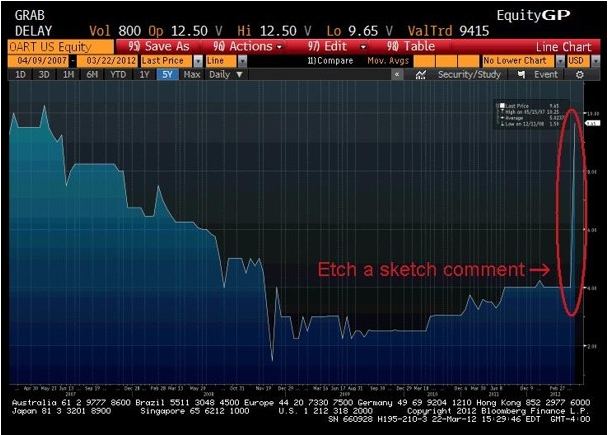
Maybe not such bad advice. Wonkblog offered this chart, showing the gaffe-fueled spike in Ohio Art’s stock price.

The Washington Post debuted a new feature, “Comments of the Week,” which presumably rewards the 10% of comments on the site that don’t degenerate into ad hominem attacks or all-caps shouting matches. A reader called “gardyloo” left the following remark:

The main difference between an Etch-a-Sketch and Mitt Romney is that with the Etch-a-Sketch the control knobs are visible.

An entire website went up at www.etchasketchmittromney.com that generates pairs of conflicting statements from the candidate. Example: “I’ve been a hunter pretty much all my life” shows up alongside “I’m not a big game hunter . . . I’ve always been a rodent and rabbit hunter. Small varmints, if you will.” Yes, Mr. Romney often gets out his shotgun when there’s a mouse in the house.


Pinterest users have assembled a collection of Romney’s favorite classic toys:


Finally, Etch-a-Sketch maker Ohio Art is getting in on the game itself, launching an ad campaign that plays off its sudden notoriety. The creative director of Team Detroit, the company’s ad agency, remarked that “we wanted to steer the direction of the conversation in a little bit more of a positive direction.” As you might expect, the ads are carefully non-partisan and riff on the viral nature of the incident itself, not the comparison to Romney’s erase-and-replace politics.

Conservatives (like the aforementioned Rubin) are feeling vindicated by a recent Pew Research Center poll showing that 55 percent of respondents hadn’t heard about the Etch-a-Sketch gaffe at all. Among those who did know about the incident, only 11 percent said it made them less likely to support Romney; 29 percent said it made no difference. Well, thank goodness Americans aren’t basing their votes on whatever’s most popular on BuzzFeed at the moment. You can’t argue, though, that the Etch-a-Sketch humor wasn’t a refreshing break from the usual campaign rhetoric. This week, the candidates returned to attempting to outdo each other on the evils of the Obama administration. Romney: Obama surrenders to “our number one geopolitical enemy.” (Russia — really? I thought it was Iran.) Santorum: Obama “told Russia we’re not going to defend ourselves.” Gingrich: “Elect me president, and we’ll take out Putin with an Earth-orbit death ray.”

OK, I made that last one up. But it sort of proves the point: All the Etch-a-Sketch talk was labeled a distraction, but it’s not as if it distracted from anything more serious or adult. In comparison to the usual block-throwing temper-tantrums that have characterized the 2012 Nursery School Primary, the ability to use an Etch-a-Sketch — dexterity! hand-eye coordination! — just might be a step up.


Afghanistan: The Forever War

21 03 2012

Mark Thiessen, a conservative op-ed writer for the Washington Post, warns against a stepped-up pullout of American forces from Afghanistan — but what he’s really warning against is pulling out of Afghanistan at all. Ever.

Thiessen devotes Tuesday’s column to what he calls “the top five disastrous consequences of a precipitous American withdrawal,” including an end to drone strikes in Pakistan, a higher risk of nuclear proliferation, a strengthened Iran, and a resurgent al-Qaeda “emboldened to strike the United States again.” These arguments are shaky to begin with — many would argue that it is our presence in Afghanistan, not our withdrawal, stoking al-Qaeda’s ire — but Thiessen’s logic really breaks down when he rails against the “ripple effect of a precipitous American retreat.” (Apparently “precipitous” is the only adjective in the author’s arsenal.) He never addresses how two more years in Afghanistan will produce an outcome even marginally better than the dismal one he describes. By 2014, will the drone war in Pakistan be any less necessary? Will the country’s nuclear weapons be any less vulnerable to extremists? Will Iran, after another two years of U.S. troops on its doorstep, be ruled by anyone more stable than the current ayatollah? Thiessen proclaims that leaving now would mean “Iran won’t fear us, our allies won’t trust us, and fence sitters will have no reason to stand with us.” It’s hard to believe he really thinks Khamenei and Ahmadinejad are quaking in their boots right now, or that anything short of a nuclear explosion in Beijing would compel China and Russia to get off the fence.

Thiessen is not stupid, and one must assume he deliberately neglects to address what two more years in Afghanistan can achieve. After all, to admit that remaking Afghanistan requires not two years but decades would force the admission of an even more uncomfortable (and unpopular) truth: Thiessen does not think we should get out of Afghanistan at all. He believes American blood and treasure is well spent by staying in Afghanistan for the foreseeable future. Given that half the respondents to a recent USA Today/Gallup poll not only “endorsed speeding up the withdrawal plans” but also “are worried that keeping American forces there makes the United States more vulnerable to terrorist attacks,” recommitting the U.S. to a never-ending war is a bridge too far for even a neoconservative chickenhawk to cross.

It’s interesting to note that Thiessen’s own party has grown considerably more bearish on the entire Afghanistan adventure. Newt Gingrich, going further than Romney or Santorum in expressing his doubts, recently admitted that the mission “may frankly not be doable.” Gingrich is rarely the voice of reason on any topic, but the question he raises is worth asking: “Is this in fact a harder, deeper problem that is not going to be susceptible to military force — at least not military force on the scale we’re prepared to do?” Certainly his position is more reasonable than those who advocate a seemingly interminable presence in the Middle East, and far more reasonable than one would expect from a politician salivating over military action against Iran.

Gingrich is in tune with Thiessen, however, in his low regard for the Obama administration’s war effort. Thiessen, who authored a book with the dubious title “Courting Disaster: How the CIA Kept America Safe and How Barack Obama Is Inviting the Next Attack” (really, the same CIA that missed 9/11?) writes in his op-ed that Obama “has almost entirely abdicated” the role of commander-in-chief. It’s a shaky conclusion, especially considering that the administration has studiously avoided the sort of “precipitous withdrawal” that Thiessen so vehemently warns against. On the same day that the Post published Thiessen’s op-ed, General John Allen, the top U.S. commander in Afghanistan, testified to the House Armed Services Committee that “we will still have combat forces in Afghanistan all the way to the end” in 2014. When pressed by Rep. Howard McKeon, a persistent critic of the administration, whether Obama “has always followed your best military judgment,” Allen answered in the affirmative and claimed the U.S. military was “on track” to achieving its goals. Presumably, those goals don’t include laying down a welcome mat for al-Qaeda or inviting further Iranian intransigence, as Thiessen claims Obama is doing. In fact, a news article in Thiessen’s own newspaper observed that “Allen’s comments appeared to place a military marker in the path of the rapid withdrawal advocated by some lawmakers and, according to opinion polls, by a majority of the American public.”

While I obviously don’t agree with Thiessen that Obama’s approach to Afghanistan is undermining Gen. Allen’s war effort, I also don’t agree with Allen that two more years will transform Afghanistan into a functional country. The rest of America seems to share that evaluation, as a recent Pew survey found that “57 percent of respondents want a quick withdrawal from Afghanistan, versus only 35 percent who want to keep forces there until the country is stable.” More ominously, sixty percent of respondents to a Washington Post/ABC News poll “believe the Afghan war wasn’t worth fighting.” I wouldn’t go that far; the 2001 overthrow of the Taliban was a legitimate response to 9/11, and denying Osama bin Laden a safe haven ultimately drove him to his end in Pakistan. (I assume Thiessen doesn’t include the killing of bin Laden among the ways Obama is “inviting the next attack.”) But the U.S. effort in Afghanistan is subject to the law of diminishing returns, and I doubt the situation will look much better in 2014 than it does today. Perhaps the best recommendation for the 2014 withdrawal date is also the most cynical: It’s not an election year.


Hot-Button Issues: Abortion, Taxes . . . Salmon?

19 03 2012

An editorial in my local paper bemoans the cancellation of the final Republican debate, originally scheduled for March 19 in Portland. The candidates, writes the ed board, “have yet to focus on many of the issues that are of vital importance to Oregonians and Northwesterners.” Seemingly unaware that the issues most important to Oregonians are the same issues — the economy, “entitlement” programs, how many cabinet departments each candidate promises to slash — important to the rest of the country, the paper then goes on to opine that “Without a debate, it may be difficult for Oregonians to figure out where the candidates stand on the state’s medical marijuana law and protections for imperiled salmon species in the Columbia River basin.”

Well, yes. It will be difficult to figure out where the candidates stand on these issues because the candidates have probably not even considered the issues. (Ron Paul, who would legalize marijuana full-stop, without monkeying around with this “medical” business, is the exception.) Why each state feels entitled to address its parochial concerns on the national stage is beyond me. At the Jan. 26 debate in Florida, the candidates went into mind-numbing detail on American policy toward Cuba, a topic which anyone outside of the Palmetto state devotes very little attention. Newt Gingrich in particular has made a point of pandering to whichever community he happens to land in, from talking up a new VA hospital in New Hampshire to advocating the expansion of the Port of Jacksonville in Florida. At one debate, Romney brushed off “this idea of going state to state and promising people what they want to hear, promising hundreds of billions of dollars to make people happy.” Besides, if there are Republicans in Oregon basing their primary votes on Rick Santorum’s take on federal timber payments or fish management, I would suggest they reconsider their priorities. Really, when a candidate wants to tear down the wall between church and state, does it matter what he thinks about a few fish?

The Register-Guard’s professed curiosity about Northwestern issues is especially curious considering the ease with which any moderately intelligent person can predict the candidates’ responses. For the slow types that apparently make up the paper’s ed board, I offer the following primer:

Mitt Romney: Favored protecting salmon under the Endangered Species Act in 2005. Now denies he was ever pro-fish.

Ron Paul: Sorry, Fish and Wildlife Services was eliminated when the Interior Department got the axe. But don’t worry — the free market will save the salmon. (Just hope the free market isn’t hungry for fish sticks.)

Newt Gingrich: Will enable fish to self-defend by outfitting streams with laser-guided defense missiles. Alternatively, may consider shipping salmon to Mars to aid in terraforming project.

Rick Santorum: Clearly humans have dominion over the fish of the sea, and over the fowl of the air, and over every living thing that moveth upon the earth. Rejects the “phony theology” of environmentalism.


Welcome to the Hall of Lame

19 03 2012

Another week, another round of “huh?” remarks from the GOP presidential field. The latest, along with some snark from the peanut gallery:

Rick Santorum attacked Mitt Romney recently for his changing positions on abortion, health care mandates and the like by saying this:

I am not someone when the climate changes, I change.

Hey, did Rick “Global Warming Is A Hoax” Santorum just admit the climate is changing?

*****

Extending the GOP’s impressive track record on energy policy, Newt Gingrich mocked President Obama for suggesting that algae-derived biofuels could one day reduce the country’s reliance on oil:

Maybe we should, as an experiment, get some algae and go to a gas station, and you know, sort of the “Barack Solution.” Would you like some algae instead of gasoline? This is the kind of stuff that’s Cloud Cuckoo Land.

Gingrich was practically born in Cloud Cuckoo Land. This is the guy who promised to give statehood to a Moon colony once it reached 13,000 people. Who planned to light cities with giant, sun-reflecting mirrors in Earth orbit. Who sponsored legislation to give marijuana smugglers the death penalty. And who, most pertinently, is currently promising to bring gas prices down to $2.50 per gallon. “I think grandiose thoughts,” Gingrich announced. “I accept the charge that I am grandiose and that Americans are instinctively grandiose.” So, remind me — what’s his problem with algae again?

*****

Rick Santorum gets frustrated when reporters focus on social issues and neglect what he considers his economic bona fides. Why can’t Santorum shake his reputation for being obsessed with other people’s sex lives? This sort of remark, in which he criticizes his opponents’ plans to limit charitable tax donations, may have something to do with it:

Mitt Romney is bed with Barack Obama on destroying these vital mediating institutions in our society by starving them of money from the very people that keep these organizations alive and well in our society.

Of course, his Freudian slips don’t help much either, as when he lays out his policy on Iran by beginning, “Under a Santorum pregnancy . . . .”

*****

Writing on the conservative website Redstate, Santorum castigated Romney for being insufficiently committed to destroying the environment. Not only has Romney “appointed litigation-happy environmentalists to key government jobs, flip-flopped on cap and trade, flip-flopped on carbon taxes,” but he also “made the following promise about a coal-fired plant: ‘I will not create jobs or hold jobs that kill people, and that plant, that plant kills people.’”

Rick Santorum: Protects the unborn, but A-OK with killing people.


Fear and Loathing on the Campaign Trail, 2012 Edition

9 03 2012

Gingrich supporters in South Carolina (Photo by Christopher Anderson/Magnum Photos/New York Magazine)

This photo from a Jonathan Chait article in New York Magazine captures a central truth of the Republican race: it’s been a real downer. Newt Gingrich may describe himself as “cheerful,” but the Newtser is far from a happy warrior. In fact, the entire Republican field is in a funk. Debates are BYOR — bring your own raincloud. Of course, for every angry audience shot, you could probably dig up a photo of gleeful kids crowding around Ellis the Elephant. But there is truth to this meme of negativity. Not only is it a contrast to Obama’s 2008 campaign, which packed stadiums with excited fans and spawned spontaneous YouTube love letters to the candidate, but it is a contrast to Obama’s 2012 campaign. The president may be looking for a new slogan — “hope” is still on the menu, but an incumbent can’t exactly call for “change” — but he is still pushing the theme of a brighter future. Columnists have compared his most recent push to Reagan’s Morning in America; the Republican candidates, on the other hand, see not sunshine but gathering storm clouds on the horizon.

Ellis the Elephant and Callista Gingrich (Photo by CNN)

There is an element of necessity in the Republican rhetoric. The job of any challenger is to tear down the incumbent, while the sitting president is charged with defining his record in the most positive terms possible. Even Obama, in 2008, positioned himself in opposition to George W. Bush; if Obama was the country’s great hope, Bush was the war-monger who had driven hope into the ground. If you’re trying to convince voters to change horses midstream (or, as it was cleverly recast in one of the left’s few messaging victories, to change horsemen in mid-apocalypse), you’d better argue not only that the horse is too small but that the stream is too deep and swift for the beast in question. Beyond demonizing the opponent himself, the opponent’s entire record — and thus the state of the country — must be tagged as a failure. The GOP’s problem is that it has crossed the line from criticizing the “Obama economy” to painting the entire nation as a gloomy, dismal place.

Will all the negativism stir up the base and drive turnout in November, or will sad-sack voters be saddled with seasonal affective disorder? (Or perhaps it’s election-season affective disorder.) The constant barrage of negativity also threatens to cast a pall on the candidates themselves. It’s no surprise that the (literal) mud thrown in attack ads can splatter even the candidate doing the attacking, but even a general aura of negativity can be a reputation-ruiner. Project gloom long enough and you will be known as the gloomy candidate, as Rick Santorum has been described. “Dismal,” “righteous” and “finger-wagging” are other words often applied to the former senator, though he is hardly the only member of the Eeyore brigade. As Steven Pearlstein writes at the Washington Post, “If all you did was to listen to Republican presidential candidates . . . you would surely be under the impression that the country was teetering on the brink of bankruptcy, businesses were barely getting by under the weight of excessive taxation and regulation, and most of the middle class was standing in bread lines.”

The angry resentment on the faces in the New York Magazine photo cannot be solely attributed to standard campaign negativity, however. The downfall of western civilization is not an inherently uplifting topic, but it is one that half the Republican field — Santorum and Gingrich — feels compelled to address. Both men genuinely believe that America is on the edge of a precipice; as Gingrich says, the current “danger to America is greater than anything I dreamed possible after we won the Cold War and the Soviet Union disappeared in December 1991.” A website set up by Winning Our Future, the super PAC supporting Gingrich, announces that “Super Tuesday could absolutely mean Life or Death to America as we know and love it!” Santorum is equally convinced that America’s fate hangs on the results of the 2012 election, though he speaks less of a slide toward socialism than a future straight out of the Book of Revelation. “Satan is attacking the great institutions of America,” he told students at Ave Maria University in 2008. Gingrich may warn against President Obama’s “Kenyan, anti-colonial” radicalism, but no one can beat the Devil himself. Presumably, Beelzebub is working his dark arts through HHS Secretary Kathleen Sebelius, as the administration’s policy on birth control is part of an agenda that is “systematically trying to crush the traditional Judeo-Christian values of America.” If I thought the country was literally going to hell in a handbasket, I would probably be depressed too. Even after George W. Bush’s 2004 reelection, liberals might have joked about moving to Canada, but I can’t remember anyone seriously claiming that the president was ushering in the End of Days. Despite the frequency with which the Republican candidates invoke “American exceptionalism” and promise to “restore America’s greatness,” they have remarkably little faith in the nation and its institutions to survive four more years of Obama. Santorum plainly states that re-electing the president will be “the beginning of the end of freedom in America.” It raises the question: If a country can be destroyed by a middle-aged community organizer from Chicago, was it really that great to begin with?

The candidates’ embrace of the dour and the grim is partly a political calculation — the worse the incumbent looks, the more appealing even a middling challenger appears — but especially in Santorum’s case, it reveals almost a fetish for the apocalyptic. David Brooks, who is no bleeding-heart liberal himself, sums it up perfectly when he writes that the former senator “has a tropism for the tragic”:

The odd thing is that Santorum seems to be enjoying all this. That’s in part because he has a tropism for the tragic. Most of us look past bad events. We want life to look like our photo albums — a bunch of happy faces, editing out all the bad times. But Santorum seems to dwell on misfortune — the enemies the country faces, the depravity closing in on us, the unfair criticism hurled against him, the terrible things that have happened. When the campaign goes into its fallen state, he has the pleasure of seeing his tragic worldview confirmed.

I get the feeling that the people who attend Santorum rallies are big fans of Tim LaHaye’s Left Behind series, perhaps the sort of folks who welcome the Tribulation because it signifies the second coming of Christ. The worse the situation gets here on earth, the closer we are drawing to the End of Days — which, if you’re among the chosen, may not be such a bad thing. When the sheep and goats are separated on Judgment Day, you can bet the sheep will be wearing schadenfreude-filled smirks. And when the Obama administration plays into day-of-reckoning prophecies by waging “war on religion,” I suspect Santorum’s public rage disguises a private feeling of vindication: Finally, the evils of the godless left are being exposed.

Less clear is whether Newt Gingrich buys into this Biblical worldview. Certainly the candidate is convinced that his background as a “historian” entitles him to speechify on the Judeo-Christian foundations of America, but Gingrich is also the consummate politician. His campaign is driven by rage, and he surges in the polls when he inveighs against the “media elite” or the “Washington establishment.” If Santorum’s base is angry at the secularization of America, Gingrich’s base is angry at . . . everything. His talent is in channeling that anger, and he engages a more passionate section of the electorate than the cool, businesslike Mitt Romney, whose negativity on the stump is mostly confined to the exigencies of the “Obama economy.” When Romney attempts to emote, the furthest he gets is declaring that “If Barack Obama is reelected, Iran will have a nuclear weapon.” Hand Santorum or Gingrich the same briefing book, and you’ll get a disquisition on electro-magnetic pulses or the imminent dangers to cities like Cleveland. The most Romney can promise is this lukewarm prediction, delivered on Super Tuesday in Boston: “But, on November 6th, we will stand united, not only having won an election, but having saved a future.” Woo. Save that future — but don’t win the future, because that line, depending on who you ask, belongs to either Gingrich or Obama.

The sourness of the Republican race is the polar opposite of the increasingly upbeat attitude coming from the White House. As the man with whom the buck has stopped for the last four years, Obama has a vested interest in cultivating a positive atmosphere; the more positive voters feel, the more likely they will be to endorse the status quo. The unemployment rate has happily obliged, dropping from 8.6 to 8.3 percent in February, and public sentiment has followed:

In an Associated Press-GfK poll last month, 48 percent said they approved of how Obama was handling the economy, up 9 points from December. And 30 percent of Americans described the economy as “good” – a 15-point jump from December and the highest level since the AP-GfK poll first asked the question in 2009.

As his re-election campaign has ramped up, Obama has adopted a pugilistic yet hopeful stance, managing to criticize his rivals while keeping the emphasis on broader themes of “fairness” (what conservatives call class warfare) and “an economy built to last.” He speaks less of the catastrophe that awaits a Republican win in November and more of his own plans for a second term. Washington Post columnist Matt Miller writes that, “last week, the president’s rousing defense of his auto bailout marked the return of the ‘happy warrior’ persona that gives political leaders their greatest appeal, and which Obama too often lacks.” Of course, Obama has the advantage of running unopposed for the Democratic nomination. He has remained largely above the fray, holding his fire until the general election and rarely mentioning his potential challengers by name. This is a luxury not afforded to Romney and company, who have been forced to lace into each other with venom typically reserved for their liberal opponents. The danger of such attacks — Barbara Bush has called this year “the worst campaign I’ve ever seen in my life” — is that they leave the eventual nominee saddled with a record of denouncing aspects of the standard Republican platform. (One wonders whether Barbara Bush, in declaring this year’s campaign “the worst,” is forgetting the Willie Horton ad her husband’s backers ran against Michael Dukakis in 1988.)

Instead of focusing on the perceived shortcomings of the liberal worldview, Gingrich is forced to smear private equity as “vulture capitalism” and Santorum is obliged to dismantle the parts of the Speaker’s legacy — the 1994 takeover of the House, welfare reform — still surrounded by a rosy conservative glow. Arguing over the finer points of conservatism when they could be delivering broader rebuttal of big government, the candidates have revealed chinks in the GOP armor that Obama will surely exploit in the general election. When Obama wants to accuse his opponent of selling out the middle class, he need only cue up video of Rick Santorum going after Mitt Romney. When it’s time to debate health care, Romney’s assertion to Gingrich that “the individual mandate was your idea” will come back to haunt Newt. Forced to argue that their opponents are unelectable, the candidates inadvertently sow doubts that will haunt the party’s standard-bearer in November. In a post-Super Tuesday speech in Alabama, Gingrich declared that “we are staying in this race because I believe it’s going to be impossible for a moderate to win the general election.” Democrats will be all too happy to quote him on that once the Romney-Obama battle heats up. The electorate’s response to all the negativity has been predictable. The percent of Republican voters who view the candidates unfavorably has spiked, and the Times reports that, in an “NBC/Journal survey, four in 10 Americans say the primary process has given them a less favorable impression of the party, with only 12 percent indicating that the season has given them a better impression.”

Despite such internecine warfare, GOP stalwarts are convinced that the party will eventually coalesce around the nominee, whomever it may be. Bob McDonnell, the Republican governor of Virginia, maintained that “I’d love for this to be over sooner rather later so we can focus on the president’s record. But however long it takes, the desire to replace President Obama will motivate conservatives and libertarians in such a significant way.” This sentiment, though widely echoed among the Republican elite, is less of a sure thing than McDonnell might hope. Anti-Obama rage is surely a motivator for conservatives, and it will certainly drive Tea Party types to the polls, but how potent a force is it among those who don’t see the president as the anti-Christ? No less a dyed-in-the-wool conservative than Wall Street Journal columnist Kimberly Strassel makes the following observation:

A senior campaign aide airily dismissed Mr. Romney’s Super Tuesday weaknesses, noting: “The areas we didn’t do as well in are rural and they are more anti-Obama.” Meaning, who else are these guys going to vote for come November?

How about: no one. They could stay home.

Anger worked for the GOP in 2010, when Tea Party fervor crested in an anti-incumbent wave that swept Democrats and insufficiently conservative Republicans out of Congress. And the party’s disparate factions could still unite behind the eventual candidate, as Super Tuesday interviews by the New York Times suggest. Reporter Kim Severson describes voters as “unanimous on one point . . . They wanted a candidate who could defeat President Obama.” Tina Kreimer, a Georgia Republican, is quoted as vowing, “I’d pick the geese in the parking lot before I’d pick Obama.” However, though Republican representatives in states like Ohio have lost primaries to challengers from the right, in 2012 the Tea Party fire is burning at a lower grade. Elections in a country split down the middle are decided by turnout; will anger be enough to bring out occasional or first-time voters? Obama won in 2008 by mobilizing segments of the population — minorities and young people — that were not even registered the year before, and his campaign apparatus is rightfully legendary. New York Times columnist Charles Blow is bullish on Obama’s chances, writing that “[t]he elections will boil down to a duel between anger and optimism, and in general elections optimism wins. Energy wins. Vision wins.” Real Clear Politics, a slightly more neutral source (Blow is uber-liberal even by the Times’ standards), offers a telling distinction between Republican and Democratic supporters:

The bulk of Tea Party activity in 2010 was inspired by intense anger at government; it rose up out of negativity. But each of the Obama volunteers RCP interviewed for this story insisted that they are fueled by a positive message. They had nothing to say about Romney or any of the other Republicans, just that they were focused on supporting the president.

To some extent, Romney is aware of this positivity gap. Unidentified aides tell the Times that he “has become too mired in the nuts and bolts of how to win the nomination rather than offering an inspiring argument for why he should.” Indeed, “inspiring” is not the word I would choose to describe Romney, who waxes about trees being the right height and whose most rousing line on the stump is that “real change is finally on the way.” Of course, insisting that declining unemployment is a mirage, or that the uptick in consumer optimism is misplaced, is not exactly the way to rev up a crowd.

Obama campaigns in Michigan in 2012: Still cheerier than Gingrich's crowd (Getty Images)

Even Obama cannot match the enthusiasm stoked by his 2008 campaign. There is truth to his acknowledgement that he is older and grayer, no longer the blank-slate candidate of hope and change. (If you’re looking for confirmation that the bloom is off the rose, note that Shepard Fairey of Obama-poster fame just pleaded guilty to charges stemming from his “borrowing” of an AP photo.) Obama spoke to stadiums full of people in 2008; crowds like that are not dime-a-dozen in 2012. But this picture, of an Obama rally this year in Michigan, nevertheless makes the case that, compared to the Gingrich crowd in the New York photo, the Democratic Party is still the place to be.


Another Apology — And That’s a Good Thing

24 02 2012

In a futile but personally revealing gesture, President Obama sent a letter of apology today to Afghan President Hamid Karzai for the American military’s burning of copies of the Koran. Though the burning was not a deliberate offense — the Times reports that the NATO personnel who burned the Korans at a landfill apparently didn’t realize the significance of the act — it nevertheless stoked rioting in Afghanistan, where the Taliban encouraged the protests and urged Afghan security forces to “repent for their past sins . . . by turning their guns on the foreign infidel invaders.” Two American soldiers were shot amid the furor.

I won’t pretend to understand the thinking behind killing people over a burned book. The response is not only bizarre to Western eyes but should be seen as disproportionate by anyone, of any religion, who values human life. But the riots hardly come as a surprise, considering the similar outrage in 2005 over cartoons of Muhammad and a firestorm in the same year over reports that guards at Guantanamo had flushed a Koran down the toilet. The uselessness of apologizing is obvious; apologies have not stopped these riots in the past, and President Obama’s latest didn’t stop the violence today. Part of me certainly feels that an apology, especially one from someone as important as the president, is only legitimizing such a destructive reaction, but the practical side of me realizes that Obama did the right thing. Looking down our noses at the Afghans’ passion for the Koran will do nothing to help the American troops still attempting to put Afghanistan back together. We’re not going to change the cultural dynamics, as the struggle against the insurgency quickly proved, and so we are forced to work within them. If anything, the death of the two soldiers proved that the president cannot afford to be stingy with apologies; he must do everything in his power to end the riots. Obama must have known that an apology would mean little to the people shouting in the streets in Afghanistan, but he had to at least try to calm the violence.

That Obama apologized despite knowing that conservatives would crucify him for it speaks to his character. The entire Republican presidential field has criticized the president for his non-existent “apology tour,” and Mitt Romney has repeated “This president apologizes for America” so many times that he is blue in the face. Sure enough, Newt Gingrich wasted no time in labeling Obama’s letter “astonishing” and “an outrage.” The AP reports that, at a campaign event in Washington state, he said, “There seems to be nothing that radical Islamists can do to get Barack Obama’s attention in a negative way and he is consistently apologizing to people who do not deserve the apology of the president of the United States period.” The Wall Street Journal adds that Gingrich announced that Obama “refuses to defend the integrity and the lives of the people who serve under him and instead abjectly crawls to apologize to the country whose religious fanatics.”

Lovely. Newt Gingrich is the epitome of classless cluelessness. As president, how would he have responded? By egging the rioters on? That surely would have preserved “the lives of the people who serve under him.” Gingrich also ignores the fact that the NATO military commander in Afghanistan also apologized. Was General John Allen also refusing to defend the lives of his troops? The White House spokesman, Jay Carney, was right when he said Obama’s “primary concern as commander in chief is the safety of the American men and women in Afghanistan, of our military and civilian personnel there.” That’s the difference between being president and wanting to be president — one actually has the responsibility of being commander in chief, while the other only has the responsibility to demagogue and campaign. Gingrich’s faux-indignation was as predictable as it was distasteful, but Obama nevertheless acted like a president, not a candidate. During an election year, it’s often hard to see a separation between the two roles, as Obama conveniently chooses swing states in which to make major policy speeches. It wasn’t a coincidence that he chose to unveil his 2013 budget at a community college near Washington, D.C. — job training and support for community colleges are priorities not just for his proposed-yet-unpassable budget but for his reelection campaign. In the case of his apology to Karzai, however, Obama clearly put necessity above political expediency. The meme of Obama apologizing for America is a dangerous one, and one which Republicans are determined to keep alive until November. If they are able to convince enough Americans that the president really does, as Gingrich claims, “bow to a Saudi king,” Obama could be in trouble.

The president obviously knows this. But today he did the right thing anyway. That, as much as anything, shows why he’s worth reelecting.


More Lies (NYT, you’re breaking my heart)

23 01 2012

Twice in as many days, the New York Times has made assertions that it almost certainly knows are false. In both cases, there is ample evidence that the newspaper has access to the correct facts, yet deliberately chooses to obscure them. And in both cases, the misstatements — actually, we might as well just call them “lies” — reinforce the conservative stereotype of the Times as a liberal paper that injects ideology into its news articles. I would usually be the first to defend the Times against charges of bias, as nine out of ten articles are written with studied objectivity, but the last two days have been disappointing.

First, as I complained in a previous post, the Times has continued its practice of referring to Mitt Romney’s 15% tax rate as higher than the effective rate of a middle-income earner. Now, the paper again makes a claim that has been pointed out as a fallacy. In an article describing the Adelson family’s multi-million-dollar donations to Winning Our Future, a super PAC supporting Newt Gingrich, reporter Nicholas Confessore mischaracterizes the Citizens United decision, in which the Supreme Court ruled that the First Amendment permits corporations and unions to make unlimited donations to independent political committees. While Citizens United certainly changed campaign finance rules, it played no role in the Adelsons’ ability to donate $10 million to Winning Our Future. The $5,000 limit on private citizens’ donations to PACs was lifted by a federal appeals court ruling, SpeechNow.org vs. FEC. That decision indeed drew on Citizens United, but even prior to the SpeechNow ruling, wealthy individuals hoping to influence politics had a smorgasboard of options.

Anyone with a spare $10 million could give unlimited amounts to “issue-oriented” 527 groups, named for the section of the tax code that regulates them, as early as the 2004 election. Though technically prohibited from endorsing or criticizing a specific candidate, these organizations predictably blurred the line between “issues advocacy” and advocacy on behalf of a candidate. After all, if you can air an ad calling pro-choice politicians baby-killers, and the only pro-choicer in the race is the Democrat . . . . why bother naming names? Certain charities — 501(c)(4)s — could also accept unlimited (and anonymous) donations prior to Citizens United, as long as their “primary purpose” was not political. The Koch-funded Americans for Prosperity, as well as Karl Rove’s Crossroads GPS, which were tossing around millions long before super PACs arrived on the scene, walked right up to the 49% “political” limit in 2010.

Deep-pocketed donors have had a hand on the scales of democracy since before I was born. Yet the Times writes: “The Adelsons’ contributions on Mr. Gingrich’s behalf illustrate how rapidly a new era of unlimited political money is reshaping the rules of presidential politics and empowering individual donors to a degree unseen since before the Watergate scandals.”A paragraph later, the paper explains the ramifications of “the emergence of new campaign finance rules in the wake of the Supreme Court’s landmark Citizens United ruling”:

That decision paved the way for super PACs, including the kind that have spent more than $30 million in the Republican primary so far: political committees run by each candidate’s former aides and financed by a few wealthy supporters. Because they are technically independent of the candidate, the groups can raise and spend unlimited amounts of money, rendering less relevant the limits that Congress imposed in the 1970s on contributions to candidates . . . . But critics warn that the new rules have reopened avenues for the very wealthy to exert undue influence over campaigns and candidates.

Citizens United indeed reopened avenues for corporations and unions to exert such influence, but the decision said nothing about wealthy individuals like the Adelsons. Is it really that tough for the Times to cite the correct court case? Also unsupported is the implication that corporate donations have been a game-changer in this election cycle. Because many super PACs have altered their disclosure schedules to allow them to delay publishing their donor lists until January 31, there is no way of knowing whether big businesses are behind the recent spending. Are corporations and unions really financing slimy attack ads, or are the bulk of the super PAC funds coming from individuals? Considering the general level of nastiness, I’ll be curious to see if any big-name corporations indeed donated to Winning Our Future and its ilk. When Target gave money to a politician who opposed gay marriage, an Internet backlash ensued. Will corporations really put their cash behind movies like “When Bain Came to Town,” the anti-Romney production that skewered capitalism?

What really gets me, however, is that the Times knows exactly what Citizens United did and did not allow. On Jan. 16, it published a letter to the editor from a lawyer involved in Citizens United that pointed out the very inaccuracies Confessore repeats in his Jan. 23 article. The lawyer, Floyd Abrams, cites two articles that blame Citizens United for enabling “a wealthy individual to influence an election.” In any other context, I would probably loathe Abrams, who works for Senate Minority Leader Mitch McConnell. But I happen to agree with him on the First Amendment. Free speech isn’t always pretty or polite, but it’s the bedrock of the Constitution — and like it or not, in today’s world, speech without funding is so quiet as to be meaningless. Abrams makes a valid point, and does so in fewer words than I have spent haranguing the Times:

The Citizens United case does not deal with “wealthy individuals” at all . . . . The Citizens United case dealt with a different subject — the rights of corporations and unions to participate fully in the political process.

Abrams concludes that “Citizens United’s defense of First Amendment values remains highly controversial, but it is important to bear in mind precisely what it is about.”

Amen.


“I’m Rick Perry, and I Approve This Ad”

27 12 2011

A commercial break in Iowa can tell you a lot about the state of the Republican primary race. Political ads can drive changes in the polls, tarring a onetime frontrunner with allegations of malfeasance and impropriety, but they also serve as important gauges of the health of the campaigns. A confident candidate may not spend much money on an ad buy at all; Mitt Romney, whose nomination has seemed all but inevitable since he lost to John McCain in 2008, didn’t run his first ad until early December. Candidates at the bottom of the pack don’t purchase much television time either, though their silence is less a function of strength than a sign of financial weakness. Rick Santorum brags constantly about visiting all 99 counties in Iowa, yet he had little choice about his extensive road-tripping. He simply didn’t have a more efficient way to get his message out. The Times reports that Santorum “has only recently started advertising on television and his commercials are significantly less frequent than those of Mr. Romney or Mr. Perry,” though a new Super PAC has stepped in to argue on his behalf. For Jon Huntsman, even a last-minute infusion of cash from his multi-millionaire father wasn’t enough to tempt him into competing in Iowa: his close-to-broke campaign is putting all its eggs in the New Hampshire basket, hoping a decent result there will turn the contest in his favor.

Even more instructive than who does the advertising is whom is being advertised against. The candidate sitting at the top of the polls naturally draws the most fire. The Times observes that, while Michele Bachmann goes out of her way to discredit her fellow candidates, “they all but ignored her, a sign of what many Republicans here see as her fading fortunes after winning the Iowa straw poll this summer.” The more grenades lobbed Newt Gingrich’s way, the more convinced the former speaker becomes that he is the man to beat. Heavy spending by supportive Super PACs has allowed Mitt Romney to keep his own advertising mostly positive; Restore Our Future is running endless spots reminding voters of Gingrich’s $1.6 million Freddie Mac payday and his tete-a-tete with Nancy Pelosi. The obvious takeaway: Gingrich makes the Romney camp nervous in a way that vaccine-conspiracy theorist Michele Bachmann or Israel-denouncing Ron Paul do not. Tellingly, however, a Restore Our Future spot slated to run in South Carolina criticizes not only Gingrich but Rick Perry as well. Linguistically challenged as he may be, Perry’s appeal to southern conservatives, especially evangelicals, is undeniable. There’s little chance that Perry will win in South Carolina, but like Santorum and Bachmann in Iowa, he could play spoiler, sapping enough votes from Romney to put Gingrich over the top. Perry’s own advertising, which paints the Texas governor as the lone outsider among a crowd of Washington operatives, speaks to the shakiness of his candidacy. The candidate whose prospects were once bright enough to merit the coveted spot at Mitt Romney’s elbow in the Sept. 7 debate has been reduced to tossing bombs at the most small-time of competitors:

“If Washington’s the problem, why trust a congressman to fix it?,” an announcer asks as the ad shows pictures of Newt Gingrich, Ron Paul, Rick Santorum and Michele Bachmann. “Among them, they’ve spent 63 years in Congress, leaving us with debt, earmarks and bailouts.”

Rick Perry trying to match the poll numbers of Rick Santorum — who would’ve thunk it? In fact, Perry is one of several candidates aggressively courting Iowa’s evangelical community. The Times notes the dramatic change in atmosphere since 2008, when Mike Huckabee stoked controversy with an ad that appeared to feature a cross in the corner of the screen. This year’s religious references are anything but subliminal; in addition to Perry holding forth on how “there is something wrong in this country when gays can serve openly in the military but our kids can’t openly celebrate Christmas or pray in school,” Gingrich offers Christmas greetings and nativity scenes, and even Ron Paul affirms his Christian faith. The Times writes that “the new, more pointed religious references reflect how campaigns are scrambling for support among evangelicals who are still divided over whom to support as the caucuses near,” and provides this priceless quotation from a Republican media strategist: “At this point in the game, the candidates in the GOP primary don’t have the time or the money for subtlety . . . . They will light a fire and stand by a burning bush in order to send a signal to evangelicals, ‘I’m one of you, vote for me.’ ”

Newt Gingrich’s advertising has largely tracked the roller-coaster of his poll numbers. Initially absent from the airwaves as his campaign — dogged by cruises to the Greek Isles and $1 million in revolving credit at Tiffany’s — limped into fall, Gingrich’s silence took on new meaning with his vow to “stay positive.” But positivity is a luxury afforded only to the frontrunner. Now that Gingrich’s popularity is seemingly on the wane, a nominally independent super PAC is making a million-dollar ad buy in the run-up to the Iowa caucuses. While Gingrich adheres to the letter of his commitment by refraining from attack ads, he shows no such compunction about the words from his own mouth, telling CNN that Romney is “a moderate Massachusetts Republican who in fact is very timid about job creation.”

As the Jan. 3 Iowa caucus date nears, the advertising will undoubtedly intensify. The Washington Post reports that the chairman of the Polk County Republican Party called Tuesday for a moratorium on negative ads, saying that “they create deep rifts at the base of the party, which make it harder to pull the party together by the general election.” Really? After the Swift-Boat smearing of John Kerry and thinly-disguised racial attacks on Barack Obama, the 2012 race has thus far produced comparatively genteel criticism. Iowa voters are supposedly turned off by negative advertising, but Iowans are no more fragile or easily offended than the rest of our desensitized nation. Republicans lived through the first coming of Newt Gingrich, and I suspect the party is tough enough to make it through the second.


Where Do They Find These People?!

22 11 2011

No surprises here: Newt Gingrich is off his rocker and Mitt Romney’s idea of slumming it is only having two Cadillacs. In anticipation of tomorrow’s Republican debate (which will surely produce its share of YouTube moments), here are the best bits from recent political coverage.

1. On the trail with Gingrich, Politico reports that the candidate “said at an address at Harvard that child work laws “entrap” poor children into poverty – and suggested that a better way to handle failing schools is to fire the janitors, hire the local students and let them get paid for upkeep.” The ghastliest part of the whole episode is that Gingrich apparently doesn’t see this as a blooper or a Rick Perry “what’s the third department?” moment. He truly believes we should put our children to work. In the Newt’s own words:

It is tragic what we do in the poorest neighborhoods, entrapping children in, first of all, child laws, which are truly stupid. You say to somebody, you shouldn’t go to work before you’re what, 14, 16 years of age, fine. You’re totally poor. You’re in a school that is failing with a teacher that is failing. I’ve tried for years to have a very simple model. Most of these schools ought to get rid of the unionized janitors, have one master janitor and pay local students to take care of the school.

2. The Washington Post’s Jason Horowitz reports on Mitt Romney’s leadership role in the Mormon church. Horowitz talks to Nancy Dredge, a member of Romney’s ward when he served as a bishop in Boston.

During one meeting with the church’s women’s relief society, he encouraged the wives of his peers to look after less fortunate families in the congregation, but advised that the culture shock might be difficult for them. “‘Sometimes, people are wearing polyester in Medford,'” Dredge recalled Romney as saying.

Polyester — oh, the horror!


Design a site like this with WordPress.com
Get started