Hot Off the Wire

12 02 2013

If you’re a reporter for a wire service — the AP and Reuters are really the only big ones left, though Bloomberg also distributes some content — you have to be pretty satisfied when papers across your country pick up your article. That’s doubly true if said article is about something as dull as government regulation; after all, the Pittsburgh Courier  or the Fresno Bee could have gone with the latest dancing cat or celebrity breakup. But how does it feel to have your story splashed across the home pages of more partisan outlets that, despite forking over the same fee for AP content as the legacy print publications, have a far sketchier relationship with truth?

ap obama

AP: Happy Obama

Case in point: a comprehensive look by the AP at Obama’s second-term regulatory agenda snagged prime real estate at Newsmax and the Washington Examiner, two right-wing websites that, when they aren’t peddling stories about the president’s ties to radical Communists, regularly run wire pieces under misleading headlines that distort the otherwise neutral content.What appeared on the AP’s own site as “How Obama Is Wielding Power in Second Term” morphed into “Regulatory Revolution” on the Newsmax home page, and earned even more dramatic billing — “Obama’s Commandments” — above the article itself. The Examiner kept the AP headline, giving it half the screen alongside an editorial blasting the president for “ignoring Medicare warnings” and a link to a story about the the GOP’s trumped-up crusade to derail Chuck Hagel’s Defense Department nomination. Most mainstream news sites stuck with the AP head as well, though a couple exercised creative license, opting instead for things like “President Obama’s Been Busy in Second Term.” The article is also given a shout-out by Wall Street Journal crass provocateur-in-chief James Taranto, who provides a link under the snarky headline referring to an insurance-company surcharge as “an ObamaCare innovation” and “a premium idea.”

examiner obama

The Examiner: Bad Obama

The photo the Examiner chose to accompany the AP story is particularly telling, featuring a finger-wagging Obama caught in mid-speech, as if ready to swallow a fly, and Vice President Biden glowering in the background. The AP’s choice of photo? A smiling president waving as he crosses the White House lawn.

It’s enough to make you wonder what the journalists responsible for the AP story are thinking. If they’re embarrassed to see partisan outlets latching onto their reporting to reinforce the stereotype of Obama as a big-government, red-tape-happy socialist, they can at least find relief in the fact that neither the Examiner nor Newsmax bothered to credit authors Calvin Woodward and Richard Lardner by name, instead attributing the piece to “AP Staff Writer.” Newsmax doesn’t even acknowledge the source until the end of the article, when the wire service appears in parentheses. That the reader doesn’t know until the end of the story whether it was written by an ostensibly neutral party or one of Newsmax’s own “journalists,” who churn out gems about death panels and creeping shariah law, demonstrates, at least to me, what the conservative publications saw in the AP article. A recent Newsmax op-ed says it all: “The Coming Regulatory Recession.” Though the AP supposedly strives to be free of bias, its content is often heavily moralistic: see, for example, its in-depth series about the nation’s aging nuclear plants, which tipped heavily toward the anti-nuclear-power stance. Its slant is not consistently liberal or conservative, changing with whatever point it happens to be pushing in a given article, but in its crusade to write pieces “relevant” to its readers’ lives, it often slides into advocacy and agenda-pushing.

Woodward and Lardner’s article on regulation is an interesting case. It’s easy to see why it appealed to Newsmax; even the most fair-minded piece on the subject would make conservative mouths water, as anything that discusses new regulations fits comfortably into its Tea Party worldview. The mere existence of regulation irritates right-wingers, who follow in Rick Perry’s footsteps in wanting to do away with entire rule-making cabinet agencies (goodbye Commerce, Education . . . and what’s that other one?),  so even the most unbiased article detailing new laws is worthy of a 60-point headline. The AP story doesn’t drop any major bombs; it’s not much different from any number of other mainstream media pieces on Obama’s use of executive power in his second term, from the Post (“Obama Weighs Executive Action to Counter Congress“) to Bloomberg (“Obama Poised to Skirt Congress to Seal Legacy”).

The Post suggests that “Obama is likely to rely heavily on executive powers to set domestic policy in his second term,” and details many of the same EPA rules and Federal Housing Administration policies outlined in the AP article. But while the strongest language in the Post article is an observation of the president’s “increasingly aggressive use of executive authority,” the Woodward/Lardner piece is sprinkled with buzzwords that undoubtedly caught the eye of the editors at Newsmax. Given a choice between the AP article and a dry discussion from Reuters or Bloomberg about the ins and outs of the EPA’s new rules for coal-fired power plants, any conservative worth his copy of Atlas Shrugged would opt for the AP. Qualifiers like “To be sure, Obama says he still prefers legislation when possible, recognizing that it gives his agenda deeper legal roots,” found in the Bloomberg piece, won’t make anyone’s blood boil. Here are a few of the AP’s more inflammatory passages, starting with the lede itself, which could be construed as mocking the president’s campaign slogan:

This is what “Forward” looks like. Fast forward, even. President Barack Obama’s campaign slogan is springing to life in a surge of executive directives and agency rule-making that touch many of the affairs of government.

It’s probably a stretch to see the invocation of “Forward” as a slight; in all likelihood, it’s just a catchy opener. But I can also see the stereotypical Newsmax reader sneering at the word (Yeah, “forward” off a cliff!) and recalling Mitt Romney’s twist on the tagline (“I think forewarned is a better term”).

Woodward and Lardner posit that the administration deliberately delayed issuing controversial regulations prior to the election in hopes of avoiding accusations of “killing coal” and executive overreach. Whether this is true is debatable; the new year has indeed seen a surge of regulations, though its unclear how much is politically motivated — only an idiot would conclude that the election had zero influence on Obama’s policies — and how much is the simple result of legislation passed in his first term finally working its way through the system. The AP seems to take it at face value that some of the delays were due to politics, writing that “the administration had tried to stall until the campaign ended but released the proposed rules in June when a judge ordered more haste.” The judge’s decision is fact, but the notion that “the administration had tried to stall” is an assumption, not a foregone conclusion, and the authors should have either written “may have tried to stall” or prefaced the entire thing with “some argue that . . .” Strangely, on the Affordable Care Act, the authors take the opposite position, pointing out that “the law is far-reaching and its most consequential deadlines are fast approaching.” Still, the phrasing in this sentence is provocative, with the clause “whatever the merits” leaving open the possibility that regulatory “commandments” aren’t all they’re cracked up to be:

Whatever the merits of any particular commandment from the president or his agencies, the perception of a government expanding its reach and hitting business with job-killing mandates was sure to set off fireworks before November.

Yes, the authors preface “job-killing mandates” with the word “perception,” but is it necessary to include a Frank Luntz-tested buzzword like “job-killing” in the first place? The epithet least deserves scare quotes, much in the same way that phrases like “tax cuts for millionaires” and “death tax” should not be used in a straight sentence. Such constructions are inventions of one party or the other, designed to sway opinion, and should be acknowledged as such.

In the next paragraph:

Since Obama’s re-election, regulations giving force and detail to his health care law have gushed out by the hundreds of pages.

Gushed — just a hint of melodrama there. And the water metaphor fits nicely with the standard conservative trope of the “regulatory wave.”

Detailing the law’s provisions, Woodward and Lardner highlight the negative ones, like the “leeway for insurers to charge smokers thousands of dollars more for coverage” and the “$63 per-head fee on insurance plans” that will “probably will be passed on to policyholders.” Unmentioned are the law’s popular mandates, like the ones that prevent insurance companies from denying people coverage, or the recent agreements made with states looking to set up their own health care exchanges. In case you don’t get the point, the authors include this punchy summation of the new rules:

In short, sticker shock.

Well, at least Newsmax readers won’t be surprised. For years now, the site has been hawking a book called “The ObamaCare Survival Guide,” which “explains how readers can protect themselves against ObamaCare’s harmful side effects” and has earned the endorsement of Donald Trump. (Special offer — it’s just $4.95!)

This is perhaps the worst passage in the entire article:

Regulations give teeth and specificity to laws are essential to their functioning even as they create bureaucratic bloat.

Talk about buying into the Republican narrative: bureaucratic bloat? Are food safety rules that protect diners from salmonella an example of “bloat”? How about rules ensuring that insurance companies can’t gouge customers with premium hikes? The size of the federal workforce has actually held steady over the last four years, despite what the GOP would have you believe, and the ostensible “tsunami” of regulation can be challenged by studies showing that Obama has issued fewer regulations than many of his predecessors. (The cost of such regulations may be higher, but the financial benefits may be higher as well.) Mitt Romney’s election-season citation of a Heritage Foundation study claiming that “the rate of regulations quadrupled under this president” was deemed “false” by PolitiFact.

The AP also writes about the presidential memoranda Obama has issued on the subject on gun control. The authors get credit for not referring to the 23 actions as “executive orders,” a mischaracterization that has popped up in stories by media outlets as varied as CNN and NPR. (Memoranda, despite the Fox News hand-wringing about Obama’s supposed slew of unilateral demands, are more akin to policy directives, and included benign provisions like “Nominate an ATF director” and “Launch a national dialogue on mental health.”) At any rate, here are Woodward and Lardner:

The steps include renewing federal gun research despite a law that has been interpreted as barring such research since 1996.

This is accurate, as far as it goes, but by not explaining that the law bars funding on research on gun control, not necessarily research on gun violence in general, the authors play into the conservative fantasy that the president is running an endgame around Congress and the Constitution. Sites like Newsmax are already rife with stories about Obama’s “gun grab” and speechifying by Republicans like Rand Paul who think an assault weapons ban violates the Second Amendment (it doesn’t). The AP should specify that the lack of federal funding for gun research stems as much from the feds’ wariness of running afoul of a confusing mandate and raising conservative ire than with the actual text of the law itself.

Woodward and Lardner return to the GOP-approved description of regulations as “killers”:

The agency also probably will press ahead on rules for existing power plants, despite protests from industry and Republicans that such rules would raise electricity prices and kill off coal, the dominant U.S. energy source.

Unless a loaded word like “kill” is part of a direct quotation — and there are plenty of those from any number of Republicans, so there’s little excuse for not finding one — it shouldn’t have a place in a straight news story, even if it is couched as a paraphrase of industry “protests.”

To be fair, the AP article also includes a lot of language that the average Newsmax reader will overlook or ignore, as it suggests a restraint by the administration that doesn’t comport with the GOP’s picture of Obama as an EPA-enabled dictator. “The Labor Department approved new rules in January that could help save lives at dangerous mines with a pattern of safety violations,” Woodward and Lardner write in a sentence that plays into the liberal perspective. Many free-market champions would argue that such rules don’t save lives at all, and that mining companies are fully capable of policing themselves. And a characterization of Obama’s detractors — “And the political opposition howls” — doesn’t exactly paint Republicans in a favorable light.

Of course, stories reported by the mainstream press have been cited by partisan outlets since Matt Drudge and Arianna Huffington first started attaching giant banner headlines to content scraped from the Times. Articles written with perfect innocence spark right-wing fury and end up as the subject of a thousand blog posts. A Post article on the Italian mafia gets gleeful attention from National Review simply because it touches on corruption in the renewable energy industry. Look, conservative publications scream, even the lapdog lamestream media admits that solar power is a farce! Anything that confirms longstanding biases is fair game; a recent piece from the Times was quoted extensively across conservative media — including not only the Examiner but the Weekly Standard and a conservative Washington Post op-ed — because it denigrated the Tesla electric car, a favorite GOP bugaboo. Under the gloating headline “NYT writer test drives an electric car — ends up stranded,” the Examiner observes that the car costs a cool $100,000, further proving to its readers that green energy is just one money-wasting debacle after another.

To some degree, the Times thrives on such coverage; there is no better driver of web traffic than a few links on a popular blog or a photo that goes viral on Twitter. But I would imagine individual journalists, who may not share the ideology of everyone who finds an attractive angle in their stories, often have mixed feelings about seeing their work used to advance a political argument. Striving for neutrality doesn’t help; the Times would be the last outlet to paint Obama in a negative light simply out of spite, but it can’t prevent its work from being repurposed in either a positive fashion (say, via links) or a negative one (as in this indignant takedown of story on modern parenthood by NR’s outraged Catholic-in-residence). It’s embarrassingly easy to predict what will trigger right-wing schadenfreude. My predictions for tomorrow: A Times story about waste in a federal program to expand high-speed Internet access, and a Wall Street Journal “investigation” into fraud in phone subsidies for low-income people, the subject of an astoundingly racist “ObamaPhone” meme pushed by the Drudge Report and the Examiner itself during the election. (Was I right? Update: Yup, here it is, courtesy of the Examiner’s morning roundup.)

The difference between the Times’ Tesla story and the AP’s exploration of the regulatory burden is that the latter actually licenses the whole of its content to places like the Examiner. Bloggers can snark about a Post or Times article until the cows come home, but they can’t reprint the entire article without getting slapped with a lawsuit. The AP, on the other hand, loses control of its work as soon as it goes out on the wires. Subscribers are free to use the articles however they wish, and the wire service is powerless to disassociate its even-handed stories from headlines that imply President Obama is playing God his job-killing regulatory power. That is the danger inherent in what the AP does: It can end up seeming to endorse a position on which it officially takes no sides. Its work ends up next to op-eds that denounce even the most sensible of regulations (WSJ: “Parents thinking of expanding their families must take into consideration financial matters like paying for government-mandated car seats”) and articles claiming that “Obama EPA regulations kill 15 power plants, 480 jobs in Georgia.”

Writing fair pieces can help — the Woodward/Lardner article does seem to tip the scale toward the regulation-is-evil crowd — but that only goes so far. Newsmax would reprint a story from the Daily Kos if it said something nasty about the president. And who knows. Maybe Woodward, Lardner and their colleagues at the AP are perfectly happy to see their pieces serving partisan ends. Maybe they’re just happy to grow their audience, whether that audience comprises right-wing conspiracy theorists or small-town Iowans who rely on wire services for their national news. For all I know, Woodward and Lardner are staunch Republicans who completely agree with the Newsmax worldview. Either way, you could argue that what they think is largely irrelevant. They work for a wire service, and that’s the nature of the beast. Besides, all a person can do is his best — if an article is fair, what a reader takes away from it is not the responsibility of the author.

Of course, I could be overthinking things. Both Woodward and Lardner seem to be long-time fixtures on the political beat. They’re professionals accustomed to releasing their words into the wild. And given the red ink swamping the newspaper industry these days, they’re probably just happy to have jobs.


Media Gripes: Yes, Details Matter

16 07 2012


The World Needs More Copy Editors

The conservative website Newsmax, whose mission statement possibly requires it to publish every inflammatory, derisive remark about “Obamacare” made by a right-wing politician, makes a particularly amusing slip in an article about Florida Sen. Marco Rubio’s response to the SCOTUS ruling. Ignoring for a moment the inaccuracy of Rubio’s “the IRS is coming!” rhetoric, I’m enjoying the irony of the following line appearing in a piece about health care:

These are things to talk about in a reasonable way, but we don’t have to sick the IRS on people in order to do that.

Yes, Obama is planning to sic the IRS on sick people.


My Compliments to the Copy Staff

Finding further schadenfreude in errors from the right-wing Internet universe, where the English-only crowd proves unable to use the English language correctly itself:

Warner, a former governor who remains the most popular statewide office holder in Virginia, was overtly complementary of the president, much to the crowds delight, even though he has in the past criticized Obama’s attacks on Romney’s tenure at the investment firm Bain Capital.

Did Warner and Obama wear matching suits too?


That’s a Downer

As a political commentator, Peggy Noonan draws a lot of mean-spirited laughter from the left. It’s not undeserved; she regularly projects her own feelings of “ennui” about the current campaign onto her Platonic ideal of “average Americans,” and the hagiographic tone she takes toward “job creators” is truly humorous. (Sample: local businesspeople are “surprised by their own passion” at the prospect of Condoleeza Rice as VP and “relieved, like a campaign was going on and big things might happen.”) Ed Kilgore of the Washington Monthly laces into Noonan’s latest claim that “Every voter in the country knows we have to get a hold of spending and begin to turn it around,” by remarking:

It seems that Peggy is saying every voter in the country thinks just like her. How’s that for some hubris? No “deep down in their hearts” qualifier, no hedging of bets on 100% omniscience about 100% of voters. Amazing.

That Noonan was a speechwriter for President Reagan makes this sort of writing, about the upward tick in Obama’s poll numbers, all the more cringe-worthy:

For the first time in months, the president looks like he’s on the Uppalator, not the Downalator . . . .

Is this the Wall Street Journal or the classroom blog of a third-grade teacher? I half-expect to see motivational kitten posters and gold stars affixed to the end of the column. If you want evidence that standards at the WSJ have slipped under Rupert Murdoch, look no further than Noonan’s descent into banality.


Manufactured Scandal

The Washington Examiner prides itself on exposing “corruption” in Obama’s sprawling socialist leviathan. And the president isn’t the only member of the Obama family held up for criticism; indeed, any item that mentions the First Lady garners an outsize number of comments (“Moochelle” appears to be a favorite epithet.) The ignorance of random readers can be excused; while it’s easy to laugh at comments about Michelle Obama’s lavish $20 million vacations, even upmarket papers like the NYT attract screeds about the way Citizens United is single-handedly destroying democracy and why Dick Cheney should be tried for war crimes. It’s harder, however, to be generous when actual reporters display a deficiency of logic:

President Obama’s Agriculture Department, which forms an integral part of First Lady Michelle Obama’s war on childhood obesity, announced it will provide a $25 million loan guarantee to support the manufacture of a sweetener used in soda pop beverages.

Myriant Technologies will use the loan guarantee to build a plant in Louisiana. “The facility will make succinic acid, which is used primarily as a sweetener within the food and beverage industry,” the USDA noted. Diet cola beverages in particular rely on succinic acids, according to the U.S. Patent and Trademark Office.

There’s a free-market argument to be made against loan guarantees in general. (And there’s even an argument to be made against the unambitious pet projects chosen by First Ladies.) But the writer accuses Michelle Obama of hypocrisy because her anti-obesity campaign somehow conflicts with support for artificial sweeteners . . . by a cabinet department over which she has no authority. Ignoring the fact that Secretary of Agriculture Tom Vilsack hardly runs financial decisions past the East Wing, is the Examiner really implying that zero-calorie sodas are a major driver of obesity? There’s some dubious research out there about diet drinks contributing to weight gain (though not necessarily obesity), but the Examiner doesn’t even try to bring that up. “USDA Hands Out Free Happy Meals” — now that’s a headline that could reasonably spark allegations of hypocrisy. But considering that the soda portion of the classic McDonald’s order (“I’d like a Big Mac, large fries . . . and a Diet Coke”) is hardly to blame for 300-pound teenagers, the “journalists” working for the Examiner should look for a more coherent way to smear the First Lady.


Freudian Slip in the Comments Section

As I said above, reader comments can’t be held to the same standard as articles by actual journalists. But I found this next slip amusing, especially considering how far the NYT has gone to inject its own bias into reporting of, say, the Citizens United ruling. (No, SCOTUS did not write “corporations are people,” though the idea is not exactly revolutionary.) If the Times’ newsroom can’t even bring itself to avoid the misconception that Citizens decision allowed a “tidal wave” of “secret donations,” what can we expect from the average reader?

After the Washington, D.C. budget diabolical earlier this year, while republicans decisions made decent folks angry by planting their backsides deep in the soil, it’s a wonder if our elected officials take their jobs seriously.

Leaving aside the odd image of politicians “planting their backsides deep in the soil” — are they digging in their heels or digging trenches with their rear ends?), “debacle” has morphed into “diabolical.” Please, tell us what you really think about Republican obstructionism.


Unfortunate Headlines

Bloomberg News gives this advice to the gowns-and-mortarboards crowd:

Grads: Skip the Bank Job, Join a Startup

A wise suggestion: The next Twitter, yes; felony record, no.


Even SpellCheck Should Have Caught This One . . . .

From a Newsweek subhead:

The chief justice proved that his court is more than an ideological rubber stamp, writes Robert Shrum. Plus, Howard Kurtz on how Roberts rised above partisanship and Obama’s big win.


. . . . But Someone Did Catch This One

A recent Politico headline about the Washington Post’s article on Mitt Romney’s legacy at Bain Capital:

WaPo will not retract ‘outsourcing’ story

Take a look at the hyperlink, which suggests that someone made a last-minute save:

http://www.politico.com/blogs/media/2012/06/washpost-will-not-redact-outsourcing-story-127466.html

What might the Post’s front page have looked like in that scenario?


Hey, They Can’t Revoke a Pulitzer

22 05 2012

Those who can’t do, criticize. With that in mind, the latest snark-filled edition of Media Malpractice (small-scale). Or, as Brad DeLong asks, “Why Can’t We Have a Better Press Corps?”

Yoda Joins AP Copy Desk

On the controversy over raising interest rates on student loans:

“Agree, they might, and act they surely will. But first, they settled effortlessly into a rollicking good political brawl.”

Politico, Your Hard-Hitting News Source

Politico takes a lot of heat for feeding off the 24-minute news cycle. Once upon a time, it was enough to win the day; now campaigns have to win the lunch hour. A fly lands on Joe Biden’s head during a speech? True story, and you’ll find the video here. In other breaking news: Massachusetts Senator Scott Brown, who has slammed challenger Elizabeth Warren for her Harvard-professor past, is exposed as  . . . a hypocrite?

Brown . . . has accepted $3,900 in campaign donations from eight Harvard employees in the first three months of the year.

Yeah, and Warren accepted donations from a teller at Bank of America! If this is the best argument liberals can find against Scott Brown, perhaps they should join up with the conservatives indignant that President Obama has savings account at JPMorgan.

NYT Automatic Linking Software Run Amok

Whatever program automatically generates informational links based on the text in the Times’ articles needs some tweaking. Health-related words tend to generate the most humor; click on “fever” in a phrase like “the excitement at the campaign rally was at a fever pitch” and the reader is unexpectedly routed to the Times Health Guide page describing a “temporary increase in the body’s temperature, in response to some disease or illness.” The latest winner, from a Q&A in the Fashion section offering advice on how to “tactfully” suggest a neck lift to one’s mother (my advice: don’t):

Finally! A mint (chocolate chip) reason for canning diets once and for all: our ensuing turkey necks. “Waiter, make mine a double scoop.”

Click on “canning,” and the reader is taken from wattles and “flappy skin” to the Times Topic page on “how to can, pickle and preserve foods, with recipes published in The New York Times.” Looking for “Green Tomato Chowchow” or a step-by-step on “marinated vegetables and quick pickles”? Well, you’re in luck!

Taglines “R” Us

Newspapers’ mission statements and catchphrases tend to be ripe for parody. Just think of all the variations on “All the news that’s fit to print” that have popped up over the years. Fox Nation, the sleazier offshoot of Fox News that patterns itself on the Drudge Report and Breitbart’s Big Government sites, characterizes itself thusly:

The Fox Nation is for those opposed to intolerance, excessive government control of our lives, and attempts to monopolize opinion or suppress freedom of thought, expression, and worship.

At first glance, am I the only one who reads this sentence as a parallel construction between “is” and “attempts”? Under this interpretation, the tagline breaks down into two descriptions of Fox Nation: 1) It is for those opposed to intolerance and 2) It attempts to monopolize opinion. True, but perhaps not exactly what the Murdoch minions intended.

The equally conservative Washington Times has a tagline of its own; someone at the paper has branded itself “The Official Newspaper of 2012.” Of course, there’s an official everything; the Superbowl has not only an official pizza sponsor (Papa John’s) but an official “payment service” (Visa). Who is selling the rights to the year 2012? And is the Times the official newspaper of the entire year, or does “2012” just refer to the presidential election? Given the Times’ penchant for breathless, conspiratorial reporting — Obama is an “arbitrary tyrant” who is “making good on his central promise: the destruction of our constitutional republic” — I suspect it is also the official paper of the 2012 Apocalypse. As Harold Camping and the ancient Mayans knew, the end times are near, and the Washington Times intends to be first in line to sponsor them.

Keeping It in the Family

NYT Editor in Chief: “For God’s sake, find the Sulzberger kid something to do in Kansas!”

Like this?

From Eudora, Kansas, cub reporter A.G. Sulzberger covers the day’s urgent news: “The sight is a familiar one along the dusty back roads of the Great Plains: an old roofless silo left to the elements along with decaying barns, chicken coops and stone homesteads . . . . Across a region laden with leaning, crumbling reminders of more vibrant days, some residents have found comfort in their unlikely profiles.” The article wraps up with one farm resident eyeing the green shoots emerging from his silo. “And on this day, he marveled that the tree had finally emerged from the top of its concrete incubator to stretch its branches above the derelict family farm.”

Eh. It’s eloquent, I suppose, but I don’t see your average new Times hire getting paid to write puff pieces on the midwest.


Is Grammar a Liberal Art?

I’m always game to smugly highlight the grammar and copy-editing errors that clutter online news stories, but it’s especially fun when conservative outlets, with their irritating certainty of their superiority over the “lamestream” (read: legitimate) media, goof up. To wit:

Fox News, which has the nerve to run pieces by Chris Stirewalt at straight news items (sample line: “But Obama can count on the establishment press helping him with his preferred narrative for the election”), gives us this head-scratcher:

Better still, Romney’s negative rating is lower than Obama’s – 46 percent to 41 percent.

Even in Rupert Murdoch’s universe, I’m pretty sure 46 is not lower than 41.

*****

Jay Ambrose writes for the OC Register. If you’re wondering about the paper’s political leanings, just know that, yes, “OC” is short for “Orange County” — prime Ronald Reagan real estate. Ambrose warns that Reagan’s free-market utopia is slipping away:

Europeanizing America: More Debt, Less Jobs

Those evil Europeans, some of whose ancestors invented the English language, would at least know enough to tell you they have “more debt,fewer jobs.”

*****

An article in the right-wing Washington Examiner describes Speaker of the House John Boehner’s determination to turn any increase in the debt limit into another hostage situation:

Congressional Democrats quickly refuted the Republican leader for reviving demands that nearly shut down the government last summer and eventually lead to a downgrading of the nation’s AAA bond rating.

Rebuked, maybe. Reproached, possibly. Reproved . . . well, that’s sort of a stretch. But “refuted” is definitely not the word reporter Susan Ferrechio was looking for. Ideas and claims can be refuted; people cannot.

*****

Newsmax, the ultimate new media source for Republican conspiracy theories, plays fast and loose with facts, grammar and standard English in a story about Obama’s poll numbers:

The president fairs slightly better on the auto industry loans, getting 50 to 43 percent approval.

Fares. This is why your sixth-grade teacher warned you against relying on Spell Check.

*****

In a piece slamming Georgetown University for the sin of inviting HHS Secretary Kathleen Sebelius to give the commencement address, the folks at the American Spectator show just how intellectual they are:

It is not just the defense of the invitation by DeGioia that raises the issue of his fitness to continue as president; it is the intellectuall dishonesty represented by the above-described evasions of the truth.

Even Spell Check would have caught this one.

Celebrities Are Real People, Too

“Sarah Palin,” Fox News contributor.

There was something particularly hilarious about Fox News accidentally substituting a picture of Tina Fey in her Sarah Palin SNL garb for a shot of the actual Sarah Palin. But the fair-and-balanced network isn’t the only one fighting the blurry line between celebrity and reality. The Times makes its own gaffe while reporting on Facebook co-founder Eduardo Saverin, who recently renounced his U.S. citizenship. A recent post on the paper’s “Bits” blog included this correction.

An earlier version of this post included a photo published in error. It showed Andrew Garfield, the actor who played Eduardo Saverin in the movie “The Social Network,” not Mr. Saverin himself.

More or less egregious than the Fox News switch? Well, at least the Times never employed Eduardo Saverin.

Saverin (left) and Garfield (right)Oops.

Fey (left) and Palin (right)


In Defense of the Doonesbury Blackout (Or: Am I A Closet Right-Winger?)

13 03 2012

Monday's "Doonesbury"

As a left-wing, pro-choice First Amendment enthusiast, I gather I should be outraged that multiple newspapers have declined to run this week’s Doonesbury strips, which focus on Texas’ new law requiring women seeking an abortion to undergo a trans-vaginal sonogram. But I can’t say I’m particularly worked up about it, especially considering that one day’s strip apparently contains a graphic depiction of said sonogram. A Texas legislator appears in the exam room to ask, “Do your parents know you’re a slut?” and the doctor wielding the “10-inch shaming wand” intones, “By the authority invested in me by the GOP base, I thee rape.”

My local paper chose to replace this week’s strips with Doonesbury “Flashbacks” (can we just say “recycled comics”?), which is understandable but not an ideal solution. I would rather see the strips run on the op-ed page, as the Los Angeles Times and several other papers are doing.explaining that “the story line was a little over the top for a comics page.” The opinion section “carries both op-eds and cartoons about controversial subjects, and this is a controversial subject.” (Jim Romenesko has a roundup of newspapers’ responses here.) I’d venture that Doonesbury fits better on the op-ed page any day, as it has more in common with satirical editorial cartoons than a lightly humorous comic strip, but making the move once the strip is an established part of the comics section tends to stir up reader resistance.

I’m definitely not opposed to discussing the issues raised in this week’s Doonesbury strips; in fact, the furor in Virginia over a similar ultrasound bill only demonstrated how easily such challenges to abortion rights fly under the radar. The Virginia controversy may have provoked scorn from late-night comedians and national politicians, but seven other states already mandate ultrasounds — and during the first trimester of pregnancy, that means an ultrasound conducted via Gary Trudeau’s “shaming wand.” I do, however, think there is a time and place to debate sensitive subjects, and the space between Garfield and Peanuts in the morning newspaper is perhaps not it. Saying that abortion and sex (and all that it involves) are not “appropriate” for the comics page should not be conflated with saying all public discourse over those issues is inappropriate. The people offended by billboards advertising the Vagina Monologues should find something better to worry about, and parents who rail against sex-ed in schools indeed perpetuate the notion that there is something shameful about sex and the human body.

At the same time, I don’t feel liberated by the race to the bottom (no pun intended) on prime-time television: When Zooey Deschanel makes vagina jokes on “The New Girl” or Sarah Silverman jokes about rape, no blows are being struck for gender equality. I’ve never found it empowering to “take back” racial slurs or words like “slut.” The message behind last year’s “slut walks” — that women be ashamed of or reduced to their sexuality — was good, but the term “slut walk” only further legitimizes an insult that shouldn’t be used in the first place. If it’s offensive when Rush Limbaugh says it, it’s offensive, period.

This isn’t exactly analogous to the Doonesbury story arc; Trudeau’s humor is not crude, and it illuminates social issues in a way that a crack to a widowed character that “your vagina didn’t die of a heart condition, too, did it?” does not. But given the composition of the average newspaper comics section, social issues are more at home among the op-eds than the funnies. Besides Doonesbury, the edgiest strip run by my local paper is “Close to Home.” Some papers that carry multiple controversial comics — “Mallard Fillmore,” “Prickly City,” “The Boondocks” (before it ended) — may find Doonesbury fits in perfectly on their comics page. But once you’ve made the decision to print a family-friendly collection of “Mutts”- and “Pickles”-type strips, the atmosphere should be consistent. (Again, that I don’t think second-graders need to read about the ins and outs of abortion is not to imply I think it’s wrong or shameful. Vaginas and pregnancy are not embarrassing, but that doesn’t mean they’re not private.)

What really makes me wary of politicizing the comics page, however, is how I would feel if the situation were reversed. I already roll my eyes at strips like “B.C.” that telegraph messages, both subtle and direct, about Christianity, God and the evils of evolution. If everyone shared my politics, maybe I’d be OK with seeing Doonesbury in the comics section. But I would be less than thrilled would if a conservative cartoon featured a cute, big-eyed fetus saying things like, “Why do you want to kill me?” or “I’m a person too!” The debate over “personhood” legislation, like that over mandated sonograms, is one we need to have, but I don’t want to have it on the comics page. If I expect an editor to balk at running a strip with a talking fetus, I should expect that editor to question a strip implying that Republicans are legislating rape. Whether or not you agree that transvaginal sonograms are “state-mandated rape,” it’s clear that not everyone shares that point of view, just like not everyone thinks abortion doctors are “baby-killers.” Controversy cuts both ways.

I generally feel that the job of a comics page cartoonist is to make people laugh, not to push ideology or use funny characters as Trojan horses for political messages. I love those cartoons — in the opinion section. But when I see them on the comics page, I feel a little used. The funnies should be a respite from the country’s increasingly hostile, polarized political dialogue, not an extension of it.

I’m all for Gary Trudeau pointing out the misogyny and paternalism of the pro-life movement. I don’t want him to stop dealing with controversial topics, or to self-censor. (For what it’s worth, people on the left crying “censorship!” need to reexamine the freedoms granted by the First Amendment, which guarantees a press free from government censorship but says nothing about newspaper corporations’ decisions on content.) But I’d rather see “Doonesbury” run alongside satirical cartoons by Mike Luckovitch (“I asked for the most effective contraceptive and got a Rush Limbaugh poster”) and columns by Dana Milbank (“The GOP’s Vagina Monologue). When you consider that half the artists on the comics page are either dead (Charles Schultz), retired (Lynn Johnston), or deathly boring (sorry, Jim Davis), Trudeau is probably in better company there anyway.


The Day They Fired the Entire Copy Desk

11 10 2011

For your enjoyment (or irritation, or maybe just severe apathy), a roundup of the news media’s latest fist-to-forehead typos and proofreading errors:

The AP not only commits grievous copy-editing sins but neglects to correct its mistakes even days after they appear. I can understand rushing a breaking story onto the wires, but neither of these examples are particularly time-sensitive — and both are still live on the AP’s website.

Yes, Catholics in Brazil are losing inches as we speak. The archbishop is a veritable Tom Thumb. And when did “secular” become a noun? The author (or whoever put this headline together) is obviously attempting to say that Catholicism is on the decline in Brazil, but only the number or percentage of Catholics — not, presumably, Catholics themselves — can “shrink.” Replacing the word “secular” with “secularism” would help the sentence, but not by much. “Secularism rises” makes for an awkward statement; what the author really means is that “secularism is on the rise.”

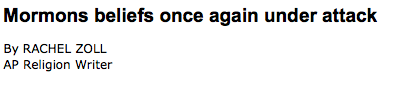
The religion beat apparently doesn’t attract many proofreaders, because we also have this headline:

Apostrophe, anyone? If “Mormons’ beliefs” takes up too much space, “Mormon beliefs” would also work.

Moving on . . . . What exactly is The Atlantic trying to say in this headline?

Are we looking for “Do Tax Cuts or Spending Cause the Deficit?” That version isn’t much better, however, considering the awkward combination of a plural noun (tax cuts) and a singular gerund (spending). The parenthetical “Or Both” doesn’t really work either; it’s a separate question, not part of the first. A suggestion for rephrasing: “Is the Deficit Caused by Spending or Tax Cuts? (Or Both?)”

The latest edition of Newsweek is an even more dismal production than usual. Perhaps all the copy editors got pink-slipped after the Daily Beast merger, because this article on the economic and political mess in Italy has more grammatical errors than a bad SAT essay:

Italians are no different from other nations: like squabbling families, whatever they may say about their faults, they deeply resent it when outsiders start to list them.

Italy may be no different from “other nations,” but the last time I checked, “Italians” were not a nation.

As recently as July, as the storm that is Greece spread through the Mediterranean, people hoped that the ill winds might do Italy some good. . . .

Granted, the writer is speaking metaphorically, but the so-called “storm” is Greece’s debt crisis, or possibly the shakiness of the Greek economy, not Greece itself. No one has spotted bits of Greece drifting around the Mediterranean. (Then again, Crete making an appearance off the Italian coast would certainly be news.)

Italy’s real economy, they protest, is even today far healthier than Spain’s, which has huge private as well as public-sector debts, banks that are badly compromised by its massive property bubble, and more than 20 percent unemployment.

Again, a modifier problem. A country can have “huge private as well as public-sector debts,” but an economy cannot. The subject of the clause about debt is “Spain’s” (shorthand for “Spain’s economy) when it should simply be “Spain.” It doesn’t make much sense to say that Spain’s economy has massive debt or at-risk banks, but by beginning the sentence with “Italy’s real economy,” the writer is forced into an awkward parallel.

Stay tuned for more carping about petty style mistakes. The media will never be perfect, and I will certainly never run out of things to whine about.


A Sad Story, Badly Told

11 09 2011

What is it about momentous occasions that brings out the Edward Bulwer-Lytton, of “It was a dark and storm night” fame, in reporters? Maybe it’s tacky to grumble that the articles about the 9/11 anniversary are poorly written, but I’m lodging a complaint anyway. The Associated Press offers multiple takes on the anniversary, as if to give its network of newspapers several options: maudlin, saccharine or lugubrious. I find it insulting that the AP thinks this sort of high school essay writing appeals to the average American. It smacks of what conservatives call media elitism, because it presumes that the only way readers will grasp the significance of a situation is to bang them over the head with it. It offends my intelligence in the same way that laugh-track sitcoms that crack stale, misogynist jokes offend my intelligence. Just as Hollywood assumes no one will pay to see a thoughtful movie about real people, but will fork over eight dollars to watch a cariciatured romp-fest, the AP assumes that its readers will choose melodrama over straight news.

There is nothing particularly unusual about the writing style on display in the AP’s 9/11 stories. Far too many of the news service’s articles are almost willfully bad, in that there is no real excuse for the overly colloquial, casual language. It does not come off as rushed or written on deadline, as one might expect from a wire service. I could understand if the sentences were hastily composed or the metaphors slightly mixed, but that isn’t the problem. The reporters choose their words carefully; it’s just that they choose the wrong ones. Still, the AP’s 9/11 reporting is especially bad. The melodramatic tone suggests that the only way to commemorate a tragedy is through weeping and gnashing of teeth. It is a mistake to assume that a slew of colorful adjectives is the only way to telegraph sincerity or grief. Other publications — the Times, to cite my personal favorite — have produced authentic, compelling 9/11 stories that are vastly more moving than the AP’s stylistic glop. There is a place and time for dramatic devices like repetition; that time, as Tom Junod’s “Falling Man” article proves, is after the author has spent six pages proving he can write. In other cases, Junod is a notorious abuser of repetition — see his 2011 profile of Pixar chief John Lasseter — but by the end of the wrenching 7,000-word “Falling Man,” he has earned his sign-off: ” . . . We have known who the Falling Man is all along.” The AP, by contrast, has done nothing to justify these opening lines:

At churches, we prayed. At fire stations, we laid wreaths. At football stadiums, hands and baseball caps over hearts, we lifted our voices in song and familiar chants of “USA!” – our patriotism renewed once more as we allowed ourselves to go back in time, to the planes and the towers and the panic and the despair, to the memories that scar us still.

Not only does the writer begin the first three sentences with “at,” but she subjects us to “the planes and the towers and the panic and the dispair” as well. Pick one, please. I don’t doubt that the reporter was sincere in her desire to convey the indelible nature of the memories, but the result is overdone and exhausting to read. Just two paragraphs later, the rhythmic list-making returns, as we are told of gatherings “on small-town main streets and in courthouse squares, in big-city parks and on statehouse steps.”

Another article begins with a smattering of descriptions that sound just slightly off:

Determined never to forget but perhaps ready to move on, the nation gently handed Sept. 11 over to history Sunday and etched its memory on a new generation. A stark memorial took its place where twin towers once stood, and the names of the lost resounded from children too young to remember terror from a decade ago.

The nation “gently” handed the day over to history? Its memory was “etched . . . on a new generation”? You can etch a memory into someone’s mind, perhaps, but on an entire generation? There’s nothing explicitly wrong with this sentence, but it sits awkwardly on the page, like a chair with one leg an inch too short. Likewise, the image of names “resound[ing]” from children” doesn’t quite work. The whole paragraph is an exercise in overwriting.

The AP article that my local newspaper chose for today’s front page includes the following:

Close your eyes and picture Sept. 11. The memories are cauterized, familiar forever. The second plane banks and slides in, the fireball blooms, the towers peel away as if unzipped from the top . . . . No one knew exactly what was happening, or how vast, or at whose hand. No one knew, for a time, that the instruments of destruction were not prop planes but jumbo jets. At the very first, almost no one knew there were planes at all.

September 11 isn’t an event that requires embellishment or fancy language. What the AP reporters don’t seem to realize is that the story is horrific enough to stand on its own. Joe Biden once accused Rudy Giuliani of composing sentences from “a noun, a verb and 9/11.” In some cases, that simple noun-verb formula may not be such a bad idea.

To be fair, the AP isn’t the only media outlet guilty of melodrama. Even the vaunted Gray Lady ran a column on September 6 by Roger Cohen that contains some pretty purple prose. Describing the post-9/11 era, Cohen writes:

Irresponsibility was allied to conviction, a heinous marriage. Self-delusion is the mother of perdition. Wars killed. Wall Street made killings. “Whatever” became the watchword of maxed-out Americans; and in time things fell apart.

Scan the rest of the column and you’ll encounter “scurrilous imaginings,” “kleptocratic tyrannies” and ” inexorable currents of history.” That’s quite a mouthful. If you’re looking for SAT-prep words, Cohen is your man.

Not all of the 9/11 coverage was poorly written. It’s just a shame that the AP, which provides content to newspapers across the country, didn’t hold itself to higher standards.


Best. Headline. Ever.

8 09 2011

From a headline on an AP article in the local paper:

“Obama has few job options.”


The subhead makes it clear that the story is about the limited impact any jobs proposal will have, but I suppose even Obama worries what will happen if he’s not reelected. Maybe Bill Clinton has an opening at his foundation.


Review: An Imperfect Novel

3 06 2011

Read the words of praise — the Times calls it “spectacular” and the Seattle PI dubs it “magnificent” — on the cover of Tom Rachman’s novel, The Imperfectionists, and you’ll begin to wonder how far our of context they were taken. It’s a bit like the P.R. for a movie like “Speed 2”; the poster says it’s “an action-packed thriller” but neglects to include the rest of the review, which may go something like this: “It could have been an action-packed thriller, but instead ‘Speed 2′ lumbers along like a cruise-ship passenger at the buffet.” Perhaps the Times had really meant to brand Rachman’s book “a spectacular failure”?

No. What the Times’ Janet Maslin really had to say was, ” Mr. Rachman’s transition from journalism to fiction writing is nothing short of spectacular.” She goes on to call the book “a splendid original, filled with wit and structured so ingeniously that figuring out where the author is headed is half the reader’s fun.” One wonders if Maslin was more taken with the detailed, cynical descriptions of the newsroom than with the literary merits of the novel. The Imperfectionists is neither original nor ingenious, unless a compendium of interwoven short stories is your idea of original. The structure, much-used of late and crafted with defter hands by Jennifer Egan (A Visit From the Goon Squad) and Elizabeth Strout (Olive Kitteredge), is hardly anything new. Yes, the vignettes hang together nicely, as each takes a character from the never-named paper (another annoying Rachman tic) as its narrator; and yes, the stories are “unified by an overarching tone” that Maslin identifies as “filled with bonhomie but is punctuated by tough, wrenching flourishes,” but Rachman’s prime achievement is confirming that there truly is nothing new under the sun.

The “wrenching flourishes,” also characterized as “firecracker bang[s] of discovery” by Christopher Buckley in the Times’ Sunday Book Review, are in fact rather pat twists in the stories that in no way put Rachman in the leagues of Roald Dahl or O. Henry, two wonderful writers to which he is compared. Each story in The Imperfectionists is so short and the characters so cursorily sketched that these so-called twists elicit nothing more than an idle “ho-hum.” The paper’s financial officer, stumbling into bed with the ex-employee whose firing she orchestrated, plopped as vulnerably and mercilessly on the mattress as a piece of meat, hears the man’s voice go cold:

“One small thing.” His eyes track down her her body. He proceeds, “Tell me this, Accounts Payable.”She freezes at the name.”Why,” he says, “why of all the people there, Accounts Payable, did you go and get me fired?” He stands at the foot of the bed, staring. “So?” he says. “Explain me that.”

The ending is indeed unpredictable, but it is hardly astonishing enough to be labeled a “firecracker.” Likewise, in another story, when the news editor calls his unfaithful wife’s hotel room to apologize for booting her out of the house, the revelation that the person who answers the phone is not his wife — “It is a man’s voice. It is Paolo.” — is hardly a shocker on the level of Roald Dahl’s “The baby is perfectly healthy . . . Frau Hitler.”

The Times review makes much of the way the vignettes’ titles, headlines from the paper such as “U.S. General Optimistic on War,” subtly play out in the narratives. The parallel between “U.S. General” and the paper’s editor in chief, however, strike me as neither subtle nor especially inspired. Buckley claims that the book is “so good I had to read it twice simply to figure out how he pulled it off.” No shabby writer himself, Buckley seems to be resorting to massive hyperbole. It’s not that The Imperfectionists is a bad book; rather, it is simply unremarkable. The reader is left to wonder what exactly Rachman pulled off, and whether he or she has failed in a reader’s duty to appreciate top-notch literature.

The unavoidable conclusion, however, is that The Imperfectionists is more an average, middling novel than a supernova of a debut. Publishing must be in a pretty sorry state if writers like Rachman are compared to “those masters hanging in the museums of Rome” (The Plain Dealer). Rachman certainly has insights into human character, but he spends so little emotional energy on each newspaper staffer that the reader hardly has enough invested in the story to raise an eyebrow at the twist of the ending. Perhaps the betrayal of the news editor’s wife would pack more of a punch if the editor were more than another member of the troupe of narrators that parades in and out of the book’s pages. But Rachman has miles to go before he sleeps, and more points about human foibles to make, so he barrels on, abandoning the hapless news editor save for a few cursory appearances in later chapters.

The greatest sin of The Imperfectionists, it turns out, is not that it is an easily forgettable book. It is that the reviews — “finely wrought” and “occasionally breathtaking,” trumpets the Financial Times — provoked more outrageous emotion than the book itself.


Design a site like this with WordPress.com
Get started