* All right, not everyone — just everyone not CC’d on the latest GOP talking points.
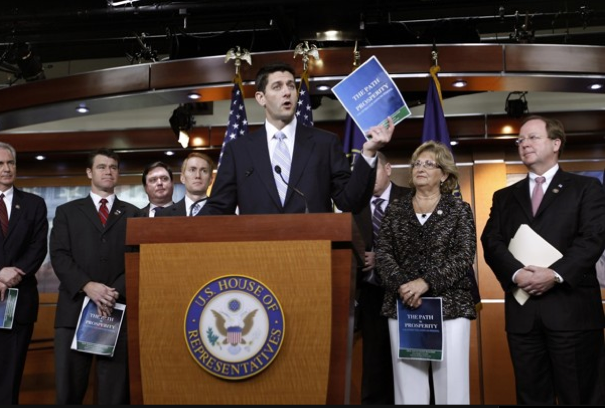
Paul Ryan at the press conference for "The Path to Prosperity" (Jose Luis Magana/Reuters via WaPost)
The only thing surprising about Paul Ryan’s budget plan was how much discussion it generated, considering how little substance it contained and how marginally it differed from last year’s “Path to Prosperity.” Like President Obama’s budget proposal, which was larded with provisions — the so-called “Buffett Rule,” a rollback of the Bush tax cuts for the rich — that will never fly in Congress, Ryan’s plan has a snowball’s chance in Hell of becoming law. It’s a political document, not a serious stab at governance, and the consensus on the left — outlined below, as people far more informed than myself have already skewered the thing — is that it fails even as a campaign tool.
For a party hooked on the fallacious comparison of the federal government to a family needing to tighten its belt, any family that budgeted by Ryan’s logic would be out on the street pretty quickly. Ryan pays for specified reductions in tax rates with unspecified “savings” gleaned from repealing various exemptions that he declines to name, which is like saying you’ll make up for losing your part-time job by vaguely instructing your kids to spend less at the mall. The plan “vows to balance tax cuts for corporations and the rich by closing loopholes, but never lists the loopholes,” according to a New York Times editorial, which goes on to say that “it is, however, quite specific about cutting Medicaid by about 45 percent, leaving 19 million people without care, and eliminating plans to provide health insurance for 33 million who lack coverage now.” Presumably Ryan would do away with popular tax breaks like those for employer-sponsored health insurance and the home mortgage deduction, but not even a Republican hell-bent on deficit reduction will risk hitting voters in the checkbook during an election year.
The scariest aspects of Ryan’s budget are described best not by the hyperventilating of liberal pundits but by the critical drubbing the plan receives from the Washington Post editorial board, which normally beats the drum about the dangers of deficits. “There is no credible path to deficit reduction without a combination of spending cuts and revenue increase,” the Post writes, and Ryan fails miserably on the second half of the equation. The ed board continues:
As the Congressional Budget Office’s analysis finds, by 2050 his budget would reduce federal spending for everything besides Social Security, health programs and interest payments to less than 4 percent of the gross domestic product, down from 12.5 percent in 2011. Since, as the CBO notes, “spending for defense alone has not been lower than 3 percent of GDP” since World War II, and Mr. Ryan wants to increase defense spending, there would be essentially nothing left for the rest of government — nothing for education, for highways, for veterans, for low-income families, for the FBI.
“Draconian” is perhaps too kind an adjective here. Left-wing blogger Greg Sargent observes that “Ryan’s long term proposal would basically shut down the federal government except for Social Security, Medicare and Medicaid, and the military. Republicans don’t really want to shut down the FDA, the FBI, and the national parks, not to mention patrolling the border and farm programs and roads.” This, I think, is an overly generous interpretation. Plenty of Republicans, including Grover Norquist and everyone at the Club for Growth, would love to see the end of the FDA and the FBI, along with however many cabinet departments Rick Perry can come up with at the moment. The New York Times is also generous in noting that “to get the budget balanced, Mr. Ryan is counting on the government shrinking to levels not seen since the beginning of World War II.” It’s slightly misleading to credit Ryan with balancing the budget, considering his plan doesn’t do so for 28 years — in 2040. He’s not balancing the budget on the back of the poor; he’s handing an extra $150,000 a year to the rich on the backs of the poor.
Indeed, despite the focus on Ryan’s proposal to reshape Medicare, the elderly are not the ones hit hardest by the GOP’s budget math. Ezra Klein sums up the effect of the budget in one sentence: “Ryan’s budget funds trillions of dollars in tax cuts, defense spending and deficit reduction by cutting deeply into health-care programs and income supports for the poor.” The key phrase here is “the poor,” as Klein points out that Medicare spending is only cut by around $200 billion. Given that Ryan anticipates $2 trillion less in revenue and $3 trillion in deficit reduction, he must find savings somewhere else, and “the cuts to programs that mainly help the poor are correspondingly deep. The $1.5 trillion the Affordable Care Act was going to spend on subsidizing health insurance for low-income Americans is gone. But then Medicaid and other non-Medicare health programs take an $800 billion cut on top of that. Education and worker training loses $200 billion. Income security loses $800 billion. These are huge cuts.”

Photo via The Atlantic; chart by Reuters
The real story, then, is the amount the Ryan plan would slash from Medicaid. The New Republic’s Jonathan Cohn explains why turning Medicaid into a block grant (or “sending it back to the states,” in Ryan-speak) is so dangerous: Currently, Medicaid “guarantee[s] insurance coverage for everybody that meets eligibility standards.” Ryan would “simply write checks to the states, for predetermined amounts, and let them figure out how best to spend the money. To generate the savings his budget needs, he’d reduce the value of those grants over time, relative to health care costs and current projections.” With fewer dollars, states would restrict eligibility or deny eligible people coverage altogether, a scary prospect in places like Texas, where the cutoff for Medicaid is already set at 26% of the poverty level. That’s $4,964 a year for a family of three. I am usually skeptical of the hyperbolic language employed by columnists like Jonah Goldberg, who likes to characterize President Obama’s so-called “war on religion” and “assault on freedom” as “breathtaking.” But breathtaking is the only appropriate word for a state that would offer less assistance to families making under $5,000 a year. It’s the ultimate definition of kicking people when they’re down.
It’s no coincidence that Ryan’s budget treats the elderly with a light touch. The GOP wagers it can get away with such savage cuts to the safety net because the young and the poor are not exactly Republican constituencies in the first place. As groups, they don’t vote in high numbers in the first place. Ed Kilgore at the Washington Monthly observes that Ryan’s one concession to moderation, the inclusion of a traditional Medicare option (courtesy of my home state’s “useful idiot,” Ron Wyden) alongside the privatized voucher program he offered in last year’s Path to Prosperity, may make the plan more palatable to seniors, whose power at the ballot box is uncontested. The wealthy, of course, will make out like bandits under either version of the “Path.” The left-leaning Center for Tax Justice estimates that high income-earners would receive $4.3 trillion in additional tax cuts over 10 years. Kilgore writes that “if you want to know how Ryan’s proposal is likely to affect you without looking at a lot of charts or believing a lot of phony assurances, just ask yourself: are you part of a demographic or economic category that tends to vote Republican?”

The lineup at the Washington Examiner
Kilgore’s point is laid out more bluntly by Jonathan Cohn, who adds that “the Republican base these days is disproportionately white and old, which means it’s more willing to tolerate cut to programs that seem mostly to benefit non-white, non-old people.” It’s fitting, then, that Ryan introduced his budget in a speech at the American Enterprise Institute, to an audience that will likely never have to worry about getting kicked off the Medicaid rolls or applying for food stamps. Conservative opinion writer Michael Barone was at the event, and in his Tuesday column has the audacity to accuse Democrats of shrinking from Ryan’s supposedly “bipartisan” suggestions because “their eyes [are] always on the next election.” Reading Barone’s column on the website of the Washington Examiner, a right-wing newspaper, I couldn’t help but notice that the “Featured Writers” promoted on one side of the page epitomize the GOP’s demographic sweet spot. Is it politically incorrect to point out that there are apparently not a lot of “non-white, non-old” people shilling for Republicans at this particular publication?
By definition, budgets are documents filled with dry figures and dollar signs, though it doesn’t take a genius to conclude from Ryan’s numbers that he, like Mitt Romney, is “not concerned with the very poor.” (Case in point: Politico reports that “while extending the Bush-era tax cuts — including lower rates for capital gains — the budget does not do the same for the added tax benefits for the working poor, which Obama initiated in his 2009 stimulus package.) If any doubt remains, however, it can be dispelled by even the most cursory glance at Ryan’s remarks to the AEI. He speaks of the “insidious moral tipping point” at which people — presumably the “lucky duckies” too poor to pay income taxes — get more in government services than they pay in taxes. The social safety net “lulls able-bodied people into lives of complacency and dependency, which drains them of their very will and incentive to make the most of their lives. It’s demeaning.” Dana Milbank of the Washington Post rightfully works himself into a lather, writing that Ryan’s justification for shredding the safety net is “straight out of Dickens. He wants to improve the moral fiber of the poor.” Milbank continues:
How very kind: To protect poor Americans from being demeaned, Ryan is cutting their anti-poverty programs and using the proceeds to give the wealthiest Americans a six-figure tax cut.
I’m with Milbank on this one. To channel Rick Santorum: Ryan’s paternalistic, patronizing blather makes me want to throw up. That Ryan refuses to own up to his low regard for the poor is particularly nauseating; at least other conservatives, namely the shrill folks at the National Review, are honest in their nastiness, coming right out and proclaiming that “the half that pays no federal income taxes likes the current sponge-and-freeload system.” (Social Security taxes, Medicare taxes, local taxes — apparently someone who pays all these is still a sponge.) Ryan, on the other hand, maintains a veneer of piety, writing in an op-ed for the Wall Street Journal that his budget “strengthens the safety net by returning power to the states, which are in the best position to tailor assistance to their specific populations.” This reference to block-granting programs like Medicaid, unemployment benefits and food stamps spurs Slate’s Matt Yglesias to plead for an end to the double-speak. Yglesias, who likes to remind us that Ayn Rand’s Atlas Shrugged is required reading for Ryan’s staffers, cuts through the crap: “Ryan doesn’t like taxing the wealthy to give resources to the poor and disabled, so he proposes to give fewer resources to the poor and disabled.” It really is as simple as that.
Ryan has been warning against “complacency and dependency” for quite awhile; the language is taken almost verbatim from his 2011 response to the State of the Union. At the time, he cautioned against “transform[ing] our social safety net into a hammock, which lulls able-bodied people into” — wait for it! — “lives of complacency and dependency.” For all of Ryan’s reductions to Medicaid, however, anti-poverty programs are not the drivers of government expansion; they’re simply a convenient checking account from which to finance tax cuts and deficit reduction. As Milbank’s Post colleague Matt Miller asks pointedly, “what hammock is Ryan talking about? The only thing slated to grow the size of government in the years ahead is the retirement of the baby boomers. The doubling of the number of people eligible for Social Security and Medicare is what is driving all the increase in federal spending.” This leads Miller to draw attention to the obvious flaw in Ryan’s logic:
If those programs for seniors haven’t been a “hammock” until now, simply doubling the number of people eligible for them can’t turn them into a “hammock” tomorrow. When it comes to fiscal policy, we have an aging population challenge, and a health-cost challenge. We don’t have a “hammock” challenge.
What we also have, according to Miller, is an excuse to carry out Paul Ryan’s real goal of shrinking government. Ryan doesn’t care about fiscal sanity; he cares, a la Grover Norquist, about making government weak and small enough to drown in the bathtub. By feigning concern about the national debt and runaway spending, Ryan paints himself as a fiscal conservative. But “a fiscal conservative pays for the government he wants. Ryan wants government smaller than the one Reagan led even as America ages, and he doesn’t want to pay for it.” Ryan actually prefers deficits — remember, he doesn’t balance the budget until 2040 — to raising taxes by a single penny.
Miller’s final assessment of the “Path to Prosperity” offers a real path forward for the rest of us, and a good end to this roundup of Ryan-bashing: “The first order of business is to expose Ryan’s overall plan for the misguided, misleading and unacceptable vision it represents.”
Amen.
 . . . So Well Read. . .