Only You Can Prevent Dictionary Abuse

2 02 2013

ImageThink grammar is for fuddy-duddies, dictionaries are only used by people who can’t grasp Wikipedia, and the difference between “its” and “it’s” will never change your life? Well, you may be right. But don’t write off the nuances of the English language just yet. Or at least read this Atlantic piece from Garrett Epps (whose work you should always read, and not just because he happens to be the father of my childhood best friend) before you do. Writing about the recent circuit court decision that invalidated President Obama’s recess appointments to the National Labor Relations Board and the Consumer Financial Protection Bureau, Epps describes exactly how the justices came to their decision — and how another panel of judges came to one precisely the opposite. It’s a case study in the continued relevance of words and their meanings.

The ruling by the D.C. Circuit Court of Appeals was sweeping; it went beyond simply rejecting the president’s power to appoint officials during “pro forma” (read: fake) sessions of the Senate, a power which Obama had used to install nominees that Republicans, hostile to the sheer existence of the labor board and the consumer bureau, refused to confirm. Instead of ruling narrowly, the justices tackled a question that hadn’t even been asked, and decided that the Constitution not only prohibits the president from appointing officials when the Senate is officially in session (and thus ostensibly able to carry out its duty to “advise and consent”) but also limits appointments to the single recess between congressional sessions, theoretically invalidating hundreds of years of appointments that occurred during inter-session breaks. Going even further, the court ruled that the positions in question must actually come open during the recess; the president can’t use a break to fill previously vacant posts. Though this all sounds like ivory-tower thought games, it has real world consequences: If you’re a homeowner trying to get a mortgage, the disclosure requirements laid out by the CFBP are now up in the air. If you want to take your boss to court for stinting on your paycheck or sacking you for an errant Facebook post, your case may now rest on fuzzy laws.

So where does good English fit into all this? As Epps writes, it all hinges on the word “the.” The clause in the Constitution allowing recess appointments dictates that”[t]he President shall have power to fill up all vacancies that may happen during the recess of the Senate.” The D.C. Circuit is stacked with justices who, in the strict originalist mold of Antonin Scalia, make decisions by parsing every word and intention (no matter how ultimately unknowable — really, what would Thomas Jefferson have thought of violent video games?) of the Founders, and they wondered: Does the word “the” in “the recess” restrict appointments to “the one and only recess between sessions of Congress? How did the justices decide? They consulted 1755 edition of Samuel Johnson’s Dictionary of the English Language, whose entry for “the” is short and sweet: “The, article, denoting a particular thing.” Epps explains:

“The recess of the Senate,” therefore, must mean one and only one “recess” per Senate — the unique one between sessions. To any living speaker of English, the word “the” can also denote one instance of a recurring but definite phenomenon. Thus, for example, when someone speaks of “the hours of darkness,” very few of us would interpret those words as referring to the one night of the year when darkness would be longest.

Yes, making monumental legal decisions by thumbing through a period dictionary does seem like a cop out. It is indeed too clever by half. But the truly ridiculous thing is that another court, the 11th Circuit, also used a dictionary — a different dictionary — in 2004 to draw a completely opposite conclusion about the recess clause. Epps again, writing about the 11th Circuit case:

In Evans v. Stephens, that panel wrote, “We do not agree that the Framers’ use of the term ‘the’ unambiguously points to the single recess that comes at the end of a Session.” It drew its evidence from the Oxford English Dictionary.

OED, written over the past century and a half,is the most complete historical dictionary of the language ever assembled; it draws on examples of usage dating back before 1000 C.E. Its entry on “the” is nearly 10,000 words long (Johnson’s, remember, is six). Here’s the relevant language: “Referring to a term used generically or universally,” as in “the pen is mightier than the sword,” or “with names of days of the week, as on the Monday, i.e. on Monday of any or every week, on Mondays generally.” The entry includes examples of that usage going back to 1340.

Why was the OED not good enough for the D.C. Circuit? Because, it seems, the OED — which has been cited by faithful Supreme Court originalists for decades when it suits them — is a “modern dictionary.”

And you thought that dictionaries were going the way of the phone book!

Epps sees a greater problem here than overuse of reference materials. The contrast between the decision only highlights the flaws in the rigidity of the originalist cause. There is a certain nonsense and refusal to deal with the world as it is in “the idea that one judge can somehow know the ‘real meaning’ of a provision enacted centuries ago, in a world as alien to ours as Narnia.” He continues: “Evidence from the period when a constitutional provision was framed is always relevant to a judicial decision. But so are subsequent caselaw, interpretation by other branches, and simple practicality.”

It turns out, however, that the dictionary has a certain pedigree in the judicial system. Courts have been relying on the old door stop stand-ins for years. An amusing New York Times article from two years ago describes the proliferation of dictionary-reliant Supreme Court decisions:

A new study in The Marquette Law Review found that the justices had used dictionaries to define 295 words or phrases in 225 opinions in the 10 years starting in October 2000. That is roughly in line with the previous decade but an explosion by historical standards. In the 1960s, for instance, the court relied on dictionaries to define 23 terms in 16 opinions.

To cite the example in the Times’ lede, Chief Justice John Roberts used five dictionaries to examine the nuances of the word “of” when he pondered over a patent case. In 2011, to find a precise definition of “prevent,” Stephen Breyer turned to none other than the OED, and in 1995 staunch originalist Clarence Thomas looked up the word “commerce” in three dictionaries — from 1773, 1789 and 1796 — as he puzzled through what the framers may have been thinking.

The article notes that Learned Hand, who is “widely considered the greatest judge never to have served on the Supreme Court,” did not have kind words for dictionary thumpers, writing in 1945 that:

It is one of the surest indexes of a mature and developed jurisprudence not to make a fortress out of the dictionary, but to remember that statutes always have some purpose or object to accomplish, whose sympathetic and imaginative discovery is the surest guide to their meaning.

Lexicographers are not huge fans of this development either, and it’s not hard to see why. “The justices have cited more than 120 dictionaries, which is suggestive of cherry picking,” the Times writes, and quotes the editor- at-large of the OED as saying, “It’s easy to stack the deck by finding a definition that does or does not highlight a nuance that you’re interested in.”

How true.

Language-lovers and grammarians fighting against the perceived irrelevance of their field may be heartened by such evidence that dictionaries really are a Higher Power. But like all magical instruments, from the Force to the wand wielded by Harry Potter, they should only be used for good, never evil. I’d like to plaster a bumper sticker on the cars of the D.C. Circuit Court members that reads “End Dictionary Abuse!” And I would certainly classify overturning centuries of precedence and infringing on reasonable executive powers as abusive.

It’s enough to make you wish that judges only cracked the Webster’s for benign purposes, like differentiating between, oh, say, “loath” and “loathe.” Because, in a delightful twist of irony, The New Republic reports that the D.C. Circuit’s decision used the wrong form, writing that “We are loathe to overturn the credibility determinations of an ALJ unless they are ‘hopelessly incredible, self contradictory, or patently insupportable.'”

Now that is what a dictionary is good for.


Correction Appended

27 12 2012

As 2012 draws to a close, the media’s “best of the year” roundups spread like kudzu. Top ten (or fifty, or hundred) lists offer journalists a chance to pat themselves on the back, but self-congratulation is in store for overserious readers as well. Who doesn’t like to pretend she read every word of the New York Times expose on corruption in China, or cried real tears at the inspirational National Journal tale of former presidents interacting with the author’s autistic son? Sometimes the worst is more interesting than the best, however. End-of-the-year rundowns of the media’s own gaffes offer a form of pleasure – schadenfreude – which is often much more enjoyable and genuine, if also more cynical, than appreciation. They also happen to be lot more light-hearted. There are lists of serious screw-ups, to be sure — CNN’s “oops” moment on the Supreme Court decision tops numerous listicles, and the “unskewed polls” guy surely warrants mention — but the smaller errors are just as entertaining.

Reuters media blogger Jack Shafer has no stomach for year-in-review packages in general. They certainly do seem to breed like rabbits; you’ll find everything from Businessweek’s “Worst CEOs of 2012” to Time’s super-comprehensive “Top Ten Everything of 2012,” which offers up 55 separate click-bait slideshows, on minutiae ranging from “Apologies” to “Marriage Stories.” (While visions of page-views danced in their heads . . . .) Shafer’s assessment is cutting but spot-on:

From their lazy fingers to your scratchy eyeballs, journalists are now transmitting their “year in review” articles and “best of 2012″ . . . . All the writer need do is drop it in the copy bank by the second week of December, pour himself an eggnog, and go Christmas shopping. The writer need not return any sooner than the first week of the new year. If real news breaks out in the interval, his editors can always run wire copy.

So am I going to let that deter me from supplying my own “Best Of” tally? Of course not. Instead of the wide-ranging grab bag that is the standard “Top Media Gaffes” roundup, however, let’s get more specific: Best Corrections of 2012. It’s a narrower but equally amusing category, though occasionally “corrections” also include non-corrections, given the way some organizations (cough, Fox) double down on inaccuracy and refuse to admit error. A few outlets, like the Economist (see below), even have a sense of humor in their mea culpas. It’s easy to take note of general media hilarity, like Karl Rove’s election-night meltdown, but in their straight-faced dedication to getting even the most banal facts right, official corrections are often the most endearing.

The Atlantic Wire recently compiled its favorite typos and goof-ups, starting with the Romney campaign’s notorious “A Better Amercia,” continuing to the well-trodden public/pubic mix-up (again? really?), and ending with some less interesting but deeply wonky New York Times corrections about star formation. The highlight, however, has to be this one, from the Toronto Sun:

torontosun

In the same spirit, Fox News gives us this:

illiterate

Poynter’s “Best (and Worst) Media Errors and Corrections of 2012” identifies some other knee-slappers. Foreign publications often take a much more light-hearted approach to amendments. Here’s the Economist:

Correction: An earlier version of this article claimed that journalists at Bloomberg Businessweek could be disciplined for sipping a spritzer at work. This is not true. Sorry. We must have been drunk on the job.

Also cited by Poynter is Vogue Magazine, which has been in the journalistic doghouse since running (and subsequently deleting from its website) an ill-timed puff piece praising Syrian dictator Bashar al-Assad and his wife, the so-called “Rose of the Desert.” The mistake just reinforces the not-entirely-inaccurate image of the fashion magazine as ignorant of anything beyond red-soled Louboutins and thousand-dollar T-shirts. Perhaps Vogue should take a break from writing about politics, as it “mistakenly identified” Assist Secretary of State Dan Baer as  “an interior designer.”

vogue

I can see cutting Van Meter some slack if Baer were, say, Secretary of the Interior. But seriously.

Jim Romenesko’s media blog recently flagged an error from an ABC News photo credit, later corrected, that would certainly make my end-of-the-year list. Pardon the creepy mug shot:

eerie

Yeah, face-biters are creepy, but the whole county? Try Erie County.

Just yesterday, Slate issued this correction:

In a Dec. 26 “Politics,” Neil deMause wrote that Cassie was studying to be a ultrasound stenographer. She was studying to be an ultrasound sonographer.

Wow, what was the ultrasound saying to Cassie? Did the fetus dictate a novel to her — perhaps My Life In Utero? Adventures in the Womb? Or maybe she was taking notes from a particularly loquacious heart murmur.

The Times’ corrections alone provide ample fodder to a cottage industry of holier-than-thou fun-pokers. Thus we have the list-topping Times clarification about My Little Ponies:

An article on Monday about Jack Robinson and Kirsten Lindsmith, two college students with Asperger syndrome who are navigating the perils of an intimate relationship, misidentified the character from the animated children’s TV show My Little Pony that Ms. Lindsmith said she visualized to cheer herself up. It is Twilight Sparkle, the nerdy intellectual, not Fluttershy, the kind animal lover.”

Also qualifying for aggregation website The Week’s “9 Most Hilarious NYT Corrections” is this one, referring to a suspect in the attack on the American consulate in Libya:

An earlier version of this article misidentified the beverage that Ahmed Abu Khattala was drinking at the hotel. It was a strawberry frappe, not mango juice, which is what he had ordered.

Terrorists like fruity drinks — who knew? Did Bin Laden relax with a Cosmo at the end of the day?

“Best Of” lists aside, the corrections pages are consistently amusing, even if the daily errors don’t rise to End of the Year status. It’s a coincidence that I started trolling the pages a few weeks before the Atlantic published their list, but it’s a convenient time to post a few of the more humorous (though hardly as epic as the My Little Pony correction) ones I came across recently.

The Times conjures up a strange image with this mistake:

An article on Nov. 25 about the artist Malcolm Morley, who has a new exhibition at the Parrish Art Museum in Water Mill on Long Island, misstated what kind of aerial battles he watched from the rooftops during the London blitz. He and his friends watched dogfights — not duck fights.

Another Times error, this one for an article about North Korea’s recent missile launch, brings to mind another country: Spain. Francisco Franco is still dead.

[The article] misidentified, in some copies, the North Korean leader who met a day before the announcement with a delegation sent by China’s new leader, Xi Jinping. He is Kim Jong-un — not Kim Jong-il, his father, who died a year ago.

Of course, the Times could have been thinking of another communist country, where being dead is no impediment to hanging around the capital city . . . .

lenin-corpse

Vladimir Lenin, dearly departed.

Then there’s this, from Dec. 10:

An obituary on Wednesday about Eileen Moran, a visual effects producer, misstated the name of a character she helped create for a series of Budweiser commercials. It was Louie the Lizard, not Larry the Lizard.

Ah. Louie, not Larry. Glad we clarified that crucial point.

It’s easy to taunt the Gray Lady, but the Murdoch Empire has faults as well, far beyond its frequent Fox News distortions of fact and manipulations of charts. (Most notorious: the unemployment-rate graph that seemed to show 8.6% as higher than 8.8%.) The Wall Street Journal, in its facts-be-damned crusade to “prove” that lowering taxes goose the economy, recently overstepped in a major way. Forbes blogger Timothy B. Lee made the initial catch, writing that “professional alarmist Peter Schiff takes to the pages of the Wall Street Journal to make the case that the income taxes in the 1950s weren’t as confiscatory in practice as their high top marginal rates might make them sound in theory.” Unfortunately, Schiff “mangles some key facts.”

Indeed. The correction is nearly as long as the article itself. Here are some of the passages in question, versus the revised sentences, which bring  to mind the innumeracy, much lamented by the editor of the Times style manual, that leads reporters to confuse millions and billions. (“We never say “one” if we really mean “a thousand.” So why, oh why do we so often say “million” when we mean “billion”? The magnitude of the error is the same — we’re off not by one consonant, but by a factor of 1,000.) Anyway, as Lee intimates, the original is much more alarmist:

In 1958, an 81% marginal tax rate applied to incomes above $140,000, and the 91% rate kicked in at $400,000 for couples.

The corrected version:

In 1958, an 81% marginal tax rate applied to incomes above $1.08 million, and the 91% rate kicked in at $3.08 million.

Hey, what’s a couple hundred thousand dollars? $140,000, $1.08 million . . . . it’s only a factor of ten! Given the WSJ’s constant insistence that no one making $250,000 (President Obama’s threshold for extending the Bush tax cuts) should count as “rich,” you’d think the editors would appreciate the difference. Ironically, the title of Schiff’s piece is “The Fantasy of a 91 Percent Top Income Tax Rate.” Yeah. A fantasy in more ways than one.

Other publications make errors yet never even bother to fix the mistakes, much less print actual corrections. Newsweek, with its infamous rejection of fact-checkers — “We, like other news organisations today, rely on our writers to submit factually accurate material,” said a spokesperson in reaction to Niall Ferguson’s widely panned story on President Obama — is a repeat offender. (Irony: A fact checker probably would have flagged that British spelling of “organization” as out of place for an American magazine.) The magazine admits to having no fact-checking department, but perhaps it should cop to firing its copy editors as well. In addition to running a premature and incorrect headline indicating that the Republican “Plan B” to avoid the fiscal cliff had passed the House, Newsweek compounded the error with a homophone confusion that would have earned a red check for a middle school paper. As the screenshot shows, the headline was later corrected, but the English-class goof never vanished from the website.

site

Sloppy.

Of course, sometimes there are good reasons for not issuing a correction. Unlike Fox News, which simply ignores requests (even requests from the California governor’s office!) for retractions, or Newsweek, which is increasingly staffed by bloggers for whom accountability is a foreign notion, most news outlets are fully aware of their faux pas. But they’re also aware that some mistakes are so gigantic and obvious that, well, who needs a correction to set the audience straight? Romenesko quotes one editor who, after penning his mea culpa, admits, “But everything just sounded like an excuse. And the truth is: There is no excuse.” The sin?

brattleboro

It doesn’t get more head-smackingly bad than that.

Or consider this Homer Simpson (“doh!”) moment, from a Tulsa TV station:

snot

Watch those runny noses, drivers.

So those were some highlights of 2012. While next year may not be quite as exciting — there is no Mayan apocalypse predicted for 2013 — it will surely have its share of silly media gaffes. Like a fruit-of-the-month club or a subscription to, say, Ceramics Monthly, mistakes are gifts that keep on giving.


Media Gripes: Yes, Details Matter

16 07 2012


The World Needs More Copy Editors

The conservative website Newsmax, whose mission statement possibly requires it to publish every inflammatory, derisive remark about “Obamacare” made by a right-wing politician, makes a particularly amusing slip in an article about Florida Sen. Marco Rubio’s response to the SCOTUS ruling. Ignoring for a moment the inaccuracy of Rubio’s “the IRS is coming!” rhetoric, I’m enjoying the irony of the following line appearing in a piece about health care:

These are things to talk about in a reasonable way, but we don’t have to sick the IRS on people in order to do that.

Yes, Obama is planning to sic the IRS on sick people.


My Compliments to the Copy Staff

Finding further schadenfreude in errors from the right-wing Internet universe, where the English-only crowd proves unable to use the English language correctly itself:

Warner, a former governor who remains the most popular statewide office holder in Virginia, was overtly complementary of the president, much to the crowds delight, even though he has in the past criticized Obama’s attacks on Romney’s tenure at the investment firm Bain Capital.

Did Warner and Obama wear matching suits too?


That’s a Downer

As a political commentator, Peggy Noonan draws a lot of mean-spirited laughter from the left. It’s not undeserved; she regularly projects her own feelings of “ennui” about the current campaign onto her Platonic ideal of “average Americans,” and the hagiographic tone she takes toward “job creators” is truly humorous. (Sample: local businesspeople are “surprised by their own passion” at the prospect of Condoleeza Rice as VP and “relieved, like a campaign was going on and big things might happen.”) Ed Kilgore of the Washington Monthly laces into Noonan’s latest claim that “Every voter in the country knows we have to get a hold of spending and begin to turn it around,” by remarking:

It seems that Peggy is saying every voter in the country thinks just like her. How’s that for some hubris? No “deep down in their hearts” qualifier, no hedging of bets on 100% omniscience about 100% of voters. Amazing.

That Noonan was a speechwriter for President Reagan makes this sort of writing, about the upward tick in Obama’s poll numbers, all the more cringe-worthy:

For the first time in months, the president looks like he’s on the Uppalator, not the Downalator . . . .

Is this the Wall Street Journal or the classroom blog of a third-grade teacher? I half-expect to see motivational kitten posters and gold stars affixed to the end of the column. If you want evidence that standards at the WSJ have slipped under Rupert Murdoch, look no further than Noonan’s descent into banality.


Manufactured Scandal

The Washington Examiner prides itself on exposing “corruption” in Obama’s sprawling socialist leviathan. And the president isn’t the only member of the Obama family held up for criticism; indeed, any item that mentions the First Lady garners an outsize number of comments (“Moochelle” appears to be a favorite epithet.) The ignorance of random readers can be excused; while it’s easy to laugh at comments about Michelle Obama’s lavish $20 million vacations, even upmarket papers like the NYT attract screeds about the way Citizens United is single-handedly destroying democracy and why Dick Cheney should be tried for war crimes. It’s harder, however, to be generous when actual reporters display a deficiency of logic:

President Obama’s Agriculture Department, which forms an integral part of First Lady Michelle Obama’s war on childhood obesity, announced it will provide a $25 million loan guarantee to support the manufacture of a sweetener used in soda pop beverages.

Myriant Technologies will use the loan guarantee to build a plant in Louisiana. “The facility will make succinic acid, which is used primarily as a sweetener within the food and beverage industry,” the USDA noted. Diet cola beverages in particular rely on succinic acids, according to the U.S. Patent and Trademark Office.

There’s a free-market argument to be made against loan guarantees in general. (And there’s even an argument to be made against the unambitious pet projects chosen by First Ladies.) But the writer accuses Michelle Obama of hypocrisy because her anti-obesity campaign somehow conflicts with support for artificial sweeteners . . . by a cabinet department over which she has no authority. Ignoring the fact that Secretary of Agriculture Tom Vilsack hardly runs financial decisions past the East Wing, is the Examiner really implying that zero-calorie sodas are a major driver of obesity? There’s some dubious research out there about diet drinks contributing to weight gain (though not necessarily obesity), but the Examiner doesn’t even try to bring that up. “USDA Hands Out Free Happy Meals” — now that’s a headline that could reasonably spark allegations of hypocrisy. But considering that the soda portion of the classic McDonald’s order (“I’d like a Big Mac, large fries . . . and a Diet Coke”) is hardly to blame for 300-pound teenagers, the “journalists” working for the Examiner should look for a more coherent way to smear the First Lady.


Freudian Slip in the Comments Section

As I said above, reader comments can’t be held to the same standard as articles by actual journalists. But I found this next slip amusing, especially considering how far the NYT has gone to inject its own bias into reporting of, say, the Citizens United ruling. (No, SCOTUS did not write “corporations are people,” though the idea is not exactly revolutionary.) If the Times’ newsroom can’t even bring itself to avoid the misconception that Citizens decision allowed a “tidal wave” of “secret donations,” what can we expect from the average reader?

After the Washington, D.C. budget diabolical earlier this year, while republicans decisions made decent folks angry by planting their backsides deep in the soil, it’s a wonder if our elected officials take their jobs seriously.

Leaving aside the odd image of politicians “planting their backsides deep in the soil” — are they digging in their heels or digging trenches with their rear ends?), “debacle” has morphed into “diabolical.” Please, tell us what you really think about Republican obstructionism.


Unfortunate Headlines

Bloomberg News gives this advice to the gowns-and-mortarboards crowd:

Grads: Skip the Bank Job, Join a Startup

A wise suggestion: The next Twitter, yes; felony record, no.


Even SpellCheck Should Have Caught This One . . . .

From a Newsweek subhead:

The chief justice proved that his court is more than an ideological rubber stamp, writes Robert Shrum. Plus, Howard Kurtz on how Roberts rised above partisanship and Obama’s big win.


. . . . But Someone Did Catch This One

A recent Politico headline about the Washington Post’s article on Mitt Romney’s legacy at Bain Capital:

WaPo will not retract ‘outsourcing’ story

Take a look at the hyperlink, which suggests that someone made a last-minute save:

http://www.politico.com/blogs/media/2012/06/washpost-will-not-redact-outsourcing-story-127466.html

What might the Post’s front page have looked like in that scenario?


Who Says Grammarians Don’t Have a Sense of Humor?

7 06 2012

My freshman-year journalism professor once called copy-editing “the most fun you can have with your clothes on.” While I don’t know if I’d go that far, I do know that the notoriously stiff Mitt Romney likely knows very little about fun or taking his clothes off. Maybe that’s why his campaign has a track record of embarrassing proofreading mistakes. (Of course, there’s also my theory that grammar and spelling are topics better suited to those commie liberal arts majors, who waste time in English courses and lamestream-media-endorsed J-school classes, than business students.)

First, there was the “America” oops moment. The official Romney iPhone app promised a better . . . Amercia?

Then the geniuses in Boston gave us a pre-Spellcheck update on the campaign’s Facebook page. “Mitt Romney’s graphics team misspelled (and randomly hyphenated) the words ‘sneak peek,'” the Atlantic Wire reported. Perhaps the millionaire candidate is hiding Mt. Everest in his brand-new car elevator?

In other Facebook news, “offical” Romney gear is also available, reported Mashable:

Today, the Romney folks misspelled “Reagan,” of all things, prompting this hilarious remark from New York Magazine’s Dan Amira: “For a Republican presidential candidate, that’s the worst word you could possibly misspell. Worse even than ‘America,’ the nation founded by Reagan in 1981.” From an Obama-bashing PowerPoint presentation developed for Romney bundlers — a group with more MBAs than English majors, I’d wager — by the campaign’s pollster:

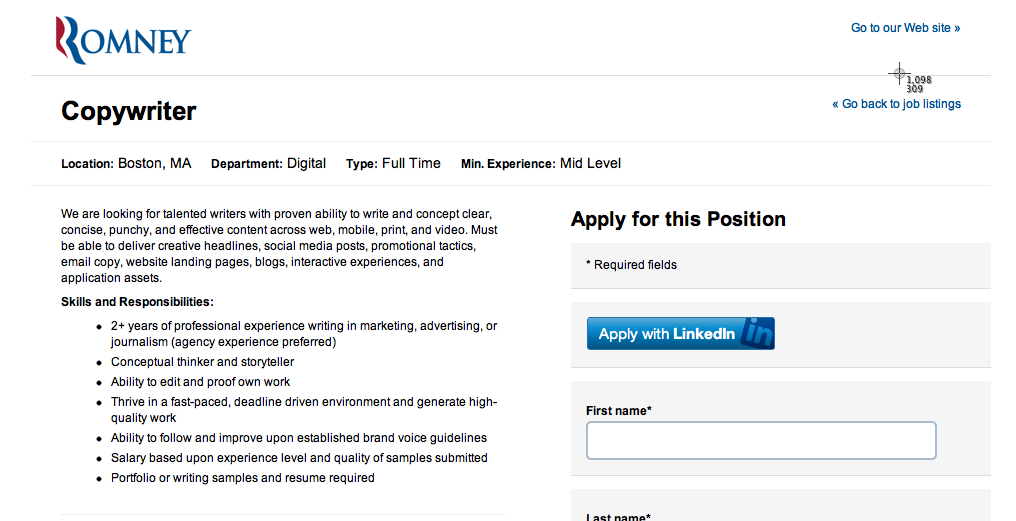
The clincher? New York Magazine’s politics blog offers a screen grab from the campaign’s LinkedIn page. Apparently, Boston is looking for a copywriter.

Grammar nerds, it doesn’t get any better than this.


Hey, They Can’t Revoke a Pulitzer

22 05 2012

Those who can’t do, criticize. With that in mind, the latest snark-filled edition of Media Malpractice (small-scale). Or, as Brad DeLong asks, “Why Can’t We Have a Better Press Corps?”

Yoda Joins AP Copy Desk

On the controversy over raising interest rates on student loans:

“Agree, they might, and act they surely will. But first, they settled effortlessly into a rollicking good political brawl.”

Politico, Your Hard-Hitting News Source

Politico takes a lot of heat for feeding off the 24-minute news cycle. Once upon a time, it was enough to win the day; now campaigns have to win the lunch hour. A fly lands on Joe Biden’s head during a speech? True story, and you’ll find the video here. In other breaking news: Massachusetts Senator Scott Brown, who has slammed challenger Elizabeth Warren for her Harvard-professor past, is exposed as  . . . a hypocrite?

Brown . . . has accepted $3,900 in campaign donations from eight Harvard employees in the first three months of the year.

Yeah, and Warren accepted donations from a teller at Bank of America! If this is the best argument liberals can find against Scott Brown, perhaps they should join up with the conservatives indignant that President Obama has savings account at JPMorgan.

NYT Automatic Linking Software Run Amok

Whatever program automatically generates informational links based on the text in the Times’ articles needs some tweaking. Health-related words tend to generate the most humor; click on “fever” in a phrase like “the excitement at the campaign rally was at a fever pitch” and the reader is unexpectedly routed to the Times Health Guide page describing a “temporary increase in the body’s temperature, in response to some disease or illness.” The latest winner, from a Q&A in the Fashion section offering advice on how to “tactfully” suggest a neck lift to one’s mother (my advice: don’t):

Finally! A mint (chocolate chip) reason for canning diets once and for all: our ensuing turkey necks. “Waiter, make mine a double scoop.”

Click on “canning,” and the reader is taken from wattles and “flappy skin” to the Times Topic page on “how to can, pickle and preserve foods, with recipes published in The New York Times.” Looking for “Green Tomato Chowchow” or a step-by-step on “marinated vegetables and quick pickles”? Well, you’re in luck!

Taglines “R” Us

Newspapers’ mission statements and catchphrases tend to be ripe for parody. Just think of all the variations on “All the news that’s fit to print” that have popped up over the years. Fox Nation, the sleazier offshoot of Fox News that patterns itself on the Drudge Report and Breitbart’s Big Government sites, characterizes itself thusly:

The Fox Nation is for those opposed to intolerance, excessive government control of our lives, and attempts to monopolize opinion or suppress freedom of thought, expression, and worship.

At first glance, am I the only one who reads this sentence as a parallel construction between “is” and “attempts”? Under this interpretation, the tagline breaks down into two descriptions of Fox Nation: 1) It is for those opposed to intolerance and 2) It attempts to monopolize opinion. True, but perhaps not exactly what the Murdoch minions intended.

The equally conservative Washington Times has a tagline of its own; someone at the paper has branded itself “The Official Newspaper of 2012.” Of course, there’s an official everything; the Superbowl has not only an official pizza sponsor (Papa John’s) but an official “payment service” (Visa). Who is selling the rights to the year 2012? And is the Times the official newspaper of the entire year, or does “2012” just refer to the presidential election? Given the Times’ penchant for breathless, conspiratorial reporting — Obama is an “arbitrary tyrant” who is “making good on his central promise: the destruction of our constitutional republic” — I suspect it is also the official paper of the 2012 Apocalypse. As Harold Camping and the ancient Mayans knew, the end times are near, and the Washington Times intends to be first in line to sponsor them.

Keeping It in the Family

NYT Editor in Chief: “For God’s sake, find the Sulzberger kid something to do in Kansas!”

Like this?

From Eudora, Kansas, cub reporter A.G. Sulzberger covers the day’s urgent news: “The sight is a familiar one along the dusty back roads of the Great Plains: an old roofless silo left to the elements along with decaying barns, chicken coops and stone homesteads . . . . Across a region laden with leaning, crumbling reminders of more vibrant days, some residents have found comfort in their unlikely profiles.” The article wraps up with one farm resident eyeing the green shoots emerging from his silo. “And on this day, he marveled that the tree had finally emerged from the top of its concrete incubator to stretch its branches above the derelict family farm.”

Eh. It’s eloquent, I suppose, but I don’t see your average new Times hire getting paid to write puff pieces on the midwest.


Is Grammar a Liberal Art?

I’m always game to smugly highlight the grammar and copy-editing errors that clutter online news stories, but it’s especially fun when conservative outlets, with their irritating certainty of their superiority over the “lamestream” (read: legitimate) media, goof up. To wit:

Fox News, which has the nerve to run pieces by Chris Stirewalt at straight news items (sample line: “But Obama can count on the establishment press helping him with his preferred narrative for the election”), gives us this head-scratcher:

Better still, Romney’s negative rating is lower than Obama’s – 46 percent to 41 percent.

Even in Rupert Murdoch’s universe, I’m pretty sure 46 is not lower than 41.

*****

Jay Ambrose writes for the OC Register. If you’re wondering about the paper’s political leanings, just know that, yes, “OC” is short for “Orange County” — prime Ronald Reagan real estate. Ambrose warns that Reagan’s free-market utopia is slipping away:

Europeanizing America: More Debt, Less Jobs

Those evil Europeans, some of whose ancestors invented the English language, would at least know enough to tell you they have “more debt,fewer jobs.”

*****

An article in the right-wing Washington Examiner describes Speaker of the House John Boehner’s determination to turn any increase in the debt limit into another hostage situation:

Congressional Democrats quickly refuted the Republican leader for reviving demands that nearly shut down the government last summer and eventually lead to a downgrading of the nation’s AAA bond rating.

Rebuked, maybe. Reproached, possibly. Reproved . . . well, that’s sort of a stretch. But “refuted” is definitely not the word reporter Susan Ferrechio was looking for. Ideas and claims can be refuted; people cannot.

*****

Newsmax, the ultimate new media source for Republican conspiracy theories, plays fast and loose with facts, grammar and standard English in a story about Obama’s poll numbers:

The president fairs slightly better on the auto industry loans, getting 50 to 43 percent approval.

Fares. This is why your sixth-grade teacher warned you against relying on Spell Check.

*****

In a piece slamming Georgetown University for the sin of inviting HHS Secretary Kathleen Sebelius to give the commencement address, the folks at the American Spectator show just how intellectual they are:

It is not just the defense of the invitation by DeGioia that raises the issue of his fitness to continue as president; it is the intellectuall dishonesty represented by the above-described evasions of the truth.

Even Spell Check would have caught this one.

Celebrities Are Real People, Too

“Sarah Palin,” Fox News contributor.

There was something particularly hilarious about Fox News accidentally substituting a picture of Tina Fey in her Sarah Palin SNL garb for a shot of the actual Sarah Palin. But the fair-and-balanced network isn’t the only one fighting the blurry line between celebrity and reality. The Times makes its own gaffe while reporting on Facebook co-founder Eduardo Saverin, who recently renounced his U.S. citizenship. A recent post on the paper’s “Bits” blog included this correction.

An earlier version of this post included a photo published in error. It showed Andrew Garfield, the actor who played Eduardo Saverin in the movie “The Social Network,” not Mr. Saverin himself.

More or less egregious than the Fox News switch? Well, at least the Times never employed Eduardo Saverin.

Saverin (left) and Garfield (right)Oops.

Fey (left) and Palin (right)


The Best and the Rest

6 12 2011

I haven’t stumbled across any excitingly egregious language bloopers lately, but there have been some highlights . . . as well as some low points. Here’s a roundup of the most memorable.

This Times headline ostensibly refers to the airline, but it’s a nod to the broader geopolitical situation as well. American is to Southwest and JetBlue what America is to China and India.

Once on Top, American Now Fights to Keep Up.

Usually I dislike both puns and the Wall Street Journal, but this headline about factotum-finding websites like Task Rabbit and Mechanical Turk amused me. Anyone willing to milk the cow for $5.00?

Serfing the Web: Sites Let People Farm Out Their Chores.

The reader comments on most websites are a mixture of partisan rants and ad hominem attacks, but this clever gem from the Washington Post is an exception to the rule:

Matt Haig’s The Radleys, a novel about a vampire family passing as everyday folk, serves up a great description of a small British town:

On the map, Bishopthorpe resembles the skeleton of a fish. A backbone of a main street with thin little lanes and cul-de-sacs threading off to nowhere. A dead place, leaving its young people hungry for more.

Haig also provides a wonderfully physical characterization of the school bully:

Harper is actually Stuart Harper, but his first name fell off him in tenth grade, somewhere on the rugby field.

Newt Gingrich says a lot of questionable things, from condemning child labor laws to accusing President Obama of having an “Kenyan, anti-colonial” worldview. However, one recent remark is notable not only for its pompous ridiculousness but because its clumsy grammar suggests Gingrich was rooting out reds in the legislature. Watch out, Bernie Sanders!

“I helped lead the effort to defeat communism in the Congress.”

From a Times article on President Obama’s encouragement of the Arab Spring:

In so doing, the president opened up a litany of risks, exposing a fault line between the United States and the Egyptian military . . . .

A “litany” is not merely a series of things or a large amount; it implies a spoken list, a recitation or chant. The word’s out-loud connotation makes it a poor fit in this context.

There’s nothing particularly bad about the next sentence, but it stands out as a missed opportunity. From a Philadelphia Magazine profile of NBC Universal CEO Steve Burke:

And even when he’s at ease, he stands ramrod straight, hands on his hips, elbows out, a satisfied smile playing across his lips, like Superman observing a peaceful Metropolis from the top of some tall building – his resume fanning out behind him like a cape.

Burke, who became CEO after NBC Universal was purchased by Comcast, is tasked with revamping the company’s television and film brands. Painting Burke as a superhero conveys his success and power, but the image of a cape “fanning out behind him” brings to mind an even better image: an NBC peacock, splaying its feathers and puffing out its chest.

An AP article makes an entry-level editing error:

Public financing, which officially started in 1976, has been on the decline in recent years because of public disinterest and the massive infusion of private money into campaigns.

Recorded announcement: Disinterested = impartial. It does not mean “not interested.”

From an AP story about erstwhile presidential candidate and perpetual blowhard Donald Trump:

In a round of TV interviews, he blistered many of the GOP candidates, saying that former Massachusetts Gov. Mitt Romney “doesn’t get the traction” he needs to nail down the nomination.

Words can be blistering, and an encounter with a hot stove can blister skin, but can Trump blister a candidate? I vote no. The AP is notoriously overeager to create verbs out of other parts of speech; in a story about Black Friday shopping, one reporter writes that “cutthroat marketing has hyped the traditional post-Thanksgiving sales to increasingly frenzied levels.” There is definitely lots of hype surrounding holiday sales, and “to hype” can even work in the sense of “to promote,” but the idea of hyping a sale to a certain level of excitement strikes a discordant note. Likewise, “to blister” does not seem to be the verb the writer of the Trump story is looking for.


. . . The Bad . . .

27 10 2011

A roundup of this month’s best and worst (well, mostly worst) sentences. There’s nothing egregiously wrong with most of these examples; the problem hinges on a single word that doesn’t quite work the way the writer intended. They’re dissonant notes that don’t even require a copy editor to catch — a simple read-through from a fresh-eyed colleague would have sufficed. Today’s blunders come to us courtesy of the Associated Press, which has the dubious distinction of producing all of the following.

An attorney defending a man accused in a failed plot to bring down a U.S.-bound jetliner faces a tough task pecking away at the government’s evidence in a case where the suspect was captured in a snap.

Are we looking for “chipping away”? It’s one thing to choose colorful verbs; it’s another to reach too far in attempting to coin a cute new phrase. And if the suspect was captured in the act, why don’t we say so? “Snap” is unnecessarily vague.

 Eyjafjallajokul volcano . . . chugged ash all over Europe for several weeks in an eruption that local scientist Pall Einarsson describes nonetheless as “small.”

Another verb gone astray. Trains chug, volcanoes . . . spew. Dump. Scatter. Whatever the volcano was doing with its ash, it sure wasn’t “chugging” it.

There are 30,000 fewer federal workers now than a year ago – including 5,300 Postal Service jobs canceled last month.

If “canceled” is supposed to be a cute nod to the Postal Service (which cancels mail), it’s not working. By the time the reader makes the connection, awkwardness (who’s ever heard of a job being canceled?) has already set in.

Hardliners still want more punishment against Ahmadinejad for actions viewed as political hubris.

Can punishment be directed “against” someone? Reword: “Hardliners want to punish Ahmadinejad further for actions viewed as political hubris.”

In a rare political spectacle of a visiting head of state on a field trip outside Washington with the U.S. president, both sounding boosterish about American industry, Lee said the trade pact “will create more jobs for you and your family.”

Seriously? “Boosterish”?

Russia . . . sent two strategic bombers on a mission to circumnavigate the islands last month – a move seen as a test of the new government of Prime Minister Yoshihiko Noda, which had just been launched six days before.

Technically I suppose a government can be “launched,” but the odd word choice draws attention to itself and throws the reader.

Just to prove I’m an equal-opportunity critic, let’s end on an example from the Times. Proving that writing about humor is rarely humorous, the Times offers this awful mouthful of a title for an article on Chinese dissidents using jokes and cartoons to get around online censors: “The Dangerous Politics of Internet Humor in China.”

Ha. Ha. Ha.


The Good . . . .

27 10 2011

Here are my picks for this month’s best bits of writing.

In the New Yorker, Peter Schjeldahl, reviews a “Degas and the Nude,” a “wonderful and weird show at the Museum of Fine Arts in Boston.”

Viewing his work, we breathe the dizzyingly thin air on the snowy peak of the capital “A” in Art.

Paul Krugman, my favorite NYT columnist, apparently never sleeps: In addition to writing a twice-weekly column, he does Nobel Prize-winning work in economics and manages to update his blog five or six times a day. He is also an excellent writer who has come up with the best description of the federal government I’ve ever read. Pointing out that the money lost in the Solyndra debacle amounts to “a rounding error on a rounding error,” he writes that “the vast bulk of . . . spending goes to the big five: Social Security, Medicare, Medicaid, defense, and interest on the debt.” The clincher:

Your federal government is basically an insurance company with an army.

In an article in the UK newspaper The Guardian, author Will Self recounts his experience with a rare blood disease. The personal essay also delves into his history of intravenous drug use, and is far grittier than anything a U.S. paper would run. His language reflects his state of mind without being cutesy or using puns. He describes a skyscraper as

“. . . a vast hypodermic needle lancing up into the cloudy tissue of the sky.”

Adam Kirsch, writing on H.G. Wells in the New Yorker:

A malnourished childhood had left him short and slight, until he became short and stout with age.

Dan P. Lee’s article in New York Magazine describes Harold Camping’s life in the aftermath of the non-apocalypse. Two of his sentences stand out for the terrific, descriptive word choice:

The Bible is perfect—the literal word of God—infallible and utterly precise,” 89-year-old Harold Camping reminded them each weeknight, his slow, sonorous voice spilling from radios across the world.

At any minute, he was sure, trumpets would sound as Jesus Christ, flocked by angels, surfed the billowing clouds.

James Wood, writing in the New Yorker on Alan Hollinghurst’s novel The Line of Beauty, pairs an elegant sample of prose with his own analysis:

“Above the trees and rooftops the dingy glare of the London sky faded upwards into weak violet heights.” We can suddenly see the twilit sky of a big city afresh, and the literary genius is obviously centered in the unexpected strength of the adjective “weak,” which brings alive the diminishing strata of the urban night sky, overpowered by the bright lights on the ground. The effect is paradoxical, because we usually associate heights not with weakness but with power or command.

Those were the highlights of the month. Moving on . . . .


The Day They Fired the Entire Copy Desk

11 10 2011

For your enjoyment (or irritation, or maybe just severe apathy), a roundup of the news media’s latest fist-to-forehead typos and proofreading errors:

The AP not only commits grievous copy-editing sins but neglects to correct its mistakes even days after they appear. I can understand rushing a breaking story onto the wires, but neither of these examples are particularly time-sensitive — and both are still live on the AP’s website.

Yes, Catholics in Brazil are losing inches as we speak. The archbishop is a veritable Tom Thumb. And when did “secular” become a noun? The author (or whoever put this headline together) is obviously attempting to say that Catholicism is on the decline in Brazil, but only the number or percentage of Catholics — not, presumably, Catholics themselves — can “shrink.” Replacing the word “secular” with “secularism” would help the sentence, but not by much. “Secularism rises” makes for an awkward statement; what the author really means is that “secularism is on the rise.”

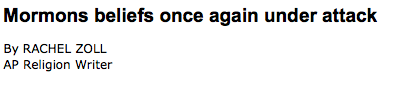
The religion beat apparently doesn’t attract many proofreaders, because we also have this headline:

Apostrophe, anyone? If “Mormons’ beliefs” takes up too much space, “Mormon beliefs” would also work.

Moving on . . . . What exactly is The Atlantic trying to say in this headline?

Are we looking for “Do Tax Cuts or Spending Cause the Deficit?” That version isn’t much better, however, considering the awkward combination of a plural noun (tax cuts) and a singular gerund (spending). The parenthetical “Or Both” doesn’t really work either; it’s a separate question, not part of the first. A suggestion for rephrasing: “Is the Deficit Caused by Spending or Tax Cuts? (Or Both?)”

The latest edition of Newsweek is an even more dismal production than usual. Perhaps all the copy editors got pink-slipped after the Daily Beast merger, because this article on the economic and political mess in Italy has more grammatical errors than a bad SAT essay:

Italians are no different from other nations: like squabbling families, whatever they may say about their faults, they deeply resent it when outsiders start to list them.

Italy may be no different from “other nations,” but the last time I checked, “Italians” were not a nation.

As recently as July, as the storm that is Greece spread through the Mediterranean, people hoped that the ill winds might do Italy some good. . . .

Granted, the writer is speaking metaphorically, but the so-called “storm” is Greece’s debt crisis, or possibly the shakiness of the Greek economy, not Greece itself. No one has spotted bits of Greece drifting around the Mediterranean. (Then again, Crete making an appearance off the Italian coast would certainly be news.)

Italy’s real economy, they protest, is even today far healthier than Spain’s, which has huge private as well as public-sector debts, banks that are badly compromised by its massive property bubble, and more than 20 percent unemployment.

Again, a modifier problem. A country can have “huge private as well as public-sector debts,” but an economy cannot. The subject of the clause about debt is “Spain’s” (shorthand for “Spain’s economy) when it should simply be “Spain.” It doesn’t make much sense to say that Spain’s economy has massive debt or at-risk banks, but by beginning the sentence with “Italy’s real economy,” the writer is forced into an awkward parallel.

Stay tuned for more carping about petty style mistakes. The media will never be perfect, and I will certainly never run out of things to whine about.


Does It Say “Donald Thump” On His Long-Form Birth Certificate?

26 09 2011

An amusing typo from an AP article about Republican candidates angling for Donald Trump’s endorsement:

I’m not entirely sure why I find this so funny . . . . There’s something about Trump that just seems to fit with a nickname like “Thump.” Maybe it’s “thump . . . the Donald’s hairpiece falls to the floor” or “thump goes the Donald’s fist on the conference table.” Even better: “thump: the sound of the Donald’s Nielsen ratings hitting the ground.”

Plus, this is the headline:

Sorry, but all I see here is “Republican candidates seek tramp stamp of approval.” Probably not what Sarah “Abstinence Worked So Well for My Daughter” Palin had in mind.


Design a site like this with WordPress.com
Get started