
Banksy takes on the Goebbels quotation
Last week, Garance Franke-Ruta at The Atlantic offered a good suggestion for journalists faced with the myriad untruths trotted out by the Romney and Obama campaigns. She praises fact-checking websites like PolitiFact and the Washington Post’s Fact Checker, but concludes that “one-off fact-checking is no match for the repeated lie.” Political junkies read fact-check websites, but casual consumers — especially people who get most of their news from cable TV — may never venture into the weeds of a true-and-false listicle. The standard media practice of separating fact-checks, which are often written as short blog posts or hidden below the digital fold, from anchor articles necessarily limits their reach. Even if the New York Times runs an entry on its Caucus blog headlined “In Ryan Critique of Obama, Omissions Help Make the Case” and tucks a moment of editorial-page outrage away on Andrew Rosenthal’s “Taking Note” blog, the article splashed across its home page is a more traditional collection of quotations from Paul Ryan’s distortion-filled convention speech: “Rousing GOP, Ryan Faults ‘Missing’ Leadership.” Though Franke-Ruta sees a continued role for stand-alone fact checks, she advocates a more interventionist strategy in mainstream news stories:
The solution now as then lies in repeated boilerplate, either inserted by editors who back-stop their writers, or by writers who save it as B-matter (background or pre-written text) so they don’t have to come up with a new way of saying something every single time they file. Basic, simple, brief factual boilerplate can save an article from becoming a crutch for one campaign or the other; can save time; and can give readers a fuller understanding of the campaigns, even if they haven’t had time to read deep dives on complex topics.
She offers an example from the 2008 campaign as a precedent. To combat rumors that Barack Obama was a closet Muslim, writers regularly used language like “”Obama, who is a Christian” and “”the false allegation that Obama is Muslim.” Franke-Ruta acknowledges that such journalistic detail did little to disabuse the 18 percent of Republicans who still believe, despite four years of media scrutiny and Rose Garden appearances, that the president is socialist Kenyan devotee of Islam. But the boilerplate at least allowed journalists to report on the rumors without being so complicit in their promotion.
Franke-Ruta continues:
The underlying approach is not that different from using the terms “anti-abortion” instead of “pro-life,” “abortion-rights advocacy” instead of “pro-choice advocacy,” or calling Obama’s health-care law an “overhaul” rather than a “reform,” because of the implication that the result is an improvement. It’s basically an editorial decision that the news outlet in question gets to control the terms of the debate on its own pages, rather than outsourcing it to partisans, even as it seeks to fairly inform readers what those partisans are saying.
She would apply the boilerplate to, for example, the oft-repeated Democratic claim that Paul Ryan’s current Medicare proposal would increase costs for beneficiaries by $6,400, when the figure actually applies to a previous version of the Ryan plan. (The current version, as even Ryan admits, was deemed “unscorable” by the CBO.)
Use of a quote like this could be followed by a graf such as: The voucher system Obama is campaigning against was proposed by Ryan in his 2011 budget, but Ryan’s 2012 budget dropped the plan in favor of a proposal to subsidize private or traditional plans on new Medicare exchanges created a decade from now. The extra costs potentially imposed by the 2012 proposal on future seniors are not yet clear, though it is anticipated to raise them.
Instead, most news organizations let Obama and his surrogates get away with the falsehood, simply reporting the $6,400 accusation and occasionally appending a statement from the Romney campaign that says even less about the charge. Talk about boilerplate: the Boston flacks pump out identical language in response to anything they don’t like, whether true, false or egregiously inaccurate. Andrea Saul must have her own boilerplate queued up in the “paste” function of her Blackberry: “President Obama and his team are running a campaign of personal destruction to avoid talking about his failed economic record.” News outlets — especially publish-or-perish websites like Politico — dutifully record such responses, which contribute absolutely nothing to the discussion and seem designed as a CYA tactic to protect media outfits from lawsuits. Such he-said/she-said journalism gives readers no idea whether Obama is lying through his teeth or speaking truth to power; it simply repeats the spin each side wants voters to hear. Reporters are thus reduced to stenographers.
Lately, however, there have been glimmers of hope that the major news outlets are taking Franke-Ruta’s advice. The first sign was this line in a Times article:
The Romney campaign is airing an advertisement falsely charging that Mr. Obama has “quietly announced” plans to eliminate work and job training requirements for welfare beneficiaries, a message Mr. Romney’s aides said resonates with working-class voters who see government as doing nothing for them.
The welfare charge, rooted as it is in class warfare and racial resentment, is not only one of the nastiest lies of the campaign, but one of the most frequently debunked. On PolitiFact’s Truth-O-Meter, it was rated “Pants-on-Fire,” and Glenn Kessler awarded it the maximum four Pinocchios.Yet all the fact-checks in the world haven’t deterred the Romney campaign, whose spokesperson called the attack “Our most effective ad” because “it’s new information.” Well, it’s “new” because it’s entirely made-up. But Boston doesn’t let what Karl Rove would call the “reality-based community” get in the way. “We’re not going to let our campaign be dictated by fact checkers,” said Romney pollster Neil Newhouse. Instead, it will be dictated by people like Rove himself, who never had a problem with bending the truth to bolster George W. Bush’s record and continues to fabricate tissue-thin versions of reality as a columnist for the Wall Street Journal. If campaigns are content to ignore fact-checkers, the struggle for accuracy must be shifted into news coverage itself — written, as James Fallows of the Atlantic says, “in the reporter’s own voice.” The Times article exemplifies this shift; it doesn’t tell the reader that an Obama spokesperson alleges the ad is false or that fact-checkers have cast doubt on the welfare claim. It says, plainly and without qualification, that Obama never “gutted” welfare or eliminated” the work requirement. (In fact, the administration is offering flexibility to states, mostly ones led by Republican governors, that can use innovative programs to move 20 percent more people off welfare.)
Other examples of Franke-Ruta’s boilerplate in action have cropped up across the mainstream media. At Mother Jones, Kevin Drum points to an LA Times article that reveals the lie in the headline itself:

Drum praises the LA Times, writing that “it’s about time reporters and copy editors started putting this stuff front and center.” While I don’t share his optimism that even the most direct call-outs by the media will lead to politicians “paying a very visible price for spouting these lies” — I’m much more of the James Fallows school, which asks, “but what if it turns out that when the press calls a lie a lie, nobody cares?” — the LA Times headline is indeed a step forward. In an interview with media critic Eric Wemple, the Times’ Washington bureau chief explains that separate fact-checking articles are not always sufficient. “We need to try new ways to at least make clear to the readers what the camps are doing,” David Lauter says, and points out that, while Santorum’s speech itself was “interesting but not exactly news” (or, as Wemple writes, it was nothing we hadn’t heard “300 times in the primary season”), the politician’s willingness to tell a bald-faced lie was newsworthy. Wemple observes that “In the case of Santorum, he wasn’t the nominee nor the keynote speaker, and the point about work requirements has been significant to the Romney campaign.” Thus, Lauter determined that, “in this case, it was not a particularly close call”: the lie made it into the header.
The “Obama is giving your money to those people” subtext of the welfare falsehood has also been addressed quite explicitly by the AP, which headlined an article, “Romney pushes on with discredited welfare attacks.” The piece garnered a lot of attention for its suggestion, the most direct yet by a mainstream media outlet, that the welfare charge is “could open Romney up to criticism that he is injecting race into the campaign and seeking to boost support among white, working-class voters by charging that the nation’s first black president is offering a free pass to recipients of a program stereotypically associated with poor African-Americans.” Less sensational, but perhaps just as significant, as the AP’s effort to address the racial elephant in the room is its assertion in the first paragraph that “Mitt Romney claims he’s got a winner with his criticism that President Barack Obama is giving welfare recipients a free ride. Never mind that aspects of his argument against the Democrat are factually inaccurate.” The article notes that fact-checkers — “including the Associated Press” — have dismissed the allegations, but even the AP’s own fact check probably ran in few newspapers. The stand-alone article about the advertisement’s racial subtext, on the other hand, received significant play in outlets across the country.
The welfare charge is not the only lie being addressed head-on by the media. Fallows himself highlights a bit in the print edition of the New York Times addressing the Republican distortion — omnipresent on the first day of the convention and currently filling TV screens across the country — of the president’s “You didn’t build that” statement.
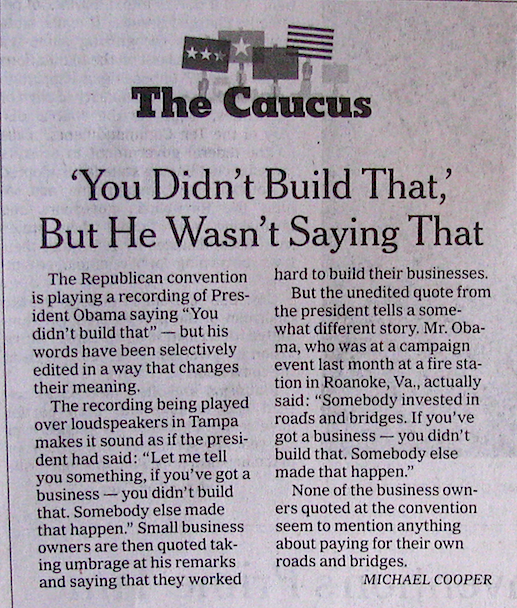
Recently, conservatives have not only twisted the meaning of Obama’s remarks (he was referring to infrastructure, not saying that entrepreneurs don’t create businesses) but “selectively edited” them, splicing together fragments from the speech in order to turn non sequiturs into a supposedly unbroken indictment of capitalism that has served as a non-stop audio track to the convention. The Times’ blunt acknowledgement that “He Wasn’t Saying That” addresses this distortion, albeit with considerable qualifications in the piece below. The item received little play on the website — it was part of a live blog of the Republican convention that didn’t even merit its own URL — but there is something hopeful about its appearance in the print edition.
Yesterday, similar directness on a different subject cropped up in another Times article.
Rae Lynne Chornenky, the president of the National Federation of Republican Women, addressed the convention on Monday, repeated the oft-discredited claim that 92 percent of all the jobs lost under Mr. Obama were those of women.
On issues that require a more nuanced take, simply inserting words like “false” or “oft-discredited” does not suffice. The argument over the $716 million that Obama’s health care reform either steals (if you ask a Republican) or saves (if you ask a Democrat) is not such a straightforward lie as the welfare attack; it contains at least a grain of truth. Both the Times and the Post manage to address the issue in news articles, however, and their language is so rote that they seem to be following Franke-Ruta’s advice about automatic qualifiers. The similarity between the two papers’ approaches to Paul Ryan’s convention speech is striking. Here’s the Post on the Medicare question, as well as on Ryan’s tenure on the Simpson-Bowles commission:
However, at several points, Ryan critiqued Obama’s positions without disclosing the fact that he had held similar ones. For instance, although he attacked Obama for reducing Medicare spending by more than $700 billion, his own budget proposal would curb the program by a similar amount. He also criticized the president for not supporting the recommendations of a bipartisan commission on deficit reduction, without noting that he had been a member of the commission and had not supported it either.
And here is the Times:
Mr. Ryan was referring to a provision of the health law that cuts more than $700 billion in projected spending from the Medicare program. Mr. Ryan’s budget assumes similar reductions, a point Democrats will be certain to continue making in the weeks ahead.
Likewise, Mr. Ryan, whose deep budget-cutting plans drew intense criticism from Mr. Obama long before the Republican ticket was completed, accused the president of failing to act on the recommendations of his own bipartisan debt commission. Mr. Ryan did not mention that he had served on that commission and dissented from its policy proposals, which included specific steps to reduce budget deficits.
Both papers present the facts without veering into the opinion-page territory of labeling Ryan a liar. Conservatives like to paint fact checks as thinly-disguised spin, but the Times and the Post are careful not to pass judgment. Contrast such cool treatment in the news pages with the harsher verdict of the Post’s editorial:
Mr. Ryan’s selection prompted a serious discussion of Medicare reform but also ushered in a depressingly predictable series of “Mediscare” charges and counter-charges. Mr. Ryan stooped to some of that Wednesday night, asserting that “the greatest threat to Medicare is Obamacare,” although the health care law began the hard task of reforming the program. He assailed Mr. Obama for having “funneled” $716 billion out of Medicare, without mention that his own budget assumed cuts of precisely that magnitude.
It’s worth noting that even loaded terms like “stooped” and “Mediscare” maintain a civility scarce among the self-proclaimed fact checkers of the blogosphere. Michael Tomasky of the Daily Beast writes of a “cavalcade” of lies and concludes that “It just boggles the mind to imagine how Paul Ryan can stand up there and lash Barack Obama for abandoning Bowles-Simpson when he did exactly that himself.” New York Magazine’s Dan Amira gripes that, with all the “lies and deception” in the speech, “Ryan’s pants are on fire, but all America saw was a barn.” The Post’s editorial looks tame by comparison.
Of course, not every issue should be — or even can be — fact-checked. Conservatives have a point when they complain that fact-checkers overstep their bounds when they attempt to police more subjective statements. When Romney surrogate John Sunnunu calls Obama “un-American” or Rush Limbaugh accuses a Georgetown grad student of wanting taxpayers to fund her sex life, the remarks are certainly odious — but they’re not necessarily inaccurate in the traditional dichotomy of true and false. They’re opinions, albeit opinions based on twisted reasoning and malicious intent, but they are opinions nonetheless. Likewise, there are plenty of issues that spark controversy because of differing perspectives, not differing facts; in such cases, he-said/she-said journalism still has a place. Abortion, for example, is a hot-button topic because morality is inherently uncheckable; there are no facts that will convince a pro-lifer that restricting abortion restricts a woman’s autonomy, just as there are no facts that will convince a pro-choicer that ending a pregnancy is tantamount to murder. Someday we may be able to offer a fact-check about the moment a fetus becomes “alive,” but currently no amount of science or mainstream consensus will make abortion foes believe that fetuses don’t feel pain. It’s simply not an issue worth litigating on PolitiFact or FactCheck.org, much less in mainstream news articles. In fact, it’s often the best journalists can do just to report the opinions on both sides of the issue. Less controversial but equally subjective are the merits of labor unions, a question on which the Times wisely reverts to the old he-said/she-said dynamic. There is no “truth” to append to the argument, no statement like “PolitiFact has ruled that unions make America happier and more prosperous” to add to the debate. On the right to form a union via card check, which the Republican Party platform opposes, the Times relies on an “on the one hand . . . on the other hand” formulation:
Employer groups argue that card check is far less trustworthy than secret ballot elections, asserting that union organizers pressure workers to sign pro-union cards. But labor leaders complain that election campaigns often turn into an unfair exercise in which companies intimidate workers and have far greater access and ability to persuade workers than the union has.
Though both sides of the aisle take issue with fact-checking, especially when it occurs in the middle of a straight news article, the conservative dogma of a “liberal media elite” plotting against Republicans means that most of the ridicule comes from the right. Certainly Democrats, including myself, have problems with PolitiFact, particularly in its designation as “Lie of the Year” the assertion that Paul Ryan’s budget proposal would “end Medicare as we know it.” Frankly, saying that the Ryan plan — which would give seniors a voucher to cover the second cheapest insurance option or put toward traditional fee-for-service Medicare — doesn’t end Medicare is like saying that a company switching its employees from a pension plan to a 401(k) isn’t ending defined-benefit retirement as we know it. Yet any liberal dissatisfaction with media fact checking is overwhelmed by the vehemence of the right. The Washington Post points to one example of many:
Jon Cassidy, writing on the Web site Human Events, said one fact-checking outfit declares conservatives inaccurate three times as often as it does liberals. “You might reasonably conclude that PolitiFact is biased,” he wrote.
Well, you might conclude that. Or you might conclude that conservatives lie three times as often as liberals. If Romney doesn’t like the fact that, as Charles Blow observes, 42 percent of his statements reviewed by PolitiFact have been classified as “Mostly False”, “False” or “Pants on Fire” (compared with 27 percent for Obama), perhaps he should stop saying things like “We’re only inches away from no longer being a free economy.” He earns “Pants on Fire” ratings at four times the rate of the president not because of fact-checker bias but because such statements are patently ridiculous. Still, conservatives soldier on with the narrative of the liberal PolitiFact stooges. At National Review, Mona Charen conveniently invents a universe in which Paul Ryan has Democrats shaking in their boots: “There’s a reason the so-called “fact-checkers” and other liberals have gone beserk about him. It’s quite simply this: He is the most impressive Republican politician since Reagan . . . . As such, he delights us and scares the Hell out of them.” I’d argue that Charen misses the largest similarity between Ryan and Reagan: both are/were actors, and both traffick in untruths.
James Fallows, who pointed out the Times’ “You Didn’t Build That” headline in the Atlantic, explains why he sees little bias in the paper’s decision to call out the Romney camp’s mendacity. He compares the Obama quotation to Romney’s own “I like to fire people” remark, which was likewise stripped of context by the opposition and used against the candidate. In both cases, Fallows writes, it’s apparent that the speaker didn’t really mean what the attack ads imply: Romney wasn’t saying he enjoys laying people off, and Obama wasn’t saying entrepreneurs deserve no credit for their success. Yet the “You didn’t build that” remark has morphed into a centerpiece of the Romney campaign, complete with its own line of T-shirts. “I like to fire people” was a joke on late-night TV for a couple days. Fallows continues:
Nonetheless their party is devoting much of its convention time and ad budget to the pretense that Obama “really” thinks that people don’t achieve things on their own; this is another step toward post-truth politics. And here is the fair-minded test: if the Democrats spend comparable emotion and air time in Charlotte on “I like being able to fire people,” they will be just as misleading and should be called out in just the same way. Including, yes, with a comparable headline in the NYT.
For as much as conservatives pretend not to care about the verdicts of fact-checkers — see National Review’s recent “PolitiFiction” — they spend an inordinate amount of time refuting those checkers’ conclusions. After media outlets from the AP to National Journal (aggregators at The Week actually compiled a list titled “The media coverage of Paul Ryan’s speech: 15 euphemisms for ‘lying'”) had the audacity to point out that Ryan blamed Obama for the closing of a GM plant in Ryan’s hometown of Janesville that actually closed during the Bush administration, the Romney camp fired back with the legalistic contention that Ryan didn’t technically blame the president for the shut-down. The actual line in Ryan’s speech?
Right there at that plant, candidate Obama said: ‘I believe that if our government is there to support you, this plant will be here for another hundred years,’ That’s what he said in 2008. Well, as it turned out, that plant didn’t last another year. It is locked up and empty to this day.”
“I’m not saying it was his decision,” Ryan protested later on CNN. “I’m saying he came and made these promises, makes these commitments, sells people on the notion that he’s going to do all these great achievements, and then none of them occur.” The Post reports that a Boston spokesperson also defended the Janesville accusation by “point[ing] to a campaign statement by Obama in late 2008, when it was announced production would end, that he would ‘lead an effort to retool plants like the GM facility in Janesville.'” And Obama did engineer a bailout of Detroit that kept hundreds of plants open — but apparently he can be faulted for not focusing on the hometown of one Wisconsin congressman. Would the “Let Detroit Go Bankrupt” GOP have preferred a more far-reaching bailout, possibly a nationalization of the auto giants altogether?
Cowed by the Romney campaign’s indignant reaction, fact-checkers modified their original analyses to note that GM only announced its closing under the Bush administration; it ultimately locked its doors under Obama. Contrary to Republican complaints, the fact-checking community is still more concerned with false equivalence than with “nailing” conservatives. In an attempt to appear even-handed, Glenn Kessler gives credence to Ryan’s distorted timeline and obvious implication that Obama can be faulted for half a century of auto industry mismanagement. He writes that “The plant was largely closed in December 2008 when production of General Motors SUVs ceased — before Obama was sworn in. A small crew of about 100 workers completed a contract for production of medium-duty trucks for Isuzu Motors, a contract that ended in April 2009.” The lamest part of this whole manufactured controversy is that even if Ryan is technically correct that the plant closed under Obama, it hardly closed under his policies. In no sane reality can a president in office for three months be blamed for a factory shuttered before the Detroit bailout even took effect. Ryan implies that the newly inaugurated president should have focused not on rescuing a foundering financial system from a second Great Depression but on preventing the already-scheduled closing of one Midwestern factory. Whatever happened to the Bain doctrine of creative destruction? If Ryan wants to talk about the unfairness of one group of workers being laid off to preserve the viability of a larger industry, he could start with the folks at AmPad or GST Steel fired during Romney’s stint in private equity.
Interestingly, amid the movement of mainstream media sources to imbed assessments of accuracy in their news articles, one prominent outlet took a step backward in opting for the opposite tactic on the Janesville story. The spineless culprit? The Wall Street Journal, natch, which headlined its brief item on the controversy “Democrats: Ryan Misled on Plant Closing” and wrote that “Democrats said Mr. Ryan implied that the plant closing was the fault of the Obama administration,” neglecting to mention that Ryan’s narrative had been debunked not only by Chicago but by the vast majority of independent fact-checkers. Funny how the Journal doesn’t seem to have trouble citing fact-checkers and debunking myths when it comes to misleading ads or inaccurate statements about Bain Capital by the Obama camp.
So do conservatives really lie more than liberals? They certainly seem to double down more frequently on the lies that they do tell. When David Axelrod joked to the Times that the Romney campaign was relying on “the audacity of mendacity,” veteran White House reporter Jackie Calmes seconded the sentiment, if not the tone. And this is from a straight news article:
The partisan operative’s critique was harsh even by the standards of the normal combat of presidential politics. But it is one that was echoed to some degree by a raft of nonpartisan fact-checking articles, commentary and editorial columns recently, especially on Thursday after Mr. Ryan, who generally has been credited as a straight-shooter throughout his career in the House of Representatives, in his prime-time convention speech on Wednesday night repeated some debunked claims by Mr. Romney and added a few widely disputed statements of his own.
Calmes takes Franke-Ruta’s advice and runs with it, going beyond the boilerplate insertion of facts to essentially point out that, at least lately, conservatives have indeed lied more than Democrats. “Criticism from the Obama campaign could well be dismissed among voters as the usual stuff of politics, and independent fact-checkers have criticized some of Mr. Obama’s statements, too,” she writes, in the harshest condemnation of the Romney campaign’s disdain for the truth that I’ve read yet in the Times’ news pages. “Still, the number of falsehoods and misleading statements from the Romney campaign coming in for independent criticism has reached a level not typically seen.”
Perhaps more significant than the number of lies peddled by Romney & Co. is the doggedness with which Boston repeats the falsehoods. Despite all evidence, Romney presses ahead with discredited allegations about “gutting welfare” and “apology tours.” Democrats tell plenty of lies — see Harry Reid’s outlandish suggestion that Romney paid no taxes for an entire decade, the deceptive statement that Romney’s 13.9% effective tax rate is lower than that of most middle class families, or the Obama advertisement incorrectly claiming that Romney opposes abortion, even in cases of rape or incest — but they rarely rise to the level of absurdity of the Janesville jujitsu. Harry Reid aside, Democrats are more likely to walk back or abandon arguments deemed by fact checkers to be inaccurate. (OK, the “end Medicare as we know it” line is also an exception, though the idea that PolitiFact got this one right is, in my mind, pretty far-fetched.) Obama quickly backed off the notorious — and widely panned — Priorities USA ad that linked Romney to the death of a laid-off steelworker’s wife. It’s crucial to note, as well, that while Romney and Ryan are content to lob their fictional allegations themselves, many of the more dubious liberal claims come from super PACs not controlled by the campaign. Of course, the separation between super PACs and the official campaigns is tissue-thin, but this is not a particularly winning argument for Romney, whose former campaign manager now heads the main pro-Romney super PAC (just as former Obama operatives head Priorities), and who claimed during the primaries that any inappropriate coordination would send him to “the Big House.”
Where Obama once asserted ad nauseam that the Romney-Ryan Medicare plan would raise costs for beneficiaries by $6,400, the president now acknowledges that the figure is taken from an outdated version of the Ryan plan: “I do not think it is a good idea to set up Medicare as a voucher system in which seniors are spending up to $6,000 more out of pocket. That was the original proposal Congressman Ryan put forward.” Other Democrats, like Chris Van Hollen (Ryan’s Democratic counterpart on the House Budget Committee), continue to use the inaccurate figure, and they should be called out on it. That said, at least Ryan actually proposed a plan that would indeed have shifted the costs in question. By contrast, Romney’s welfare attack accuses Obama of doing something he never did, and the Republican claim that the new Ryan plan would impose no extra costs on current seniors is demonstrably false (repealing the ACA would put reopen the prescription drug “donut hole,” put seniors on the hook for currently free preventative care, and increase Medicare premiums calculated as a share of total costs by spending more on the program as a whole).
Like Republican falsehoods, many of Obama’s dishonest statements can be finessed as technically, sort of true. The abortion ad alleged that Romney “backed a bill that outlaws all abortion, even in case of rape and incest,” and Romney has indeed indicated support for “personhood” legislation that would give fetuses 14th amendment rights to “equal treatment under the law.” It’s difficult to see how classifying abortion as the murder of a fully-formed human being is conducive to exceptions. To a greater degree than Republican lines of attack, Democratic accusations tend to be based on emotion and subjective evaluation, rather than a cut-and-dried distortion of the facts. It’s impossible to fact check an ad in which employees laid off from Bain-controlled companies lament Romney’s lack of concern for regular people. True, private equity companies exist to make money, not save jobs — but the ads rarely make that claim. Instead, they rely on heartstring-tugging personal testimony that amounts to little more than personal opinion. At the Republican National Convention, Staples co-founder Tom Stemberg talked up the nominee and slammed Obama for “demonizing the private equity industry that has created so many new jobs.” But demonizing is not the same as lying. One appeals to emotion, the other to false pretenses. In much the same way that fact-checkers raised an eyebrow at the Janesville timeline, they have taken Chicago to task for blaming Romney for factory closings that happened after his official retirement from Bain. Yet those same fact-checkers have also dinged the Republican nominee for conflicting statements about the date he stepped away from Bain, and Romney was CEO by law if not in spirit during many of those closings. (This doesn’t even account for the fact that Romney continued to make money from Bain investments for a decade after his “retirement,” which opens an even more tangled can of culpability worms.)
Ezra Klein, whose politics are liberal but whose Wonkblog prides itself on at least attempting dispassionate analysis, actually seems disappointed — I’ll let you judge whether the sentiment is genuine or just concern-trolling — that, “quite simply, the Romney campaign isn’t adhering to the minimum standards required for a real policy conversation.” Klein is no fan of false equivalency, but you get the idea that he’d prefer some actual equivalency, which would eliminate the need to equate one side’s fibs with the other’s howlers:
I don’t like that conclusion. It doesn’t look “fair” when you say that. We’ve been conditioned to want to give both sides relatively equal praise and blame, and the fact of the matter is, I would like to give both sides relatively equal praise and blame. I’d personally feel better if our coverage didn’t look so lopsided. But first the campaigns have to be relatively equal. So far in this campaign, you can look fair, or you can be fair, but you can’t be both.
So why has the Romney-Ryan ticket been so mendacious, despite an unprecedented effort not only by official fact-checkers but by the media in general to hold it accountable? In another blog post, Klein calls Paul Ryan’s convention speech “blistering,” yet notes that the veep candidate was raked over the media coals the next day for his numerous untruths. “What’s worse, the untruths were unnecessary,” he writes. “Almost every one of them could have been rephrased as an equally devastating, and reasonably accurate, attack. Obama, for instance, has released a debt plan. So rather than say he hasn’t, why not just say “the president has never proposed a path to a balanced budget” or “even the president’s own party rejected his budget when it appeared before Congress?” Klein’s point doesn’t address the most egregious of the Romney campaign’s falsehoods, many of which (e.g. the welfare attack) seem designed to throw red meat to the base without regard for accuracy. In such cases, Boston takes advantage of the unfortunate reality that efforts to debunk a lie often just perpetuate the lie itself — see “birtherism” or the Obama-as-Muslim trope, which have likely benefited from the attention called to them by the eye-rolling media elite.
Still, Klein’s befuddlement is echoed in the latest column by Kathleen Parker, a conservative who is normally sympathetic to the GOP but who has recently objected to its treatment of women’s issues, among other things. (If you’ve lost Kathleen Parker . . . .) She writes, “In one instance, Ryan criticized Obama for ignoring the recommendations of the Simpson-Bowles commission.” She continues:
What Ryan didn’t mention is that he served on the commission and that he voted against its proposals. There’s nothing wrong with either of those facts except their omission. His criticisms would have carried more weight had he mentioned them and elaborated. What’s wrong with saying, “I served on the commission and, while I had problems with it and voted against it, it was the right approach. We just didn’t go far enough, and the president simply looked the other way.”
Parker laments Ryan’s growing reputation for untruth-telling, asking, “Whom does this serve? Certainly not the Romney/Ryan ticket, which now risks being perceived as less than straightforward. This is crucial, given a recent Gallup poll that found Obama leading Romney (48 percent to 36 percent) on the question of who is more trustworthy.” Here, Parker inadvertently stumbles upon the real reason for the persistence of what Steve Benen has chronicled as “Mitt’s Mendacity”: The public just doesn’t care. Would his “trustworthy” numbers tick upwards if he told the truth more often? Unlikely, given that his favorability ratings remain mired at 40 percent, and that the “likability” gap separating him from the president is in the double digits. Slate, which partnered with Survey Monkey to run a real-time online survey during Romney’s acceptance speech, asked respondents whether Ryan’s speech would hurt the ticket’s chances in November, given that it “has been criticized by some media organizations for containing false or misleading information.” Forty-five percent said it wouldn’t hurt Romney’s chances at all; only 27 percent thought it would. (Twenty-eight percent “didn’t know.”) “Maybe those surveyed don’t believe their fellow Americans will be able to discern fact from fiction,” Slate wrote. “Or maybe they just think the average citizen doesn’t care what’s true.”
More likely, the Romney campaign is responding to the new political reality described by philosophy professor Jason Stanley on the New York Times’ “The Stone” blog as one in which “Americans no longer expect or care about candidates making honest assertions in the public sphere. They no longer expect consistency and honesty from politicians, and the savvy political campaigner recognizes that there is no cost to making statements that contradict even their most well-known beliefs.” Stanley goes much further than I would, positing that “it may not be possible to assert or lie anymore in a presidential campaign” because “the trust required to support the existence of such speech acts is absent.” Perhaps that’s true, but Stanley then uses this as an excuse to get Romney off the hook: “The Romney campaign is not at fault for making false statements. They are just astutely taking advantage of the political environment in which all campaigning now takes place.”
This ignores the vast discrepancy between the quantity of lies told by each party. It ignores the fact that writing off truth-telling as just another outdated, past-its-prime fetish is a grindingly pessimistic act. We may laugh at the post-modern idea of “truthiness” but we should not celebrate it. Even if the media can’t change the atmosphere of a campaign or force the candidates to stick to reality, it should not abandon its duty to hold elected officials’ feet to the fire, to “comfort the afflicted and afflict the comfortable,” as the Finley Peter Dunne chestnut goes. Here, we should return to Garance Franke-Ruta, who puts it best: “And if lies are going to be repeated, the truth has to be, too.”
 . . . So Well Read. . .