Left, Far Right, and Center

2 05 2012

It’s no secret that the Republican party has moved to the right. President Obama is only the latest person to suggest that Ronald Reagan could not have made it through the 2012 primaries. But with all the chatter about polarization and Congress’ inability to compromise, the media often ignores the fact that there has been no analogous move to the left by the Democrats. It’s easier, after all, to blame both parties. Given the constant accusations from conservatives about liberal media bias, the meme of equal responsibility is not only convenient but attractive in its safety. Opinion writers are just as guilty of false equivalency. Thomas Friedman tops the charts, with his pleas for a “centrist” candidate willing to both raise taxes and curb entitlements (a description that pretty much describes President Obama), but there are plenty of other offenders; Mat Miller at the Washington Post, whose columns plug the ostensibly grassroots group Americans Elect, is another notable myth-peddler. If news outlets cling to the equal-opportunity offenders meme in order to appear unbiased, pundits like Friedman and Miller do so in order to claim the coveted mantle of “centrist.” My favorite sharp-tongued economist, Paul Krugman, has this to say about centrists, colleagues like Friedman and David Brooks included:

Their self-image, and to a large extent their professional selling point, depends on posing as high-minded types standing between the partisan extremes, bringing together reasonable people from both parties — even if these reasonable people don’t actually exist. And this leaves them unable either to admit how moderate Mr. Obama is or to acknowledge the more or less universal extremism of his opponents on the right.

False equivalency is practiced by the “liberal” mainstream media, but conservatives are the prime beneficiaries. Hiding behind the idea that both sides are at fault, Republicans ignore the fact that gridlock in Washington is mostly their responsibility. If voters can spread the blame, they will exert less pressure on the GOP to move back to the center. Democrats often find themselves torn between the party’s more liberal, Occupy-type base and the vast majority of more moderate voters, but for all the talk of the Santorum-Romney split in the GOP, the real Republican rift is between the extremists and the ultra-extremists. The Tea Party tugs to the right a party that has already moved far from the center. Case in point is the frequency with which Obama – who has been silent on gun control, can’t seem to “evolve” on gay marriage, and caves on regulation of greenhouse gases – is labeled a socialist. Some socialist: his health care plan was the brainchild of the Heritage Foundation, cap-and-trade once attracted the support of John McCain, and the specter of bank nationalization devolved into a multibillion-dollar handout to Wall Street.

Writing this weekend in the Washington Post under the wonderful headline “Let’s Just Say It: Republicans Are The Problem,” Thomas Mann and Norman Ornstein delivered the sort of blunt truth that has thus far been confined to more liberal publications like The American Prospect and The Nation. (Ornstein, I should point out, is a scholar at the conservative American Enterprise Institute.) While acknowledging that “Democrats are hardly blameless” in the gridlock game, Mann and Ornstein also believe that their “tendencies do not routinely veer outside the normal bounds of robust politics. If anything, under the presidencies of Clinton and Obama, the Democrats have become more of a status-quo party.” Again, health care is a case in point. Instead of radically revamping the insurance market by pushing for the single-payer coverage favored by his party’s left wing, Obama opted to preserve the role of private companies. But Republicans, who had favored just such an idea in the 1990s, had grown too ideologically rigid to embrace a plan — any plan — by a Democratic president. The authors make a sports analogy that even I, who can’t tell a goal post from a basketball hoop, know is apt:

While the Democrats may have moved from their 40-yard line to their 25, the Republicans have gone from their 40 to somewhere behind their goal post.

Bemoaning this rightward shift is nothing new, of course, but Mann and Ornstein are more direct than most in addressing the role of the press. “We understand the values of mainstream journalists, including the effort to report both sides of a story,” they write. “But a balanced treatment of an unbalanced phenomenon distorts reality.”

It’s a message that couldn’t come at a better time, as false equivalency was on blaring display after Tuesday’s primary election in Pennsylvania. Two Democratic incumbents, both members of the moderate (but dwindling) Blue Dog coalition, were ousted by more liberal challengers. The Times reports that newcomer Matt Cartwright, who beat ten-term Representative Tim Holden, “made Mr. Holden’s vote against President Obama’s health care law a major issue in the newly redrawn 17th District.” Holden encountered something of a perfect storm; not only had a recent redistricting left him with a more liberal constituency — a previously Republican-majority district was  transformed into one in which Democrats had a 24-percentage-point edge — but his opponent received substantial financial backing from left-wing advocacy groups like MoveOn.org and the League of Conservation Voters. Cartwright ran as a ” an old-school Roosevelt Democrat” and argued that Holden was too conservative for voters. The other pivotal Pennsylvania race also turned on redrawn Congressional lines, as a merger of two districts forced a pair of relatively popular Democrats to run against each other. Jason Altmire, a Blue Dog who voted against health care reform, suffered a similar defeat at the hands of Mark Critz, who benefited from strong labor-union support and an endorsement from Bill Clinton.

Headlines at Politico spun the primary victories as a leftward march: “No Centrists Need Apply,” wrote Charlie Mahtesian, while a the site’s “In the Arena” feature asked: “Will Dems’ moderate purge backfire?” Never mind that, prior to the election, the Times had quoted David Wasserman, an editor at the authoritative Cook Political Report, as saying, “There is an ideological tinge because Cartwright is more liberal and Holden is a Blue Dog. But that’s not really the reason Holden’s vulnerable. It’s much more because of redistricting,” which meant Holden was unfamiliar to 80% of his new constituency. By contrast, Cartwright’s law firm had run TV commercials in the area for years.

Moderation in the Democratic Party is hardly dead; as Chris Cillizza of the Washington Post’s Fix column observed, many of the socially conservative Blue Dogs came from the South, where the GOP has driven Democrats (and former Dixiecrats) to extinction. “Instead of going the Blue Dog route,” Cillizza writes, “some of the candidates have chosen to align themselves instead with another moderate group — the more socially liberal and fiscally conservative New Democrat Coalition.” There is logic to this shift, as social conservatism is clearly a loser in a party that has thrown down the “war on women” gauntlet and gone to the mattresses to defend Planned Parenthood. Fiscal conservatism, on the other hand, is trendier than ever, from the constant invocation of Simpson-Bowles as the Word of God to the coronation by self-proclaimed centrist columnists of Paul Ryan as a Very Serious Person.

Yet mainstream coverage of Holden and Altmire’s losses was hardly more sanguine than the Fox News contribution. The Washington Post wrote that Holden and Altmire “lost their primary battles to more liberal opponents who painted their centrism as apostasies that could no longer be tolerated.” The races were not choices between two varieties of Democrats but referenda on the existence of moderation itself:

These were the latest blows delivered to the Blue Dogs, whose membership ranks have been decimated the last two years by a perfect political storm that has driven the House Democratic caucus farther to the left than at any time in the last decade.

But just how far left has the House Democratic caucus moved? In the language of Mann and Ornstein, has the party edged from the 40-yard-line to the 25, or is it nearing the goal post? Despite the gleeful hand-wringing of conservatives – Fox News hyperventilated that Democrats “are clearly facing a terrifying reign of their own as liberal activists and unions keep hounding moderate members out of office” – this is hardly the Paris Commune. In a classic case of false equivalency, the media has decided that both parties must bear equal responsibility for the death of moderation. If the Republican party has veered to the right, Democrats must have made a similar swing to the left.

Unfortunately, this narrative doesn’t comport with reality. The Altmire-Critz race, wrote Caitlin Huey-Burns at RealClear Politics, was between “two conservative Democrats” forced “into a member vs. member primary.” While Democrats vote out center-left representatives like Altmire and Holden, the GOP goes after staunch conservatives like Utah’s Orrin Hatch, who rated 100 percent on the ideological scorecards of the Chamber of Commerce and the American Conservative Union in 2010. There is room on the liberal spectrum to the left of Altmire and Holden, but it’s hard to get farther to the right than Orrin Hatch. The positions taken by the ousted Democrats — Altmire supported a balanced-budget amendment — were conservative by any measure; neither Altmire nor Holden was a liberal counterpart to Hatch. It’s one thing for a right-winger to face a primary challenge from an even more extreme right-winger. It’s quite another for an actual centrist to be challenged by someone incrementally further to the left. Pennsylvania’s Democrats were deposed not because they declined to become card-carrying Communists but because they declined to support a version of health care reform originally proposed by the conservative Heritage Foundation!

The Economist’s Matt Steinglass cites this development to demonstrate that, contrary to popular belief, the Democratic party has actually moved to the right in recent years: “[T]he Democrats in 2010 literally passed the universal health-insurance reform that had been proposed by the GOP opposition in the Clinton administration, only to find today’s GOP vilifying it as a form of Leninist socialist totalitarianism.” Steinglass (h/t Kevin Drum) takes exception with the football metaphor employed by Mann and Ornstein:

The Democrats, as far as I can see, have moved from their 40-yard-line to midfield, or their opponents’ 45. As recently as the Clinton presidency, Democrats actively pushed for gun control, defence budgets under 3% of GDP, banning oil exploration off America’s Atlantic and Pacific coasts, a public option or single-payer solution to universal health insurance, and…well, Clinton-era progressive income-tax rates. Today these positions have all been abandoned. And we’re talking about positions held under Bill Clinton, a “third way” leader who himself moved Democratic ideology dramatically to the right, the guy responsible for “ending welfare as we know it”. Since then, Democrats have moved much further yet to the right, in the fruitless search for a compromise with a Republican Party that sees compromise itself as fundamentally evil.

 And yet centrists like Altmire are quoted as jaded authorities on the growing gulf between the parties. “The lower the number of people who are from the center means the worse the environment is going to be,” he tells Politico. “It’s certainly fair to assume that there will be more partisanship. There will be a wider divide than we have ever seen before in Congress.”

True, but partisan venom stems less from this widening divide than from the intransigence of an uncompromisingly conservative GOP – and the resulting backlash from Democrats who find themselves forced into a corner by such rigid opposition to formerly acceptable positions. Republicans who once viewed abortion as a procedure best kept “safe, legal and rare” now equate it with infanticide. Likewise, old-school conservatives like Newt Gingrich who once advocated market-based solutions to climate change are compelled to dismiss global warming as a George Soros-sponsored conspiracy.

Democrats aren’t faultless. Even Mother Jones’ Kevin Drum grudgingly admits to a leftward shift on such issues as gay rights and financial regulation. (It’s worth noting, however, that these issues are perhaps the two on which a shift to the left is most needed.) Drum concludes that blame for the flight from the center can hardly be apportioned equally:

Nevertheless, the truth is that both sides haven’t moved away from the center. Only Republicans have, and Democrats have spent the past 20 years chasing them in hopes that eventually they could reach some kind of reconciliation. But it never did any good. The Democratic move rightward was interpreted not as a bid for compromise somewhere in the middle, but as a victory for a resurgent conservative movement that merely inspired them to move the goalposts even further out.

Again, sports metaphors are not exactly my thing. But it seems to me that conservatives have not only moved the goalposts but torn them down, tossed the pieces around the field, and started doing keg stands in the end zone.


Downgrading Democracy

18 12 2011

Gridlock in Washington, D.C. is not a new phenomenon. With Congress’ approval rating stuck at 9 percent and both parties attempting to claim the moral high ground on their plans to improve the economy, it’s a miracle that anything gets done in the capital at all. It often seems that both parties would rather let the country fall to pieces than give an inch on any dearly-held position. When democratically elected representatives find themselves unable to make decisions, democracy itself is often questioned. Surely there are few presidents who have never wished for the other two branches of government to vanish altogether. Wouldn’t everything be easier if Americans and their representatives would just shut up and trust the man at the top to make the choices? D.C. would certainly be quieter without all the squabbling.

This moment of gridlock is no exception. A recent spate of articles and opinion pieces has questioned the very foundations of American government. In the September issue of the American Prospect, Harold Meyerson wonders what the founders were thinking when they drew the blueprints for a government at odds with itself. Peter Orszag, Obama’s onetime budget director, writes in The New Republic that the solution to Washington’s loggerheads is less democracy, not more. And Michael Lind of Salon offers up a paean to the anonymous government functionary, who makes up for a lack of flashiness and media-ready quips with his (or her) stolid determination to keep the cogs of the republic turning.

Meyerson’s disquisition on the history of political paralysis is more diagnostic than prescriptive. He provides a valuable history lesson, but the conclusion he reaches — “Gridlock in Washington is no accident. It’s built into the Constitution” — necessarily limits his menu of solutions. Short of convening a constitutional convention, which Meyerson acknowledges would “unleash every bat in America’s political belfry,” the options are confined to tweaking the current system and fumbling at the margins. Wary of the power of the masses and keenly cognizant of the far-reaching effects of revolution, the founding fathers instituted the checks and balances that every middle-schooler learns about in civics class: three branches of government, a relatively weak executive, and what Meyerson calls “a bias for stasis” that “places roadblocks in the path of major policy shifts.” It was a deliberate departure from the European model of parliamentary government in which one party, by controlling both the executive and legislative branches, can enact its agenda unimpeded. It’s roughly comparable to allowing the party that captures the House to pick the president. In such a reality, John Boehner would occupy the Oval Office. (I shudder.) Instead, Meyerson writes, “Even when the same party holds Congress and the presidency, the system still fragments power. Presidents and congresses are elected not merely independently but at different times and by different electorates.”

The American system makes gridlock the default setting, as multiple factions of government must align in order to pass substantial legislation. Meyerson takes health care as an example. Opposition to national health insurance was hardly milder in 1940s Britain than in the United States, but “while Labour needed only a majority of Parliament to enact national health insurance, progressive reform in our system requires the alignment of both houses of Congress with the president, the appeasement of committee chairs, and, since the Republicans began insisting upon it, a 60-vote supermajority in the Senate.” With so many moving parts, it’s no surprise that another 70 years elapsed before the U.S. implemented even the tepid reforms of Obama’s Affordable Care Act. Meyerson blames the demise of the so-called public option on the paralysis caused by the parties’ refusal to compromise — paralysis that our system of divided government is not designed to handle.

Meyerson’s conclusion — that “the Founding Fathers got it wrong” — is actually belied by his historical focus. There is no denying the ridiculousness of modern-day Washington, most recently exemplified by sight of Democrats and Republicans locked in a stand-off over how to pay for a tax cut that both sides essentially wanted to preserve. In hopes of scoring an election-year victory, neither side offered realistic legislation, opting instead to play to their bases with proposals (the Democrats’ “millionaires’ tax” and the Republicans’ fast-track approval of the Keystone XL pipeline) that clearly have no chance of becoming law. But Meyerson makes plain that the founders did not intend their nascent government to address such intransigence. Quick and easy decision making, a hallmark of top-down monarchies, was exactly what the framers wanted to discourage. Meyerson quotes Alexander Hamilton, who wrote that “in the legislature, promptitude of decision is oftener an evil than a benefit.” In 1789, Hamilton et. al. had good reasons to be wary a domineering legislature. It does not follow that, simply because these unavoidably fallible men did not anticipate problems two centuries hence, they “got it wrong.” Perhaps what is wrong is the way we have interpreted the Constitution, continuing to hew slavishly to a document written hundreds of years ago in very different circumstances. In many ways the Constitution has proven to be remarkably flexible; indeed, that malleability is often praised by historians as evidence of the founders’ farsightedness. In other ways, however, every generation has read into the Constitution what it requires. For all of Clarence Thomas and Antonin Scalia’s talk of originalism, the Supreme Court often resorts to interpretation scarcely more logical than the ancients’ reading of goat entrails. The individual right to bear arms hangs on the placement of a single comma in the Second Amendment, and the liberties ensconced in the Bill of Rights now have “penumbras.”

Toward the end of his article, Meyerson offers his own insights into how to adapt the Founding Fathers’ government to the twenty-first century. The problem, as Meyerson diagnoses it, is a government hamstrung by the founders’ mistrust of popular sentiment; the solution, therefore, is not the retreat from direct democracy recommended by Orszag and Lind but instead a more full-throated embrace of it. But compared to the detailed analysis of the country’s problems, Meyerson’s prescriptions seem small-bore and unlikely to materialize. “The two reforms with the most support — ending the filibuster and abolishing the Electoral College — would do nothing to curtail the fragmentation of power within the federal government,” he writes, “but both would limit minorities’ ability to reduce the sway of majorities.” Though the filibuster has certainly been misused (and overused) lately, it is hasty to dismiss the founders’ wariness of pure majority rule. The GOP’s insistence on a 60-vote majority has blocked progressive legislation and created a morass out of the confirmation process, but Democrats could easily and quickly end up on the other side of the divide. In the event that a President Gingrich (who has already offered to make John Bolton his Secretary of State) tries to fill a Supreme Court vacancy with another Robert Bork, liberals like Meyerson might not be so eager to do away with the filibuster.

Meyerson’s second recommendation, to “change the timing of elections and the terms of congressional office,” holds more potential, though it would take some heavy lifting to implement. He notes that “these wouldn’t be parliamentary elections — the candidates for president, senator, and representative would still be elected separately — but at least our elected officials would all derive their power from the identical and most broadly representative electorate.” This could forestall the gridlock that occurs when an executive elected on “hope and change” in 2008 is forced to work with House freshmen voted into office by the Tea Party wave of 2010. “Elections have consequences,” Obama reportedly told Eric Cantor in 2009, “and Eric, I won.” It is difficult, however, to carry out a supposed mandate from the voters when a good portion of the legislature was elected under entirely different circumstances. Meyerson’s recommendation would remedy this problem, though there is also a case to be made that less frequent elections would further insulate the House of Representatives from swings in the national will. Whether such insulation is good or bad is up for debate; in fact, Meyerson himself might point to the meteoric rise of the Tea Party as a phenomenon from which the House should have been protected.

In spite of this note of caution, Meyerson ends his article with the argument that “The problem isn’t that we’re too democratic. It’s that we’re not democratic enough.” To accept this pronouncement, however, one must subscribe to the author’s view that a parliamentary system is inherently more democratic than a presidential one. And while Meyerson demonstrates that the former is “more responsive, and more efficient” than the latter due to the ease of moving legislation through a unified executive and legislature, efficiency is not synonymous with democracy. Health care reform would surely have been easier Democrats had dominated all branches of government, but few Republicans — whose voices would have counted for nothing in the process — would have called the outcome more democratic. Neither, I suspect, would the large portion of Americans who now oppose the Affordable Care Act. Democracy can indeed be defined as the will of the majority, but such a definition is cramped and narrow, especially in a country with a tradition of strong minority rights.

Others who pontificate on the fate of American democracy are less gung-ho about enhancing the will of the people. Meyerson is notoriously bullish on holding politicians accountable to the voters; more recently, he has fulminated against the “headlong retreat” of democracy in Europe, where he believes technocrats and bond markets have usurped legitimately elected leaders. Peter Orszag advocates for less, not more, democracy, and his analysis ultimately rings most true. Einstein is said to have quipped that “the significant problems we have cannot be solved at the same level of thinking with which we created them.” Likewise, it is difficult to believe Meyerson when he suggests that the prescription for what ails our democracy is more democracy. In his essay for the American Prospect, Orszag at least dares to think outside of the box.

Orszag diagnoses an overdose of democracy, pointing to the recurring threat of government shutdown. Last summer’s debt-ceiling showdown was only the most prominent example, as it has become almost routine for Congress to run the clock down to the last possible minute before forging an agreement — if an agreement is forged at all. Aviation inspectors spent two weeks in limbo in August amid a partisan spat over rural-airport subsidies. Then a battle over funding for disaster relief, of all things, nearly brought the government to a standstill in September. Most recently, Congress nearly missed a midnight deadline to pass an appropriations bill needed to keep the government functioning. In a sane world, the default setting would be a smooth continuation of business as usual; inaction on the part of the legislature would not herald an apocalypse. Instead, Congress is saddled with too many crucial choices, and inaction produces not the status quo but chaos. Orszag thus identifies the core decision-making dilemma as the high number of decisions themselves.  Allowing Congress to argue over everything from the tiniest details (naming post offices) to the dangerously influential (raising the debt ceiling) only multiplies the opportunities for negotiations to go off the rails. It is sheer insanity, he suggests, to give a rotunda full of squabbling children the responsibility of preserving the full faith and credit of the United States. He writes:

To solve the serious problems facing our country, we need to minimize the harm from legislative inertia by relying more on automatic policies and depoliticized commissions for certain policy decisions. In other words, radical as it sounds, we need to counter the gridlock of our political institutions by making them a bit less democratic.

Orszag is hardly the first person to point out the essentially chaotic nature of democracy. There’s a reason all 300 million Americans aren’t allowed to vote on every decision the country must make. The Athenian version of direct democracy, in which each citizen steps forward to place his marble in a jar, is obviously unrealistic for a country that stretches from one ocean to another. In lieu of such democratic purity, the Constitution established a representative democracy, in which we vote for a couple hundred goons to work our will in the halls of Congress. Orszag suggests we take the outsourcing of representative democracy one step further; not only should the general public delegate decisions to Washington, but Washington should delegate decisions to experts who possess even greater wisdom. “What we need,” he writes, “are ways around our politicians.”

To circumvent incompetent or stubborn politicians, Orszag promotes what he calls “automatic stabilizers,” which would take effect in response to external conditions without requiring legislative input. Instead of relying on Congress to ameliorate an economic downturn with a politically risky stimulus package, the stabilizers imagined by Orszag would kick in when unemployment reached a certain level or GDP declined. He offers a progressive tax code as an example: “The tax code takes less of your income as that income declines, so after-tax income tends to decline less in response to an economic shock than pre-tax income. Since spending is based on after-tax income, the impact on the economy is cushioned.”

Orszag would also link the size of the payroll tax to the unemployment rate. When joblessness spikes, the tax would decrease, thereby avoiding the current partisan stand-off over extending the current 2 percent cut. He also favors the establishment of independent commissions based on the 1980s process for closing military bases. A panel of experts compiled a list of bases slated for closure; unless Congress passed legislation disapproving the entire list, the recommendations were enacted without any further action. Orszag writes that “even though this process favored action over inaction, it was not completely undemocratic: Congress still had oversight and could, if it wanted to, reject the commission’s ideas.” Obama’s health care reform includes a similar panel charged with reducing Medicare costs, and Orszag would expand the framework to include a commission on infrastructure construction and another on tax policy. Though nominally a good idea, Orszag’s proposals were written prior to the failure of the supercommittee — a panel ostensibly empowered to make just the sort of difficult decisions that frighten politicians. The spending cuts triggered by the committee’s failure were designed to be unpalatable to both Democrats and Republicans, but Sen. John McCain and other defense hawks have since moved to exempt the Pentagon’s budget. A prime example of Congress rewriting its own rules, this outcome demonstrates the loophole in Orszag’s suggestion: There is nothing that spurs Congress to action faster than the consequences of inaction.

Orszag addresses only briefly the objection that his tweaks would “reduce the power of elected officials and therefore make our government somewhat less accountable to voters.” He doesn’t deny this fact; he simply feels that it is a small price to pay for a more efficient government. Unlike Meyerson, whose solutions are less controversial because he couches them in the rhetoric of more, not less, democracy, Orszag willingly admits that the strength of our government cannot be measured by its faithfulness to majority rule. “We might be a healthier democracy,” he writes, “if we were a slightly less democratic one.”

Even Orszag, however, in his call for independent commissions, acknowledges the inherent conflict of a representative democracy outsourcing its decision-making to professionals. Michael Lind, writing in Salon, doesn’t bother to pay lip service to the wisdom of the masses. To make the case that “America needs more powerful bureaucrats,” Lind brings up the slightly inconvenient example of J. Edgar Hoover, who used and abused his position as FBI director to dominate government through eight presidencies. Though Hoover’s legacy has made the country wary of the unchecked power of unelected officials, Lind points out that this is an anomaly; the first half of the 20th century “was an age of great bureaucratic empire-builders, many of whom, like Hoover, spent their entire lives in government.” Lind argues that the fallout from Hoover’s corrupt tenure, combined with a growing conservative disdain for government and the demonization of “empire-builders” like Robert Moses, has pushed America too far in the opposite direction. He writes:

Obsessed with thwarting anything resembling tyranny in the post-Hoover, post-Watergate era, we Americans have allowed faction to run riot. Today the chief danger to the nation is not rogue bureaucrats but a locust plague of in-and-outer lobbyists who worm their way into the civil service and the staffs of the White House and Congress, making policy on behalf of their private sector employers and clients.

When Congress tailors legislation to the whims of oil companies and Newt Gingrich draws fire for accepting $1.6 million from the very government-sponsored enterprises (Fannie Mae and Freddie Mac) he blames for the financial crisis, it’s not a stretch to think that someone who has spent his entire career at a single agency might have less of a conflict of interest. Lind writes that “A middle-aged power broker whose next career move is retirement is more likely to ask what private sector lobbies can do for his agency — not what his agency might do to please his future employers.”

Beyond Hooveresque abuses of power, Lind does not address the downside of vesting so much authority in unelected bureaucrats. Even if the GOP’s hatred for federal employees could be overcome, the general public would likely be skeptical of surrendering its ability to throw the bums out. Such a system would perhaps be efficient, but would it be democratic? Philosopher-kings are all well and good until they turn into demagogue-tyrants. Like Harold Meyerson’s push to abolish the filibuster, Lind’s suggestions could be a case of “be careful what you wish for.” Just as minority rights are a nuisance to those in the majority, powerful civil servants look less appealing when, say, Michael “Heckuva job, Brownie” Brown is heading up the agency. Given the corrupting influence of lobbyists, however, I suspect this would be a risk Lind is willing to take.

“Risk” is the common thread that links Lind, Orszag and Meyerson. While Meyerson would undoubtedly object to any prescriptions designed to dampen the voice of voters, he shares with the other two authors the belief that American democracy has become dysfunctional. Each attacks the problem from a different angle, and each puts forward remedies unlikely to be adopted anytime soon, but all three would agree that the status quo is not a viable future for the American experiment.


Rethink that July 4 Vacation, Congress

29 06 2011

The best two parts from President Obama’s press conference today:

On balancing the budget:

“But everyone also knows that we’ll need to do more to close the deficit.  We can’t get to the $4 trillion in savings that we need by just cutting the 12 percent of the budget that pays for things like medical research and education funding and food inspectors and the weather service.”

On eliminating unnecessarily burdensome laws and regulations:

“Keep in mind that the business community is always complaining about regulations.  When unemployment is at 3 percent and they’re making record profits, they’re going to still complain about regulations because, frankly, they want to be able to do whatever they think is going to maximize their profits. “

Because if Sasha and Malia can get their homework done without pulling an all-nighter, shouldn’t Congress do the same?*

* This is a nice idea, but I don’t think I ever finished a high-school or college paper earlier than the night before it was due. Or the morning it was due. Or two hours before it was due. So perhaps I’m not one to talk.


So Many Nuts, So Little Time

8 06 2011

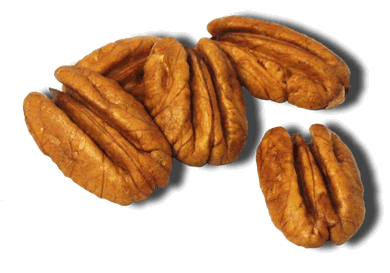
A New York Times article on the state-specific snacks — Oregon’s Jeff Merkley is noted for his promotion of Stumptown coffee — handed out in congressional offices offers this gem:

“Nuts are big in Southern states, and there is a great rivalry among them.”

Yeah, between people like Mike Huckabee and Jim DeMint . . . .

The Times may be a liberal paper, but at least it has a sense of humor about it. The next sentence mentions that “a blind taste test was administered involving a reporter (and accomplished baker) from The Washington Times, who probably should have been watching a debate on an appropriations bill instead. ”

Oh, come on, nobody from The Washington Times is watching debates. They all just crib straight from the GOP’s press releases.


Design a site like this with WordPress.com
Get started