
Cartoon by Jack Ohman, Tribune Media Services
In response to a lengthy Washington Post article claiming that Mitt Romney, during his time at Bain Capital, invested in companies that shipped jobs overseas while eliminating American workers, the Romney campaign issued this impenetrable response:
This is a fundamentally flawed story that does not differentiate between domestic outsourcing versus offshoring nor versus work done overseas to support U.S. exports.
Well, that clears things up.
Mitt Romney has spent his political career putting an extremely fine point on everything from health care (individual mandate on the state level = good; individual mandate on the federal level = socialism) to his Iran policy (Obama wants strict sanctions and a military option; Romney wants . . . strict sanctions and a military option?). But he reaches new heights with this latest distinction without a difference, insisting that voters focus on the nuance that separates outsourcing (moving jobs out-of-house, whether to domestic companies or foreign ones) and offshoring (sending jobs to foreign countries). Campaign spokesperson Andrea Saul may have a point, as James Pethokoukis of the conservative American Enterprise Institute attempts to demonstrate, but if she thinks quibbling over semantics will resonate with a public that can’t differentiate between homing in and honing in and regularly substitutes then for than, she’s setting herself up for disappointment. Technically, Bain may have been more guilty of outsourcing in-house jobs to external U.S. firms than replacing American workers with lower-paid foreigners, but if it cut current workers in favor of cheaper counterparts, will Saul’s fine distinctions really resonate with voters, especially when the unemployment rate is 8.2 percent? Fired is fired, whether you call it a “reduction in force” or an “elimination of redundancies.”
Confusing the matter further, it’s not clear what exactly Saul is claiming in her statement. At first glance, it seems she is contending that Bain only engaged in domestic outsourcing, not the larger “crime” of offshoring. But take a look at the Washington Post article and you’ll notice that reporter Tom Hamburger repeatedly uses the term “outsourcing” incorrectly, to refer to moving jobs overseas instead of simply privatizing work formerly done by a company’s own employees. This is where Saul’s objection to the elision of the two words becomes nonsensical. Going by her own logic, she’d be happy with an article that did “differentiate between domestic outsourcing and offshoring.” Yet domestic outsourcing is not what the Post article details; instead, it is filled mostly with examples of Bain companies’ efforts to offshore. It seems to me that Americans find domestic outsourcing far less offensive than replacing American workers with lower-paid Chinese or Indian counterparts. Hiring Advance Security or Merry Maids in lieu of putting night guards or housekeepers on the payroll may tick off the unions (which aren’t exactly rooting for Romney to begin with), but at least the jobs stay in the country. But ask the average American to “press 1 for English” or to explain his computer problems to a heavily-accented technician and you provoke cries of bloody murder. It’s hard to believe that Saul would have preferred an article that simply corrected a semantic mistake, yet that’s what their complaint boils down to, possibly because it’s simply not plausible for Romney to deny that private equity companies like Bain engage in offshoring. Relocating factories saves on labor costs, and the overarching goal of private equity is to save money. Even Romney can’t get around that — and so he finds himself in the difficult position of criticizing not the Post’s accuracy but its insufficient attention to the dictionary.
ThinkProgress, the left-wing blog run by the Center for American Progress, provides this amusing example of what the Post article would look like, had the author used the “proper technical terms”:
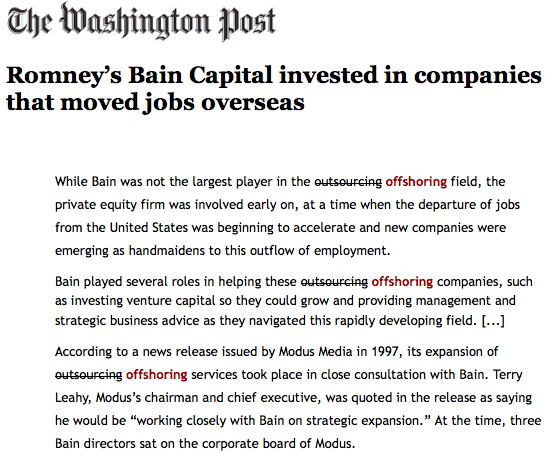
As the folks at ThinkProgress conclude, “[t]his simply doesn’t change the fact that Bain, under Romney, invested in companies whose sole purpose was to move jobs to other countries, directly countering the narrative that Romney has been trying to set.”
Despite the Romney campaign’s semantic hair-splitting, Hamburger’s piece contains ample evidence that Bain both outsourced and offshored. Yes, it shifted jobs around within countries, but it also closed factories in Colorado while opening them in Mexico, and set up foreign call center operations for numerous technology companies. Hamburger writes about Corporate Software, Inc., which “catered to technology companies like Microsoft, provided a range of services including outsourcing of customer support. Initially, CSI employed U.S. workers to provide these services but by the mid-1990s was setting up call centers outside outside the country.” While some of Hamburger’s examples seem to fall cleanly into the category of foreign expansion to support foreign operations (e.g. a European call center to answer questions from European consumers), others can be classified as traditional race-to-the-bottom offshoring.
A Huffington Post piece about the Romney campaign’s response to Hamburger — an article about an article, how very meta — provides an expert opinion from Leo Hindery, Jr., a “managing partner of private equity fund InterMedia Partners,” who asserts that the difference between Bain’s offshoring and outsourcing mattered little for displaced American workers:
“For those of us who looked at that story today, there’s a bright line between offshoring American jobs — that’s moving them outside of this country — and outsourcing them. Bain was a company that preponderantly offshored jobs. And even in those where it outsourced domestically, it did so into lower-cost settings at the expense of workers and their union organizers.
The strongest case against Hamburger’s article may be one made by the Post’s own Fix Blog, where XX writes that “not every example of outsourcing involved sending jobs overseas.” Indeed, Hamburger does elide the two functions, asserting that “firms that specialized in helping other companies move or expand operations overseas” without pointing out that overseas expansion can create new jobs in new countries rather than simply shifting existing U.S. jobs to China or India. The Fix’s Rachel Weiner explains:
Some contractors were located within the United States and some initially went offshore to serve markets where U.S. companies were exporting. Many of the companies highlighted in the article began by outsourcing domestically before expanding increasingly offshore.
But even Weiner acknowledges that this is “a narrow and nuanced argument, one that will likely have little impact on the way this story is viewed in the political realm.” Bain Capital itself, which regularly responds to media coverage critical of Romney’s record with press releases touting its business-world achievements, doesn’t even attempt to rebut the accusations of outsourcing/offshoring, noting only that the company’s “business model has always been to build great companies and improve their operations” and boasting that its investments have produced “80 billion of revenue growth in the United States.”
That the Romney campaign is reduced to making a semantic argument about Bain’s jobs record only highlights the dangers posed to the candidate by this line of discussion. Saul, the Romney spokesperson, surely knew her response was insufficient and opaque, yet she saw little benefit in perpetuating or deepening the debate. Talking about private equity in anything but the rosiest and most general greatness-of-the-free-market terms is a lose-lose situation for Romney. And it’s a minefield of his own creation. There is nothing inherently wrong with what Bain did; after all, private equity companies exist to make money for their shareholders, not run charities or prop up an inefficient American economy. By cutting costs and rooting out less profitable in-house operations, Romney and his colleagues fulfilled their duty to make a return on Bain’s investment. However, just because something is expected in the business world does not make it kosher in the political realm. There are plenty of business practices that voters would rather not endorse; for example, though it makes perfect business sense to replace long-term employees with youthful part-timers who receive few benefits and little overtime pay, no CEO-turned-candidate is going to trumpet this type of “achievement” on the campaign trail.
Hamburger notes in his article that, “[w]hile economists debate whether the massive outsourcing of American jobs over the last generation was inevitable, Romney in recent months has lamented the toll it’s taken on the U.S. economy. He has repeatedly pledged he would protect American employment by getting tough on China.” He claims that his business experience has given him the background to lure jobs back to the U.S. In February, he gave a speech at a Toledo factory in which he said of China, “They’ve been able to put American businesses out of business and kill American jobs. If I’m president of the United States, that’s going to end.”
Given the candidate’s history, there is more than a whiff of hypocrisy surrounding such pledges as, “For me it’s all about good jobs for the American people and a bright and prosperous future.” The Post story supplies a litany of statements by Romney that reinforce the candidate’s reputation as a man who says one thing (he would be “better than Ted [Kennedy]” on gay rights) and does another (appearing at Liberty University, founded by outspoken homophobe Jerry Falwell). Furthermore, it undercuts Romney’s repeated (but largely unsubstantiated) assertions that he “created” 100,000 American jobs during his tenure at Bain. Dan Primack of CNN/Fortune makes the following observation:
Had Romney been more honest, he simply would have said that Bain Capital had a singular mission: Make money for its investors. And, if he wanted to make it sound a little less Gordon Gekko, he could have added that many of those investors were nonprofit institutions like universities and charitable foundations. His responsibilities as an elected official, of course, would be different.
But Romney chose to highlight Bain’s job creation record, rather than its financial performance. And, by doing so, invited analysis like today’s Washington Post story.
The Romney campaign should take note: when it’s reduced to mumbling about the Merriam-Webster-grade distinctions between offshoring and outsourcing, it’s not just fighting a losing battle. It has already lost the war.
 . . . So Well Read. . .